
Connecticut Warbler Identification Guide
A large, elusive ground-walking warbler recognized by its complete white eye-ring, gray hood, and long undertail coverts that give it a distinctly short-tailed look.
Read the full Connecticut Warbler encyclopedia entry →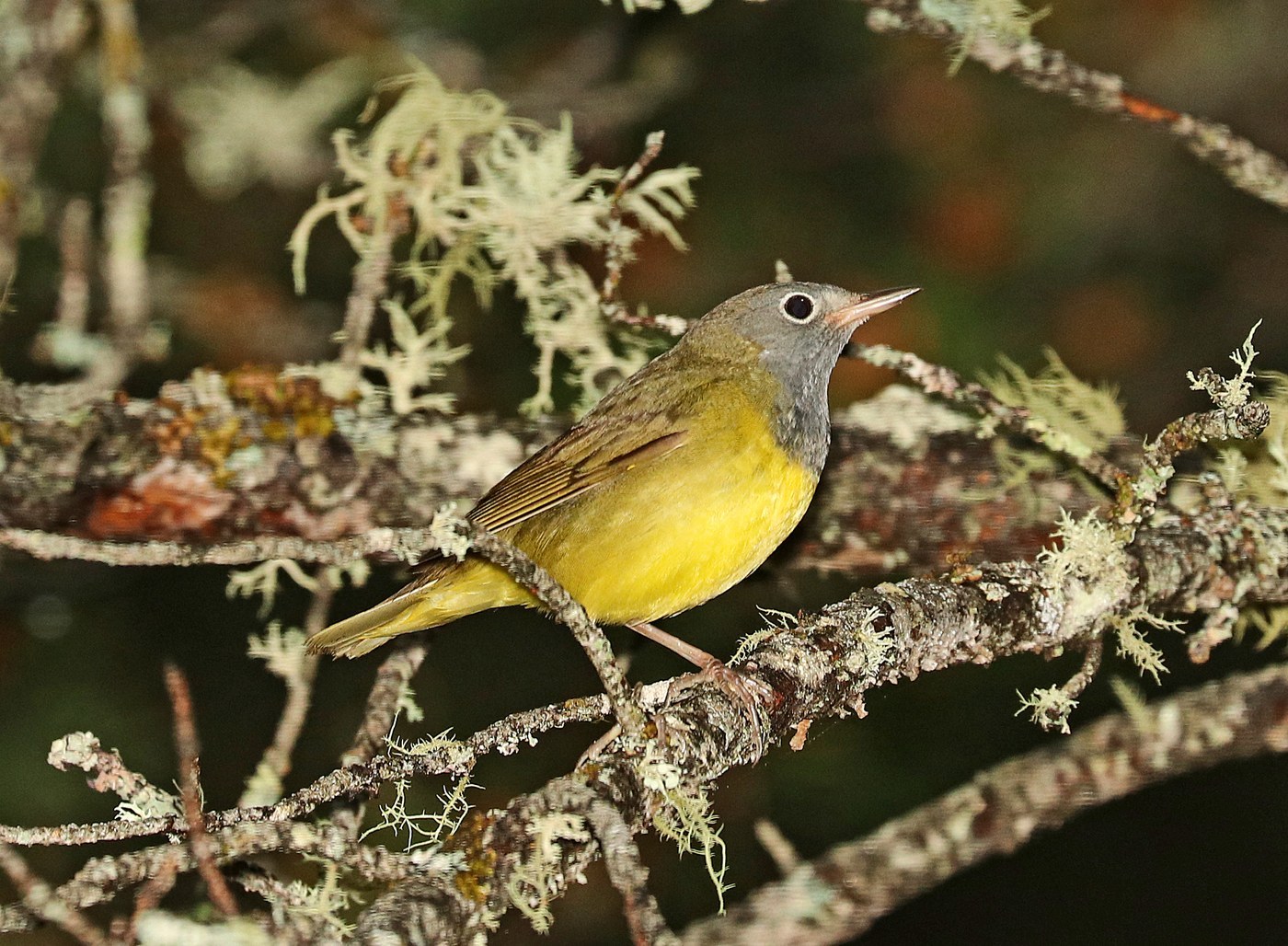
Key Field Marks
- Size & shape: One of the largest and chunkiest of the New World warblers, about 14–15 cm, with a notably short-looking tail because the undertail coverts extend nearly to the tip.
- Head: A complete, bold white eye-ring is the standout feature, set against a gray hood in males and a duller brownish-gray hood in females and immatures.
- Body: Olive upperparts and bright yellow underparts, with the gray/brown hood forming a clean contrast against the yellow breast.
- Legs & gait: Long pinkish legs; famously walks (rather than hops) along the ground, a helpful behavioral clue when views are brief.
- Behavior: Extremely skulking and deliberate, favoring dense low understory, bogs, and thickets; often detected by song before it is seen.
Separating It From Similar Species
- Mourning Warbler: Similar hooded look but has only a broken or partial white eye-ring (or none in adult males), shorter undertail coverts giving a longer-tailed appearance, and hops rather than walks.
- MacGillivray's Warbler (western range): Shows broken white crescents above and below the eye rather than a complete ring.
- Nashville Warbler: Also shows a complete white eye-ring but is much smaller, has a yellow throat, and lacks the Connecticut's bulky, short-tailed structure.
Where & When to See It
- Habitat: Breeds in boreal muskeg, poplar stands, and open spruce bog woodlands of north-central Canada and the northern Great Lakes region; on migration favors woodlands with dense understory.
- Range: An unusual clockwise migration loop — spring migrants move north mainly through the Mississippi Valley, while fall migrants head east and south along the Atlantic coast and Appalachians before crossing to South America, where they winter in the Amazon basin.
- Season: Breeds in summer; migration windows are narrow and the species is notoriously hard to find, especially in spring.
Voice
- Song: A loud, ringing, accelerating "beecher-beecher-beecher-beecher," ringing and rhythmic.
- Call: A sharp, husky chip note.
Frequently asked questions
What is the best way to distinguish Connecticut Warbler from Mourning Warbler?
Connecticut Warbler has a complete, bold white eye-ring and walks on the ground, while Mourning Warbler has only a broken or absent eye-ring and hops rather than walks.
Why does the Connecticut Warbler look short-tailed?
Its undertail coverts are unusually long, extending nearly to the tip of the tail, which creates the illusion of a stubby tail compared to other warblers.
Where should I look for a Connecticut Warbler on migration?
Search dense, low understory in woodlands — it rarely perches in the open, walks quietly on the ground, and is often located by its loud ringing song during the brief breeding season.
Why is spring migration timing different from fall for this species?
Connecticut Warbler follows a clockwise migratory loop: spring birds move north mainly through the Mississippi Valley, while fall migrants shift east to the Atlantic coast and Appalachians before heading to South America.
Does the Connecticut Warbler hop or walk?
It walks deliberately along the ground rather than hopping, a distinctive behavioral trait shared by few other warblers and useful for identification.