
Common Yellowthroat Identification Guide
A small marsh-loving warbler best known for the male's bold black bandit mask and bright yellow throat, with a rolling "witchety-witchety" song.
Read the full Common Yellowthroat encyclopedia entry →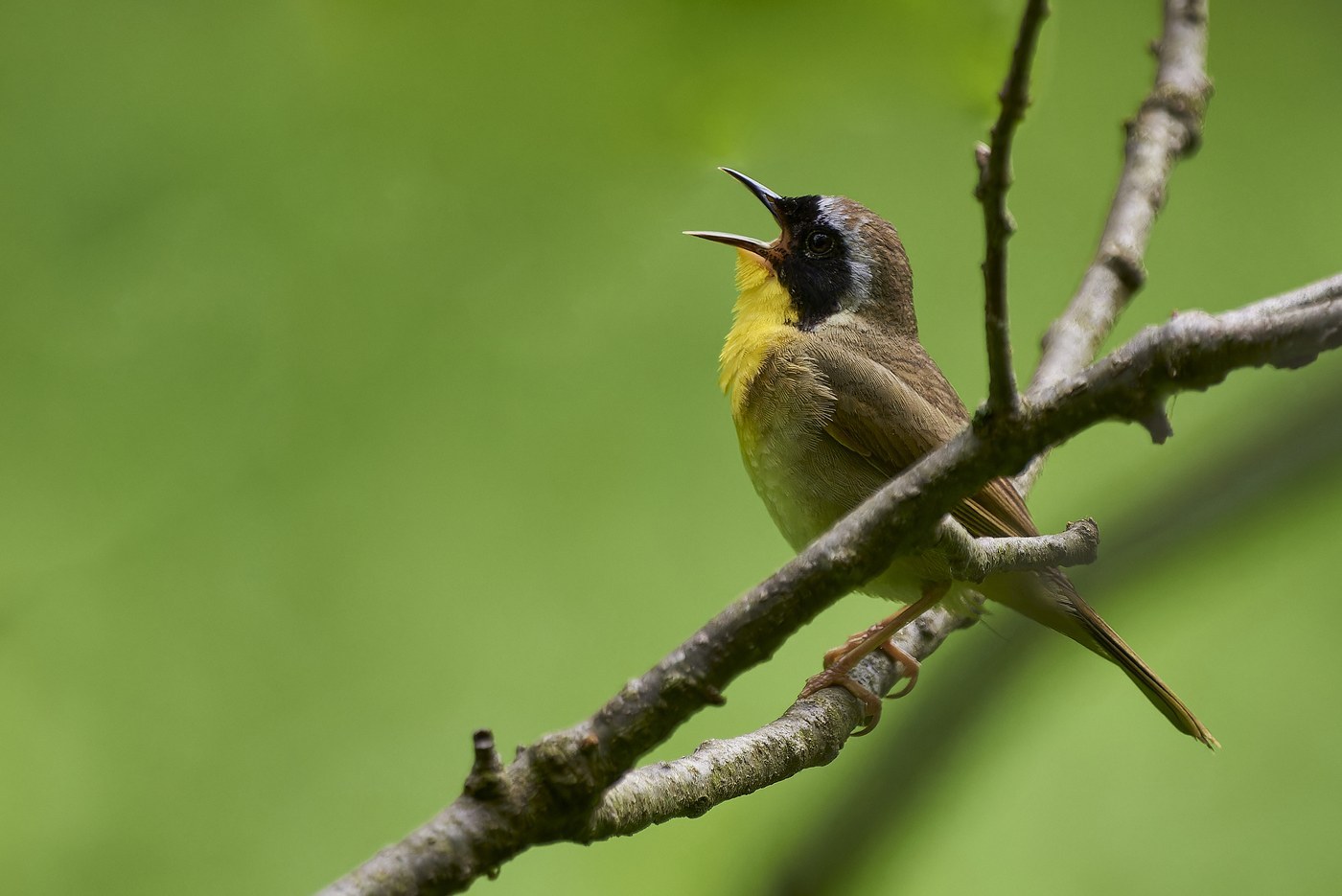
Key Field Marks
- Size & shape: A small, round-bodied warbler around 11–13 cm, with a fairly long, often-cocked tail and a rounded head.
- Male plumage: A bold black mask across the face, bordered above by a pale grayish-white to whitish band; bright yellow throat and breast; olive-brown back and wings; yellow undertail coverts.
- Female plumage: No black mask — plain olive-brown above with a yellowish throat and breast, a faint pale eye-ring, and yellow undertail coverts that help confirm identity.
- Behavior: Stays low and skulks through dense marsh and thicket vegetation, frequently cocking and flicking its tail; males sing from low exposed perches and can be surprisingly easy to see when vocalizing.
Separating It From Similar Species
- Mourning and MacGillivray's Warblers: Both have gray hoods rather than a black facial mask, and lack the yellowthroat's contrasting pale border above the mask.
- Female/immature Common Yellowthroat vs. other female warblers: The combination of a plain face, yellow throat, and bright yellow undertail coverts, along with low, dense-cover habitat and tail-cocking behavior, helps separate it from similarly plain-faced species like Orange-crowned Warbler (which lacks yellow undertail coverts as bright and has a duller olive throat).
- Kentucky Warbler: Has yellow spectacles around the eye rather than a full black mask, and a yellow (not white-bordered) face pattern.
Where & When to See It
- Habitat: Marshes, wet brushy fields, reedbeds, riparian thickets, and other dense low, often damp, vegetation.
- Range: Breeds across nearly all of the United States and southern Canada.
- Season: Northern populations are migratory, wintering from the southern U.S. through Mexico, Central America, and the Caribbean; southern populations are largely resident year-round.
Voice
- Song: A rolling, rhythmic "witchety-witchety-witchety-witch," one of the most recognizable warbler songs in North American wetlands.
- Call: A sharp, dry "tschep" or "chip" note given year-round.
Frequently asked questions
What is the easiest way to identify a male Common Yellowthroat?
Look for the bold black mask across the face bordered by a pale band above it, combined with a bright yellow throat — a combination unique among North American warblers.
How do you identify a female Common Yellowthroat without the mask?
Females show a plain olive-brown face, a yellowish throat, and notably bright yellow undertail coverts, and they behave like males by staying low and flicking their tail in dense cover.
What habitat should I search for Common Yellowthroats?
Look in marshes, wet thickets, reedbeds, and other dense, low, often damp vegetation rather than tall forest canopy.
What does the Common Yellowthroat's song sound like?
A distinctive rolling, repetitive "witchety-witchety-witchety-witch," often given from a low perch in marsh vegetation.
Is the Common Yellowthroat present year-round?
In the southern U.S., Mexico, and Central America many populations are resident, while northern breeders migrate south for the winter.