
Common Tern Identification Guide
An elegant, forked-tailed seabird with a black cap and red-orange, black-tipped bill, distinguished from similar terns by a dark wedge on the outer wing.
Read the full Common Tern encyclopedia entry →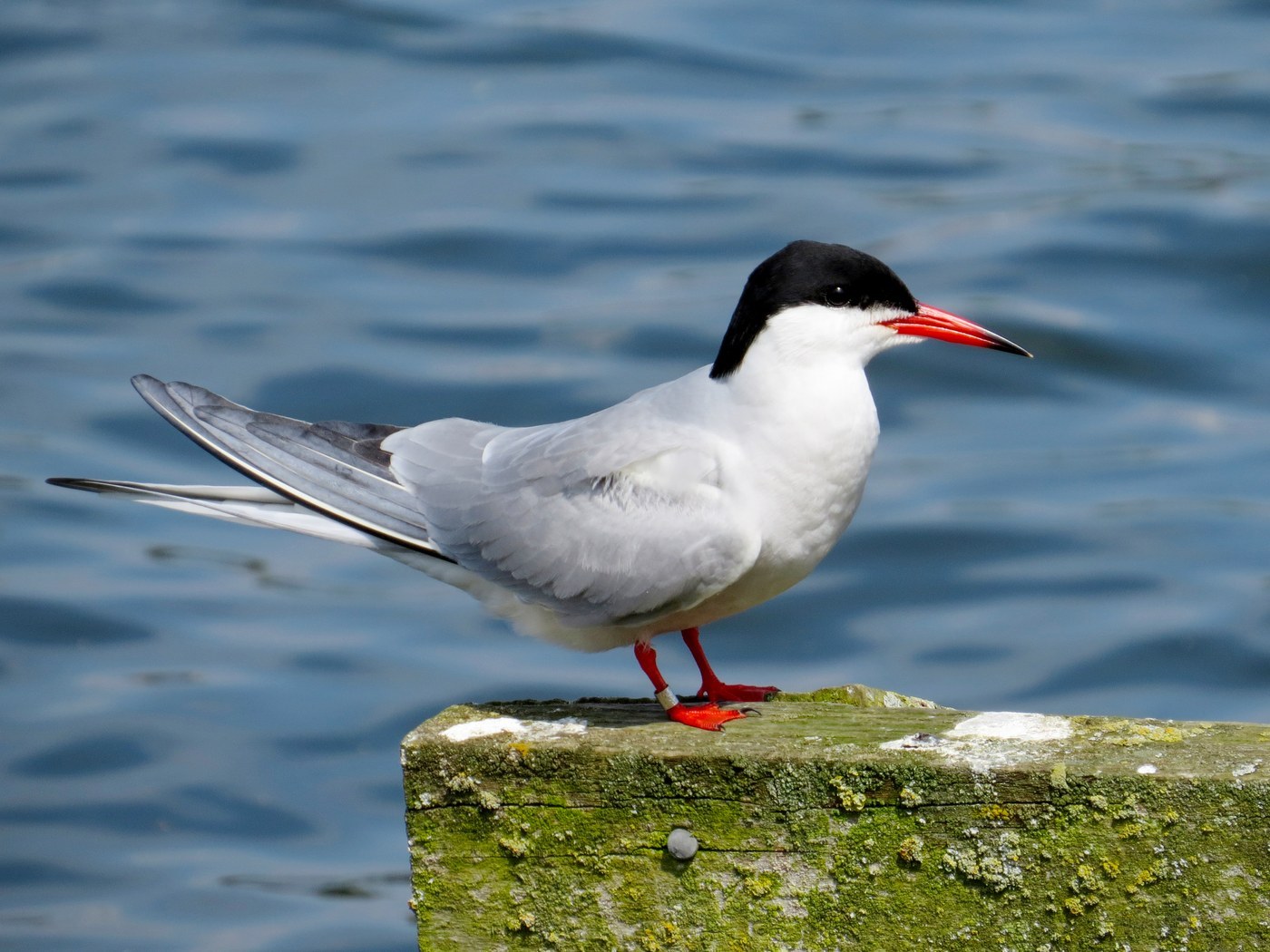
Key Field Marks
- Medium-sized tern, about 31–35 cm long, with a slender build, pointed wings, and a deeply forked tail with long streamers.
- Pale grey upperparts and white underparts; full black cap in breeding plumage, reduced to a white forehead with a black band through the eye and nape in non-breeding/winter plumage and on juveniles.
- Bill is red-orange with a black tip in breeding adults (becoming darker overall outside the breeding season); legs red-orange.
- In flight, the outer primaries look somewhat translucent but show a dark wedge near the wingtip, a key feature; rump is grey, with white on the outer edge of the tail.
Separating It From Similar Species
- Arctic Tern: shorter legs, an all-red bill without a black tip in breeding plumage, more uniformly translucent primaries lacking a dark wedge, a greyer body contrasting with a whiter cheek stripe, and longer tail streamers.
- Roseate Tern: paler grey upperparts, a mostly black bill with only a small red base, longer tail streamers extending noticeably past the folded wingtips at rest, and often a pale pinkish flush to the breast in breeding plumage.
- Forster's Tern (North America): similar orange bill with a black tip, but shows pale, silvery primaries rather than a dark wedge, and in non-breeding plumage has a distinctive black eye patch on an otherwise white head rather than the black nape band of Common Tern.
Where and When to See One
- Breeds colonially on coastal beaches, islands, and shingle banks, as well as at some inland lakes and rivers, across much of North America, Europe, and Asia.
- A long-distance migrant, wintering along tropical and subtropical coasts of Africa, South America, and southern Asia.
- Often seen fishing by plunge-diving from a hover over coastal waters, estuaries, and larger inland waters during migration.
Voice
- Common call is a harsh, grating "kee-arr," often given in alarm near breeding colonies.
- Also gives a shorter, sharper "kip" or "kik," frequently repeated in flight.
Frequently asked questions
How do you tell Common Tern from Arctic Tern?
Common Tern has a black-tipped bill, a dark wedge on the outer primaries, and shorter legs, while Arctic Tern has an all-red bill without a black tip, more uniformly translucent wings, and shorter legs relative to Common Tern's slightly longer ones.
What color is a Common Tern's bill?
In breeding plumage it's red-orange with a black tip; outside the breeding season the bill darkens and the black tip becomes less distinct.
Where do Common Terns nest?
In colonies on coastal beaches, sandy or shingle islands, and sometimes at inland lakes and rivers, usually on the ground close to open water.
How can you distinguish Common Tern from Roseate Tern?
Roseate Tern has a mostly black bill with only a small red base, paler upperparts, and notably longer tail streamers, whereas Common Tern has a red-orange, black-tipped bill and shorter tail streamers.