
Common Teal Identification Guide
The smallest Eurasian dabbling duck, with males showing a chestnut head, green eye patch, and a thin cream stripe, forming fast, agile winter flocks on wetlands.
Read the full Common Teal encyclopedia entry →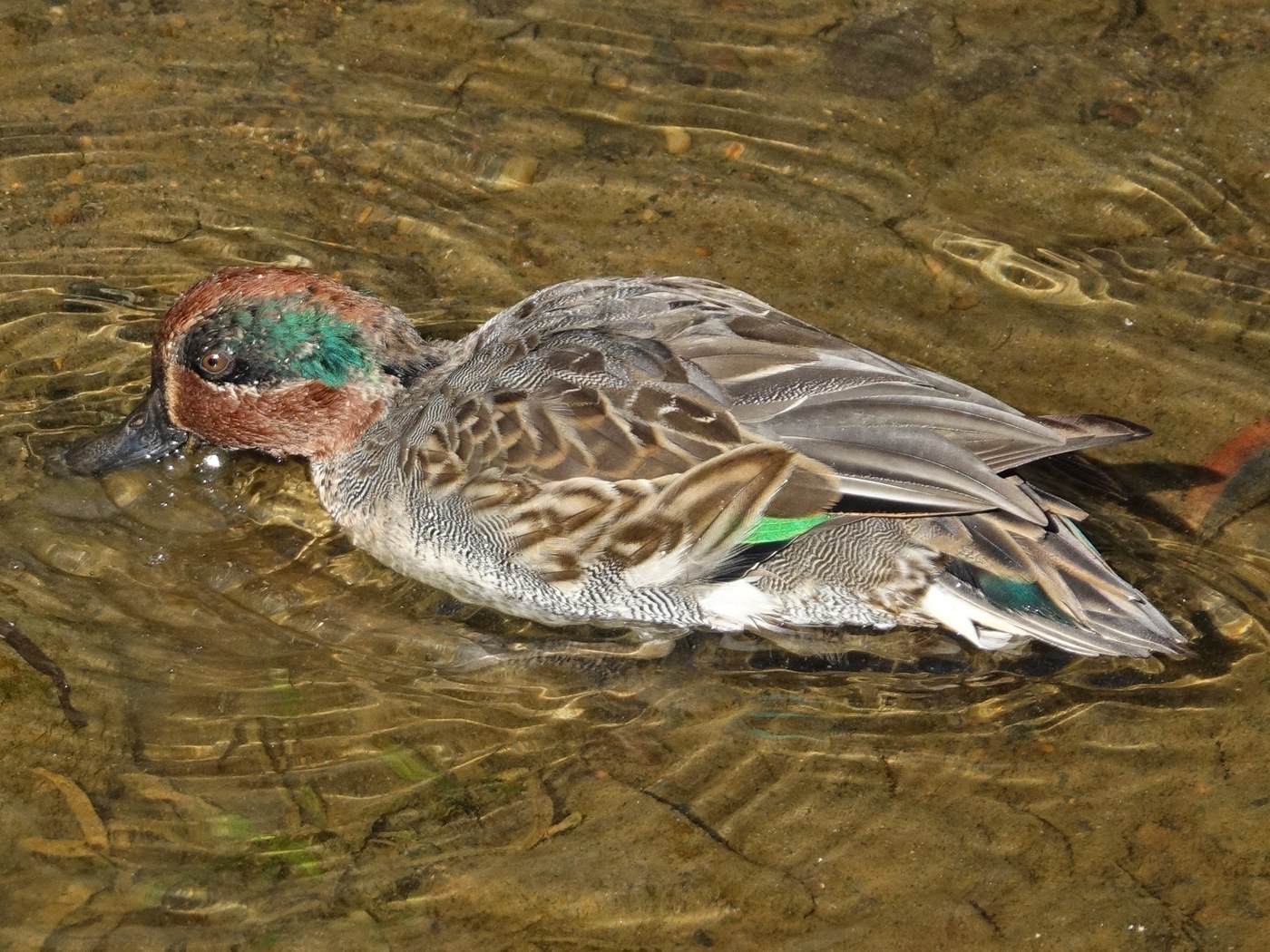
Key Field Marks
- Smallest of the Eurasian dabbling ducks, about 34–38 cm long, compact and fast-flying.
- Breeding male: chestnut-colored head with a broad, glossy green patch running from the eye to the nape, bordered by a thin cream-yellow line; body finely vermiculated grey with a black-bordered cream patch near the tail and a horizontal white stripe along the side of the body above the waterline.
- Female: mottled brown overall with a small dark bill and a plain head; best identified by size, shape, and the green speculum (wing patch) bordered with buff and white, visible in flight or when the wing is stretched.
- Flocks are notably fast and agile in flight, often twisting and turning together in tight formation.
Separating It From Similar Species
- Green-winged Teal (the American counterpart, sometimes treated as a separate species): breeding males show a vertical white stripe on the side of the breast instead of the horizontal white stripe along the body shown by Common Teal, and typically lack (or show a much reduced) cream border to the green eye patch; females of the two forms are very difficult to separate reliably in the field.
- Garganey: male Garganey has a bold white supercilium stripe sweeping back from the eye and a very different, browner head pattern; female Garganey shows a stronger face pattern including a pale spot at the base of the bill, distinguishing it from the plainer-faced female Common Teal.
- Other small dabbling ducks: Common Teal is notably smaller and more compact than Mallard, Wigeon, or Gadwall, with a proportionately smaller bill and quicker, more erratic flight.
Where and When to See One
- Breeds on marshes, bogs, and vegetated pools across northern and temperate Eurasia.
- Winters in large numbers on shallow wetlands, flooded fields, reservoirs, and coastal estuaries further south, often forming sizeable mixed flocks with other dabbling ducks.
- Widely seen across Europe, North Africa, and Asia during migration and winter, with breeding concentrated further north.
Voice
- Male gives a distinctive, ringing, bell-like "krik" or repeated "crik-crik," often heard from wintering flocks well before the birds are seen.
- Female gives a thin, high-pitched quack, weaker and higher than that of a Mallard.
Frequently asked questions
How do you identify a male Common Teal?
Look for a chestnut head with a glossy green eye patch bordered by a thin cream line, a grey vermiculated body, and a horizontal white stripe along the side above the waterline.
What is the difference between Common Teal and Green-winged Teal?
Male Common Teal shows a horizontal white stripe along the body, while male Green-winged Teal shows a vertical white stripe on the breast side instead; females of the two are very hard to tell apart in the field.
What does a male Common Teal sound like?
A distinctive ringing, bell-like 'krik' or repeated 'crik-crik' call, often the first clue to its presence on a wetland.
Where can Common Teal be seen in winter?
On shallow wetlands, flooded fields, reservoirs, and coastal estuaries, often in large mixed flocks with other dabbling ducks.