
Common Swift Identification Guide
An all-dark, scythe-winged aerial specialist that spends nearly its entire life on the wing, screaming in fast low flocks around rooftops on summer evenings.
Read the full Common Swift encyclopedia entry →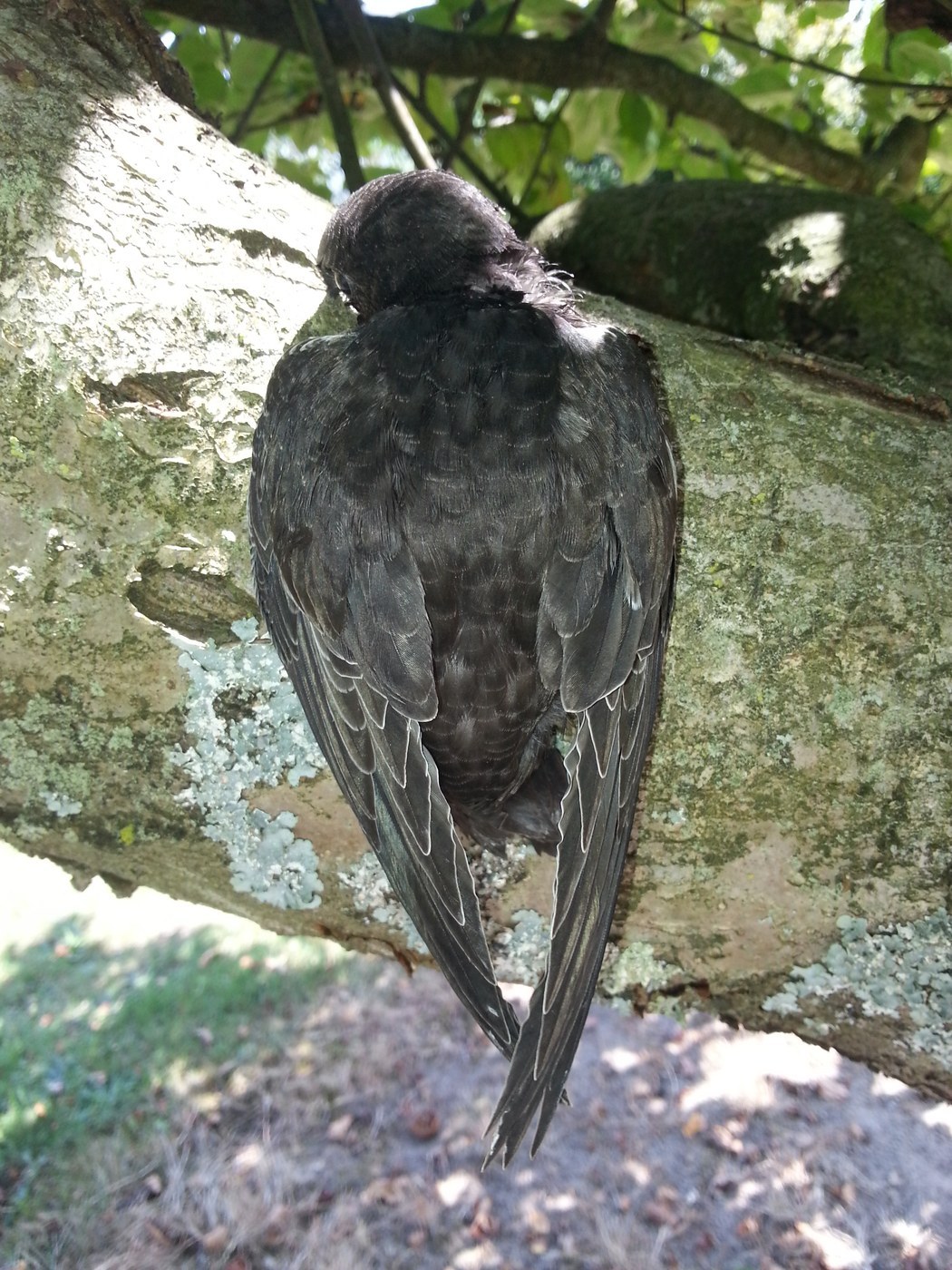
Key Field Marks
- Medium-sized aerial bird, about 16–17 cm long, but with long, swept-back, sickle-shaped wings that give a wingspan of 42–48 cm and a distinctive anchor- or boomerang-shaped silhouette.
- Plumage appears uniformly sooty-black to blackish-brown in flight, with a small, often hard-to-see pale/whitish throat patch.
- Short, shallowly forked tail.
- Extremely short legs with all four toes pointing forward; swifts almost never land except to visit the nest, and cannot easily take off from flat ground.
- Spends the vast majority of its life airborne, feeding, drinking, bathing, and even sleeping on the wing.
Separating It From Similar Species
- Swallows and martins: swifts have stiff, scythe-shaped wings and a fast, gliding-and-flapping flight quite different from the more fluttering, flexible flight of swallows and martins; swifts are also entirely dark (no white rump or pale underparts) and never perch on wires or branches, unlike swallows and martins.
- Pallid Swift: very similar but slightly paler and browner overall, with a larger and more contrasting pale throat patch and a browner cast to the flight feathers; calls are also subtly different and separation often requires care and experience.
- Alpine Swift: much larger, with clean white underparts and a white throat separated by a brown breast band — readily distinguished from Common Swift by size and pattern alone.
Where and When to See One
- Forages aerially over towns, cities, farmland, wetlands, and open country wherever flying insects are abundant.
- Nests in cavities and crevices in old buildings, church towers, and cliffs across Europe and western Asia; entirely dependent on suitable nest cavities, which has made it vulnerable to modern building renovation.
- A long-distance migrant, arriving in late spring and departing again by late summer for wintering grounds in sub-Saharan Africa, where it also remains almost entirely airborne.
Voice
- Gives loud, shrill, screaming calls, often rendered as "sree-sree," especially during fast, low group flights ('screaming parties') around nest sites in the evening.
- Largely silent when foraging high overhead alone.
Frequently asked questions
How can you tell a Common Swift from a swallow?
Swifts have stiff, scythe-shaped wings, fly with a distinctive gliding-and-flapping pattern, appear entirely dark, and never perch on wires, while swallows have more flexible wingbeats, often show pale underparts or a colored throat, and readily perch.
Why do swifts rarely land?
Their legs and feet are extremely short and adapted for clinging to vertical surfaces at the nest rather than walking or perching, so they spend almost their entire life in the air, only landing to nest.
What is a swift 'screaming party'?
It's a fast, low group flight of swifts around nesting buildings in the evening, accompanied by loud screaming calls, common on warm summer evenings near breeding colonies.
Where do Common Swifts go in winter?
They migrate to sub-Saharan Africa, where they continue their almost entirely aerial lifestyle before returning to Europe and Asia to breed in spring.