
Common Rosefinch Identification Guide
A stocky finch whose adult male glows raspberry-pink and brown, while females and young birds are famously plain and easily overlooked among sparrows.
Read the full Common Rosefinch encyclopedia entry →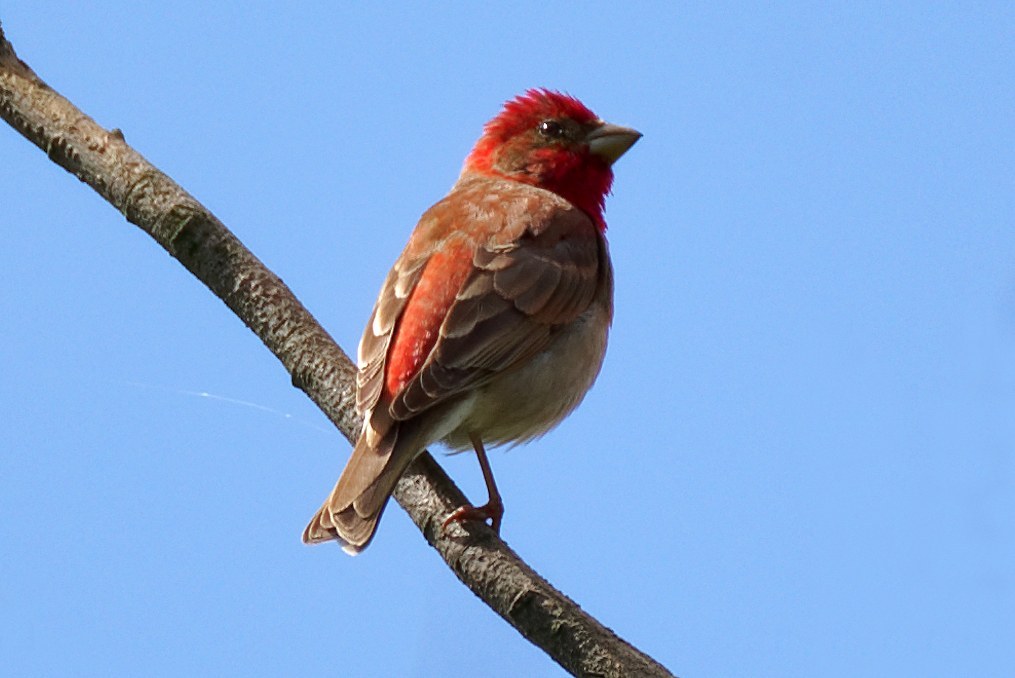
Key Field Marks
- Small, plump finch, roughly 14–15 cm, with a deep, rounded, conical bill typical of finches.
- Adult male: rosy-red head, breast, and rump contrasting with brown, unmarked wings and back — a striking two-tone bird.
- Female and first-year/immature male: plain olive-brown above, paler and unstreaked (or only faintly streaked) below, with a large dark eye set in a plain face and often faint double wing bars.
- Overall shape is short-tailed and big-headed compared with sparrows, with a noticeably deep-based bill.
Separating It From Similar Species
- House Sparrow / Tree Sparrow (female/juvenile Rosefinch confusion): rosefinches lack the streaked crown and back pattern of sparrows, have a plainer face, a deeper and more strongly curved bill, and a big dark eye that stands out against an unmarked face.
- Female/immature Common Crossbill or other finches: rosefinch bill is conical and finch-like but not crossed, and the bird lacks the crossbill's heavier build and characteristic feeding behavior on cones.
- Adult males are essentially unmistakable due to the solid rose-pink head, breast, and rump against brown wings — no other common Eurasian finch shows this pattern.
Where and When to See One
- Breeds in scrub, riverside thickets, forest edges, and overgrown grassland from eastern Europe across temperate Asia; the breeding range has been expanding westward in recent decades.
- A long-distance migrant that winters in South and Southeast Asia.
- In Western Europe it occurs mainly as a scarce passage migrant, especially in autumn, when drab immature birds ('brown jobs') turn up at coastal migration hotspots.
Voice
- Song is a short, clear, whistled phrase often rendered as "pleased, pleased to meet you" — distinctive and far-carrying from an exposed perch.
- Call is a soft, disyllabic "hui-eet" or "tu-eek."
Frequently asked questions
Why are female Common Rosefinches hard to identify?
They are plain olive-brown with no red, unstreaked pale underparts, and a nondescript sparrow-like appearance, so birders rely on the deep conical bill, plain face, and large dark eye rather than color.
What does an adult male Common Rosefinch look like?
Unmistakable rose-pink head, breast, and rump set against plain brown wings and back — no similar common finch shows this combination.
What does the Common Rosefinch's song sound like?
A short, clear whistle often described as sounding like 'pleased, pleased to meet you,' delivered from a prominent perch.
Is the Common Rosefinch's range expanding?
Yes, the species has been steadily expanding its breeding range westward across Europe over recent decades.