
Common Ringed Plover Identification Guide
A compact, orange-legged shorebird with a bold black breast band and face mask, common on sandy and shingle beaches around the North Atlantic and Arctic coasts.
Read the full Common Ringed Plover encyclopedia entry →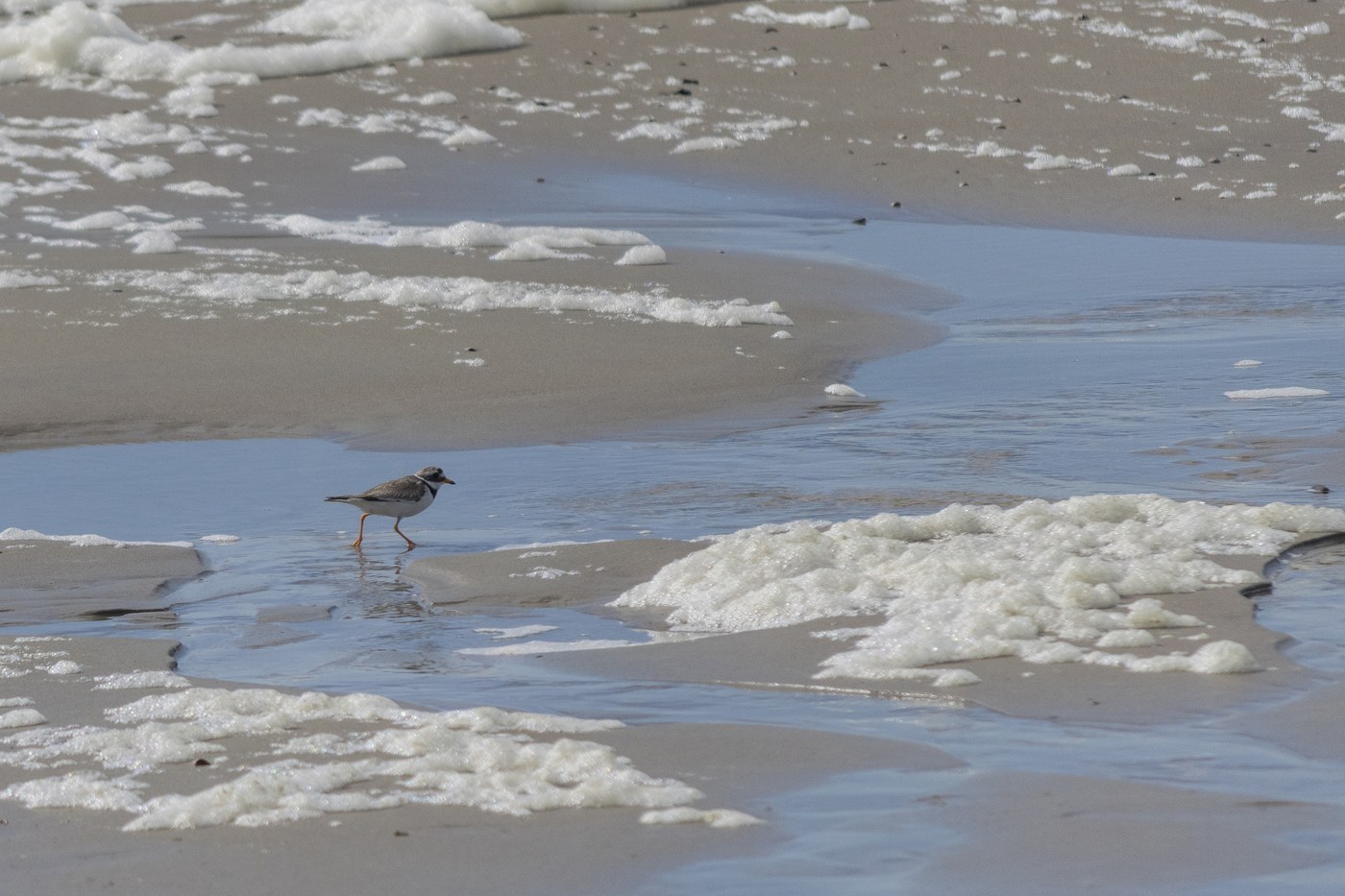
Key Field Marks
- Small, stocky plover about 18–20 cm long with a short neck and rounded head.
- Broad, complete black breast band, a black mask through the eye, and a white forehead separated from a white collar by a black band across the crown.
- Upperparts sandy brown, underparts white, legs bright orange-yellow.
- Short, stubby bill is orange at the base with a black tip.
- In flight, shows a clear white wing bar running the length of the wing.
Separating It From Similar Species
- Little Ringed Plover: smaller and slimmer, lacks a white wing bar in flight, shows a prominent yellow eye-ring (Common Ringed Plover's eye-ring is thin or absent), and has duller pinkish-flesh legs rather than orange.
- Semipalmated Plover (North America): extremely similar in plumage; best separated by range, structure (Semipalmated is slightly smaller-billed), and, in the hand, by the degree of webbing between the toes.
- Kentish Plover/Snowy Plover: show an incomplete breast band (broken into side patches, not a full band) and paler, sandier upperparts.
Where and When to See One
- Breeds on open sandy and shingle beaches, dunes, and Arctic and subarctic tundra across northern Europe, Greenland, and Siberia, with some breeding on inland gravel patches further south.
- Highly migratory; birds from the far north pass through temperate coastlines in spring and autumn, while other populations winter along the coast.
- Winters on sandy beaches, estuaries, and mudflats along the coasts of Western Europe and Africa.
Voice
- Call is a soft, fluty, slightly rising "too-li" or "poo-eep," often given in flight and easy to pick out over open beaches.
- Song, given in a fluttering display flight on the breeding grounds, is a repeated musical trill built from the same fluty call notes.
Frequently asked questions
How do I tell Common Ringed Plover from Little Ringed Plover?
Common Ringed Plover shows a white wing bar in flight and orange legs, while Little Ringed Plover has no wing bar, duller pinkish legs, and a much more obvious yellow eye-ring.
What does a Common Ringed Plover's call sound like?
A soft, fluty, rising 'too-li' or 'poo-eep,' quite different from the sharper, more piping calls of many other small plovers.
Where do Common Ringed Plovers nest?
On bare sand, shingle, or gravel — often on beaches, dunes, or Arctic tundra — where their scrape nests and eggs are extremely well camouflaged.
Are Common Ringed Plover and Semipalmated Plover the same species?
No, they are closely related but distinct species; Semipalmated Plover breeds in North America and is best told apart from Common Ringed Plover by range and subtle structural differences.