Common Redstart Identification Guide
A small woodland chat with a fiery orange tail that it constantly quivers, making even the drab females and juveniles easy to pick out.
Read the full Common Redstart encyclopedia entry →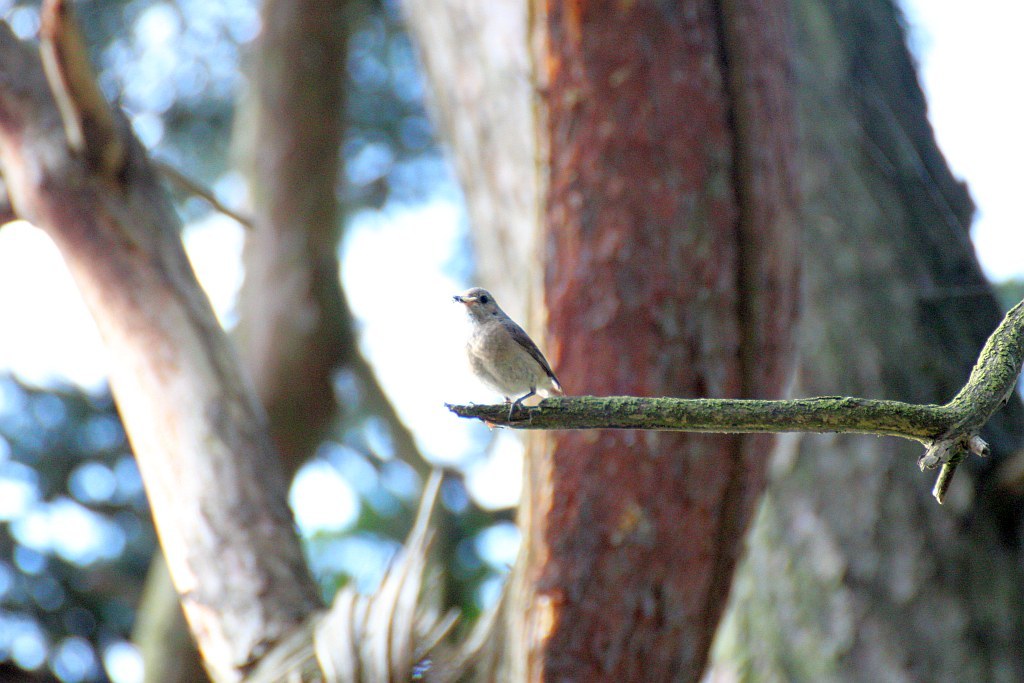
Key Field Marks
- Small, slim, robin-sized bird around 14 cm long, related to chats and Old World flycatchers.
- Breeding male: blue-grey crown and back, black face and throat, white patch on the forehead, orange-red breast fading to white on the belly, and a bright orange-red tail with a dark central pair of feathers.
- Female and non-breeding birds: plain grey-brown above, buffy-orange wash on the underparts, but retain the same orange-red rump and tail.
- The single best clue at any age or season is behavior: the bird constantly shivers and quivers its orange tail, both when perched and just after landing.
Separating It From Similar Species
- Black Redstart: male is essentially all sooty-black or dark grey (no orange breast) with the same orange tail; females and juveniles are colder grey-brown without the warm buff-orange breast wash of Common Redstart, and they favor rocky, urban, or industrial sites rather than woodland.
- Nightingale: larger, more uniformly rufous-brown overall including the tail, lacks the tail-quivering habit and the grey/black head pattern.
- Whinchat/Stonechat: told apart by the lack of an orange tail and by different head and wing patterns; redstarts are the only common chat-like bird with a truly bright rufous-orange tail contrasting with a duller body.
Where and When to See One
- Breeds in open deciduous and mixed woodland, parkland, orchards, and wooded heathland across most of Europe and western Asia.
- A long-distance migrant, arriving on breeding grounds in April–May and departing by September for wintering areas in sub-Saharan Africa.
- Favors mature trees with nest holes or crevices, and is often detected first by song from a high, exposed perch.
Voice
- Song is a short, sweet warble that trails off into a scratchy rattle or jumble of notes, sometimes incorporating mimicry.
- Call is a soft, plaintive "hweet" followed by a clicking "tucc-tucc," often given when the bird is agitated or feeding young.
Frequently asked questions
How can I recognize a female Common Redstart?
Even without the male's bold colors, females show the same orange-red rump and tail as males and constantly quiver that tail, which is the most reliable field mark at any age.
What is the difference between Common Redstart and Black Redstart?
Common Redstart males have a grey back, black face, and orange breast, while Black Redstart males are almost entirely black or dark grey; females of the two are separated mainly by warmer buff-orange underparts on Common Redstart versus colder grey-brown on Black Redstart.
Where do Common Redstarts spend the winter?
They migrate to sub-Saharan Africa, leaving European breeding grounds by early autumn.
Why does the redstart shake its tail?
Tail-quivering is thought to help startle insect prey and may also serve as a signal between individuals; it is done so consistently that it's one of the best identification clues for the species.
Common Redstart identified by the community
Recent Common Redstart sightings identified with Bird Identifier.