
Common Redpoll Identification Guide
A small, streaky, irruptive finch of the far north, marked by a red cap and black chin patch, that appears in large winter flocks feeding on birch and alder seeds.
Read the full Common Redpoll encyclopedia entry →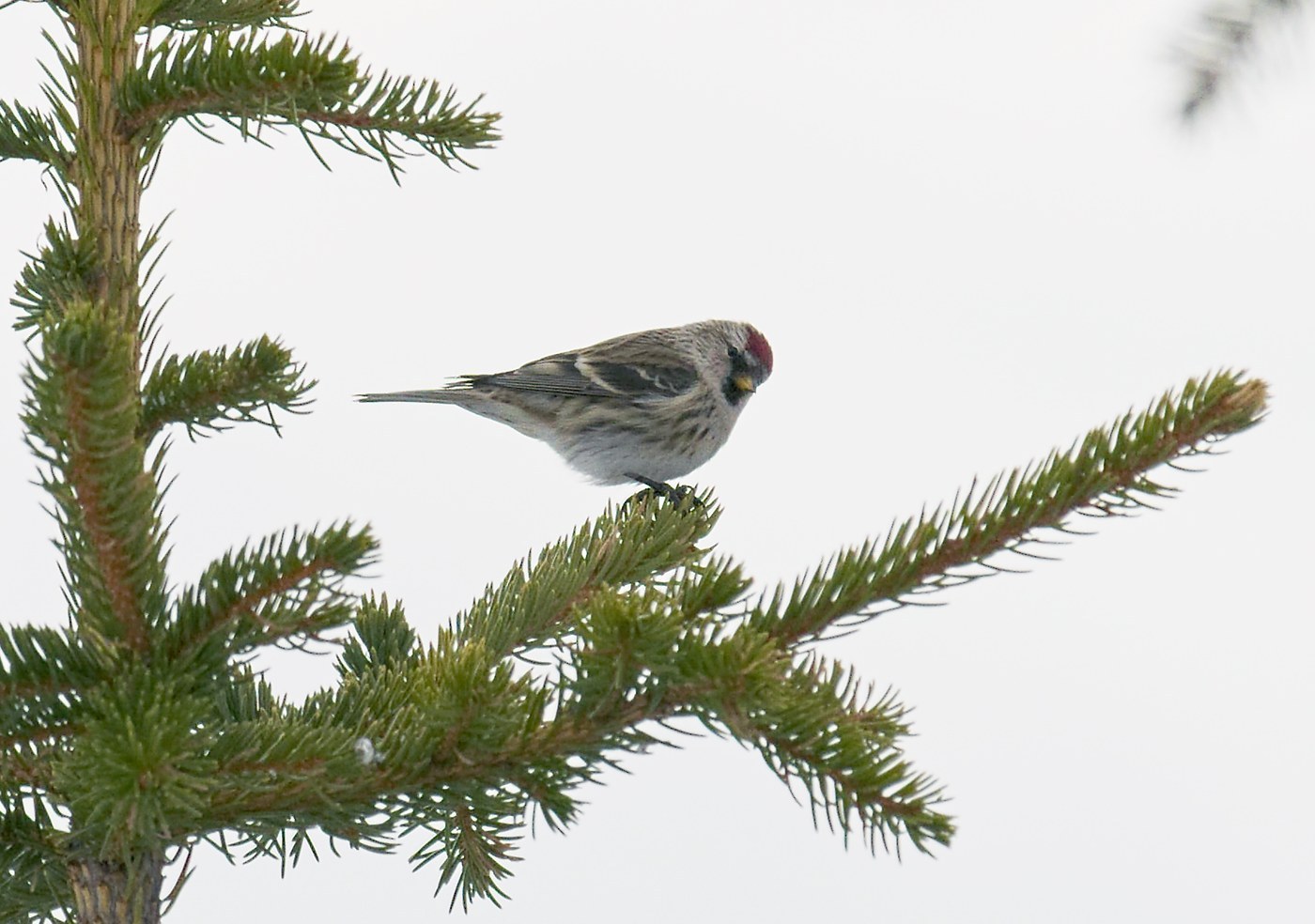
Key Field Marks
Size & Shape
- Small finch, about 12–14 cm long, with a small, sharply pointed, conical yellow bill adapted for extracting tiny seeds
- Compact body with a notched tail and fairly short, pointed wings
Plumage
- Streaky brown overall with a distinctive small red or crimson cap ("poll") on the forehead and a black chin/throat patch
- Males typically show a pinkish-red wash across the breast, especially in breeding condition, while females lack pink or show only a faint hint
- Streaked flanks and two pale wingbars are visible on the folded wing
Behavior
- Highly gregarious in winter, forming large, active flocks that often mix with Pine Siskins, goldfinches, and other small finches
- Feeds acrobatically on birch and alder catkins, weed seeds, and readily visits feeders offering nyjer/thistle seed
- An irruptive species: numbers moving south in winter vary greatly from year to year depending on the size of the birch and alder seed crop further north
Similar Species
- Hoary Redpoll: paler overall with reduced streaking on the rump and flanks and a slightly smaller, stubbier bill, giving a "frostier" look; separating the two in the field can be genuinely difficult, and recent genetic research has shown very limited differentiation between them, leading taxonomic authorities to treat all redpoll forms as a single species with variable plumage rather than fully distinct species
- Pine Siskin: more heavily streaked overall, lacks the red cap, and shows yellow edging in the wings and tail
- House Finch: larger, with no red cap, a stubbier notched bill shape, and red confined mainly to the head/breast in males without the redpoll's black chin patch
Habitat & Range
- Breeds in Arctic and subarctic tundra, birch and willow scrub, and taiga edge across the northern reaches of North America, Europe, and Asia
- Winters irregularly further south into the northern United States, southern Canada, and southern Europe, with irruption years bringing much larger numbers south
- Gregarious and conspicuous at winter feeders during irruption years
Voice & Song
- Flight call is a dry, rattling "chit-chit-chit," often the first clue to a passing flock
- Song is a twittering series mixed with buzzy trills, given mainly on the breeding grounds
Frequently asked questions
What is the easiest way to identify a Common Redpoll?
Look for a small, streaky brown finch with a bright red cap on the forehead, a black chin patch, and (in males) a pinkish wash on the breast, often in an active, twittering winter flock.
How do I tell Common Redpoll from Hoary Redpoll?
Hoary Redpoll looks paler and frostier with less streaking on the flanks and rump and a smaller bill, but the distinction can be subtle, and genetic studies have found the two forms to be very closely related, which is why they are sometimes now treated as a single variable species.
Why do Common Redpolls suddenly appear in large numbers some winters?
They are an irruptive species: when birch and alder seed crops fail farther north, large flocks move much further south than usual in search of food, a pattern known as an irruption.
What do Common Redpolls eat?
They feed mainly on small seeds, especially birch and alder catkins and weed seeds, and readily visit feeders stocked with nyjer/thistle seed in winter.
Where do Common Redpolls breed?
They nest in Arctic and subarctic tundra and birch/willow scrub across the far north of North America, Europe, and Asia.