
Common Raven Identification Guide
The largest of the all-black perching birds, distinguished from crows by its heavy bill, wedge-shaped tail, shaggy throat, and habit of soaring on flat wings.
Read the full Common Raven encyclopedia entry →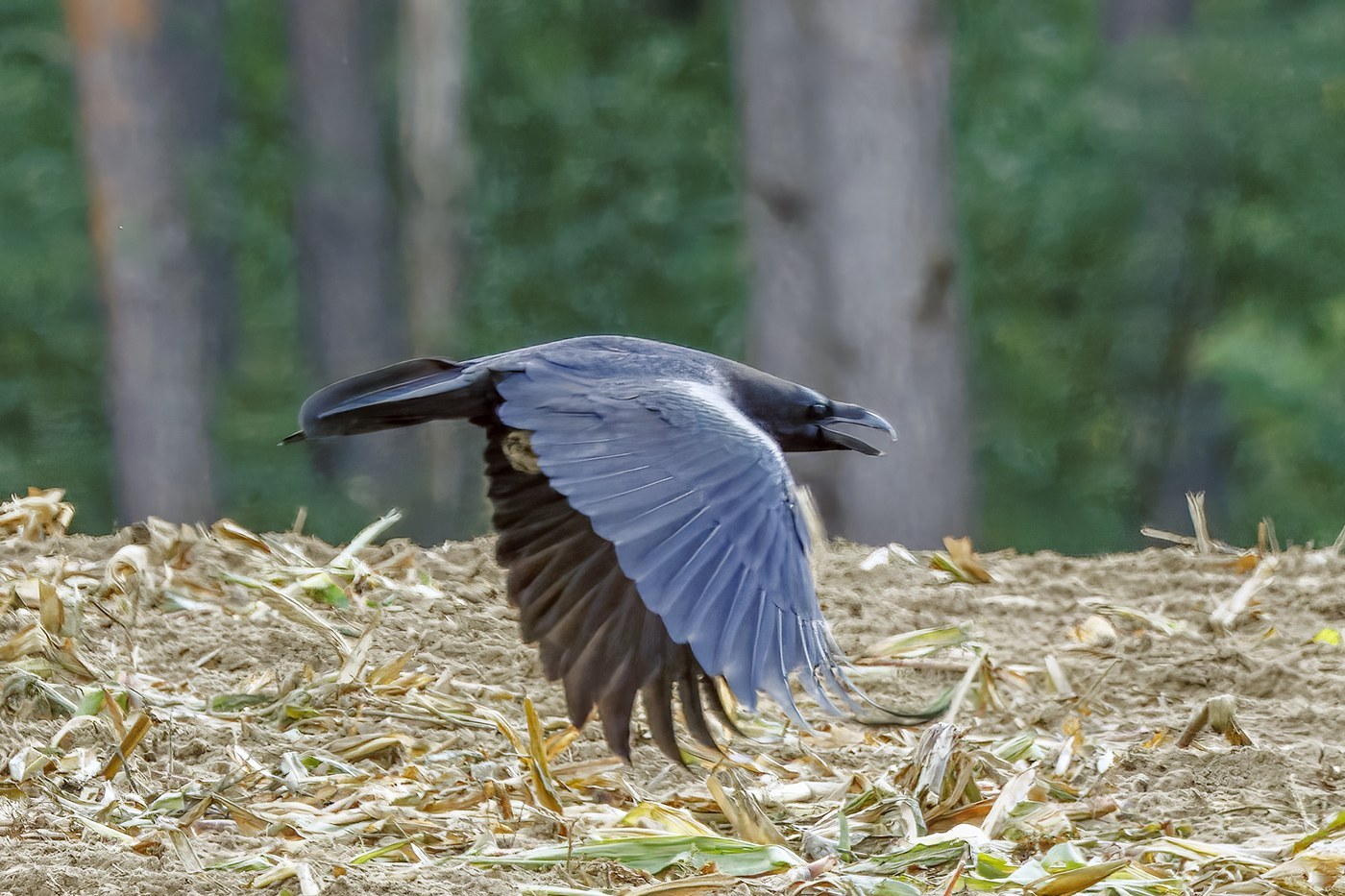
Key Field Marks
Size & Shape
- The largest passerine (perching bird) in the world, measuring 54–67 cm long with a wingspan up to about 1.5 m
- Heavy, deep bill with a pronounced curve to the upper edge, noticeably larger and more powerful than any crow's bill
- Shaggy throat feathers ("hackles") that fluff out prominently, especially while calling
- Wedge- or diamond-shaped tail, distinctly rounded rather than the flat, fan-shaped tail of crows
Plumage
- Entirely black plumage with a glossy purple, blue, and green iridescent sheen in good light
Behavior
- Frequently soars and glides on flat or slightly raised wings, and performs acrobatic rolls, dives, and even brief inverted flight — crows flap almost continuously and rarely soar
- Highly intelligent, showing sophisticated problem-solving and tool-use behavior
- Usually encountered alone, in pairs (ravens often mate for life), or in small groups; opportunistic omnivore and scavenger
Similar Species
- American Crow and other crow species: noticeably smaller, with a flat, fan-shaped tail, a thinner bill, less shaggy throat feathers, more continuous flapping flight, and a higher-pitched "caw" rather than the raven's deep croak
- Chihuahuan Raven (range overlap in the southwestern US/Mexico): smaller than Common Raven with white feather bases on the neck (usually not visible in the field) and calls that are slightly higher and flatter; best separated by voice, size, and range where the two occur together
- Tail shape in flight and flight style (soaring vs. steady flapping) are the most reliable field marks separating ravens from all crow species
Habitat & Range
- Extremely adaptable, occurring in mountains, forests, deserts, coastlines, arctic tundra, and increasingly in suburban and urban areas
- Found across most of the Northern Hemisphere (Holarctic distribution), including North America, Europe, Asia, and North Africa
- Non-migratory resident across the vast majority of its range
Voice & Song
- Deep, guttural croaking calls, commonly rendered "gronk-gronk" or "kraaa"
- Highly varied vocal repertoire also includes knocking, gurgling, and bell-like sounds
Frequently asked questions
How do I tell a Common Raven from an American Crow?
Ravens are noticeably larger with a heavier bill, shaggy throat feathers, a wedge-shaped tail, and a deep croaking call, and they frequently soar on flat wings, while crows have a flat fan-shaped tail, flap more continuously, and give a higher-pitched "caw."
What is the easiest field mark to use in flight?
Tail shape is very reliable: a raven's tail looks wedge- or diamond-shaped, while a crow's tail is flat and fan-shaped across the tip.
Where do Common Ravens live?
They are extremely adaptable and occur across mountains, forests, deserts, coastlines, tundra, and increasingly cities throughout much of the Northern Hemisphere.
What does a Common Raven sound like?
It gives a deep, guttural croak often rendered "gronk-gronk," along with a wide range of other sounds including knocks and gurgles.
Are Common Ravens intelligent?
Yes, they are considered among the most intelligent birds, showing advanced problem-solving skills, tool use, and complex social behavior.