
Common Quail Identification Guide
Europe's smallest gamebird, a tiny, secretive, streaky brown quail almost never seen but easily identified by its far-carrying "wet-my-lips" call.
Read the full Common Quail encyclopedia entry →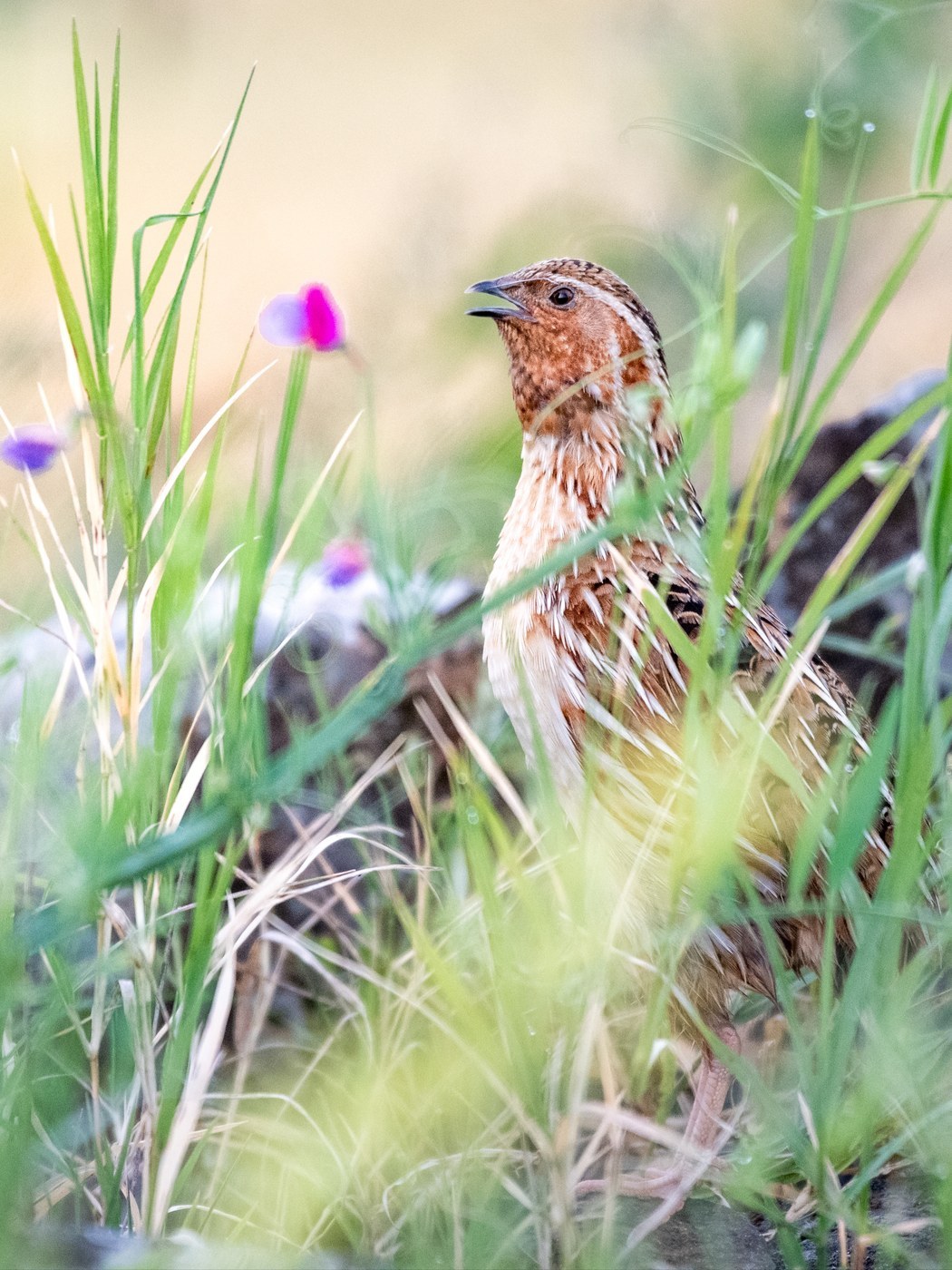
Key Field Marks
Size & Shape
- Very small, plump gamebird, only about 16–18 cm long — the smallest gamebird in Europe
- Compact, rounded body with short wings and an almost invisible short tail
- Small head with a short, stout bill
Plumage
- Cryptic streaky brown, buff, and black plumage overall, providing excellent camouflage in grass and cereal crops
- Pale buffy stripes on the head, including a distinct crown stripe and eyebrow stripe
- Males show a dark, anchor-shaped marking on the throat; females have a plainer throat but with dark spotting across the breast
Behavior
- Extremely secretive, spending nearly all its time hidden in dense grass or cereal fields and rarely seen in the open
- Flushes reluctantly, low and whirring, before quickly dropping back into cover after a short flight
- Males call persistently, often at night, from concealed positions, making the species far easier to detect by ear than by eye
Similar Species
- Corncrake: larger, a rail rather than a gamebird, with chestnut in the wings visible in flight and a harsh rasping call, quite different from the quail's clear whistled notes
- Grey Partridge: notably larger with an orange face patch, lacking the quail's fine streaking and tiny size
- Young or female pheasants: much larger overall with longer tails, easily ruling out confusion with the diminutive quail
Habitat & Range
- Breeds in open farmland, grassland, cereal fields, and steppe across Europe and western Asia, with populations also in parts of Africa
- A long-distance migrant, wintering mainly in sub-Saharan Africa and parts of India
- Numbers and exact breeding locations can vary year to year depending on habitat and weather conditions
Voice & Song
- Distinctive, far-carrying three-note call, often rendered as "wet-my-lips" or "quic-ic-ic," given by males
- The call is ventriloquial and frequently repeated, often heard well into the night during the breeding season
Frequently asked questions
Why is the Common Quail so hard to see?
It spends almost all its time hidden in dense grass or cereal crops and only flushes reluctantly for a short, low flight before dropping back into cover, making it far easier to hear than to see.
What does a Common Quail sound like?
Males give a distinctive, far-carrying three-note call often described as "wet-my-lips," repeated frequently, especially at dusk and night.
How do I tell Common Quail from Corncrake?
Corncrake is larger with a rail-like shape, chestnut wing patches in flight, and a harsh rasping call, while Common Quail is tiny, streaky brown, and gives a clear whistled call.
Where does the Common Quail live?
It breeds in open farmland, grassland, cereal fields, and steppe across Europe, western Asia, and parts of Africa, wintering mainly in sub-Saharan Africa and India.
Is the Common Quail migratory?
Yes, most populations undertake long-distance migration between European/Asian breeding grounds and African or Indian wintering areas.