
Common Potoo Identification Guide
A nocturnal tropical bird with extraordinary bark-like camouflage that lets it disappear as an upright "broken branch" by day, given away at night by its haunting wailing call.
Read the full Common Potoo encyclopedia entry →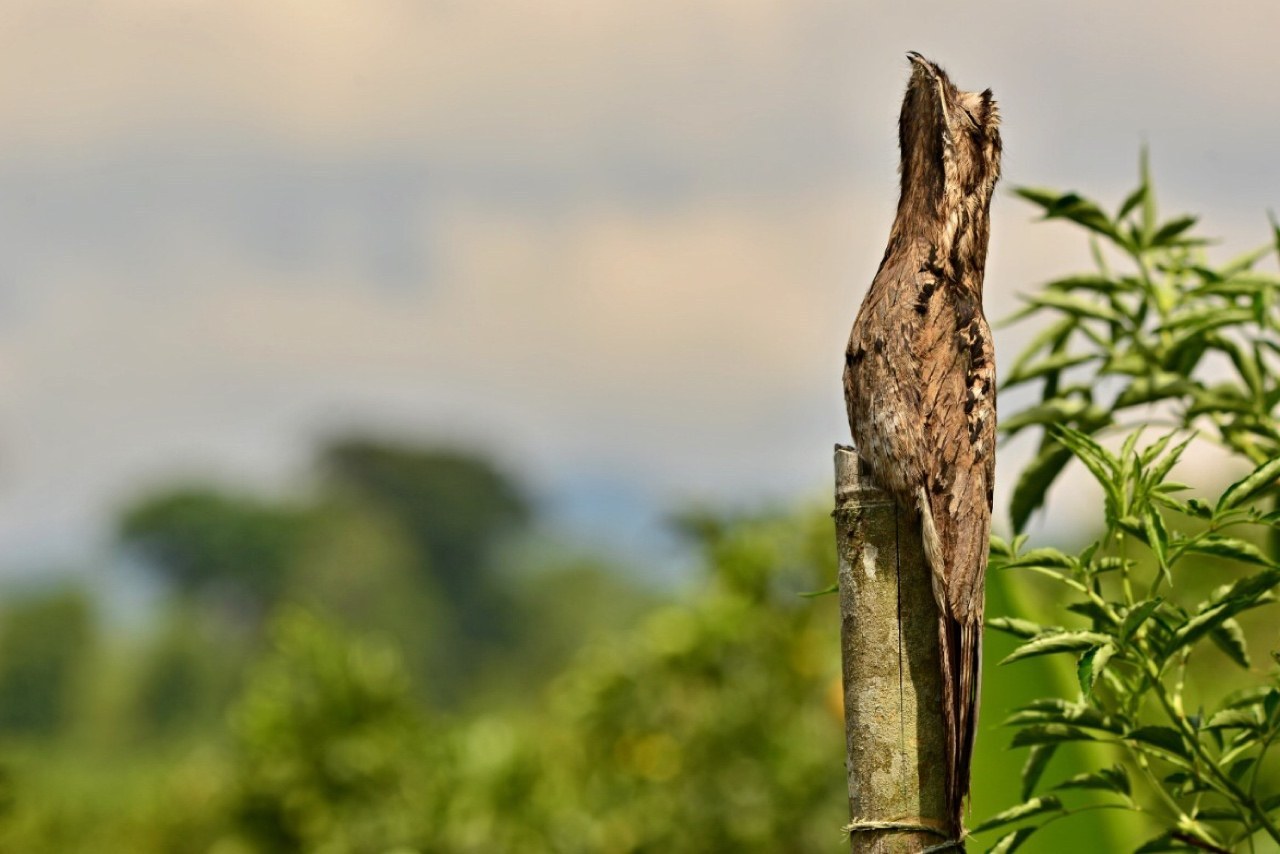
Key Field Marks
Size & Shape
- Medium-sized nocturnal bird, about 34–38 cm long, with a slim, elongated body shape
- Large head with enormous yellow eyes and a short, broad, hooked bill hiding a wide gape
- Long tail and wings that fold to give a slender, upright silhouette when perched
Plumage
- Intricately mottled gray, brown, black, and buff plumage that closely mimics tree bark and broken wood
- No obviously bold markings — the entire plumage is designed for camouflage rather than display
Behavior
- By day, perches upright and motionless on a broken tree stump, fence post, or bare branch, bill pointed skyward and eyes narrowed to slits, becoming almost indistinguishable from the perch itself
- At night, sits on an exposed perch and sallies out to catch flying insects before returning to the same spot
- Reflective eyeshine can reveal its presence at night even when the bird itself is hard to see
Similar Species
- Great Potoo: notably larger and paler, with a much deeper, guttural roaring call rather than the mournful whistled wail of Common Potoo
- Northern Potoo and Andean Potoo: similar daytime camouflaged posture, but differ in range, size, and especially voice; since all potoos look broadly alike while roosting, voice and range are the most reliable ways to separate them
Habitat & Range
- Found in forest edges, open woodland with scattered tall trees, savanna, secondary growth, and even gardens and plantations with suitable perches
- Ranges from southern Mexico through Central America and across much of South America
- Resident year-round, not migratory
Voice & Song
- Gives a haunting, mournful, descending series of wailing whistled notes, often rendered "BOU, bou, bou, bou, bou," heard mainly at night and frequently described as sad or ghostly
- This voice is usually the best way to confirm presence, since the bird is otherwise nearly invisible while roosting
Frequently asked questions
How does the Common Potoo avoid being seen during the day?
It perches upright on a broken branch or stump with its bill pointed up and eyes narrowed, and its intricately mottled plumage makes it look just like an extension of the dead wood.
What does a Common Potoo sound like?
It gives a mournful, descending series of wailing whistles, often written as "BOU, bou, bou, bou, bou," mainly heard at night.
How do I tell Common Potoo from Great Potoo?
Great Potoo is larger and paler with a deep guttural roaring call, while Common Potoo is smaller with a softer, mournful whistled wail.
Where does the Common Potoo live?
It occurs in forest edges, open woodland, savanna, and gardens with tall perches from southern Mexico through Central America and much of South America.
Is the Common Potoo related to nightjars?
It belongs to a related but distinct family (Nyctibiidae) from true nightjars, sharing nocturnal habits and camouflage but differing in bill shape, posture, and lack of a nest — potoos lay a single egg in a shallow depression atop a stub or branch.