
Common Poorwill Identification Guide
North America's smallest nightjar, a compact, short-winged bird of arid western scrublands famous for entering extended cold-weather torpor.
Read the full Common Poorwill encyclopedia entry →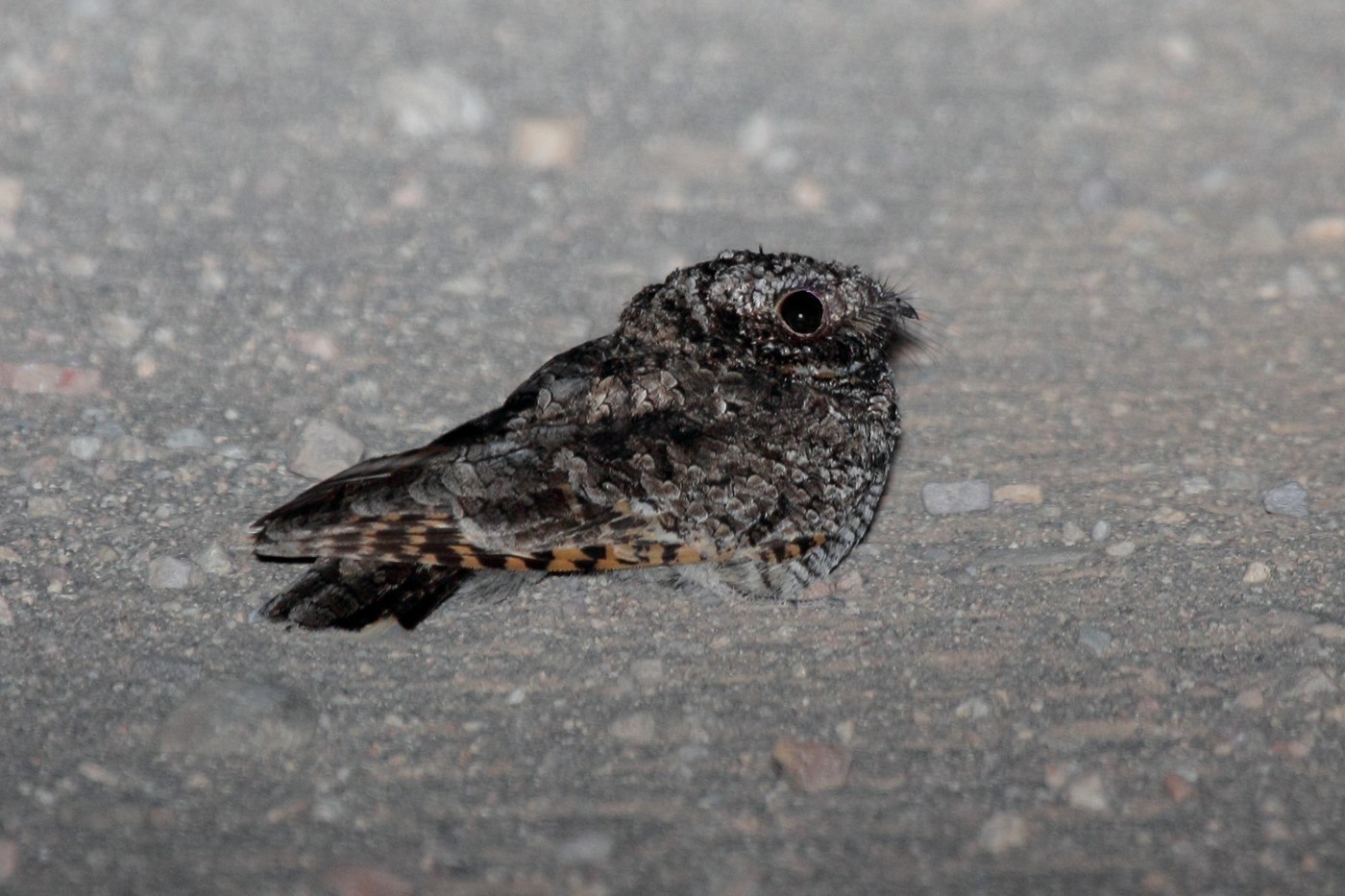
Key Field Marks
Size & Shape
- The smallest nightjar in North America, only about 19–21 cm long
- Compact and short-tailed with short, rounded wings — quite different in shape from the long, pointed-winged nighthawks
- Round head and tiny bill with a wide gape
Plumage
- Mottled gray, brown, and black plumage that closely matches bark, gravel, and rocky soil
- White throat band (buffier in females) and small white corners at the tip of the tail, though with less white than related nightjars
Behavior
- Roosts and nests directly on bare ground, often on gravel or beneath low shrubs, relying entirely on camouflage rather than concealment in dense cover
- Rounded wings mean it does not fly high overhead like a nighthawk; instead it makes short, low sallies from the ground to catch insects
- Uniquely among birds, it can enter extended torpor, dramatically lowering its body temperature and metabolic rate to survive cold periods, sometimes for weeks at a time — a behavior close to true hibernation
Similar Species
- Common Nighthawk: larger, with long pointed wings, a bold white wing bar, and habitual high daytime/dusk flight; gives a nasal "peent" rather than a repetitive song
- Common Pauraque: larger, longer-tailed with more extensive white in the outer tail feathers, and found in more tropical/subtropical habitat with a whistled "pur-wheeer" song
- Chuck-will's-widow and Whip-poor-will: both larger, occur mainly in the eastern half of North America with limited range overlap, and have very different repetitive songs
Habitat & Range
- Favors arid and semi-arid country: sagebrush flats, rocky slopes, chaparral, open pine woodland, and desert scrub across western North America
- Breeds from southern Canada south to Mexico; northern populations migrate short distances south for winter, while southern populations are largely resident
Voice & Song
- Gives a persistent, rhythmic "poor-will" or "poor-will-ip" call repeated over and over through the night, which is the origin of its name
- Often the easiest way to detect this well-camouflaged bird
Frequently asked questions
What makes the Common Poorwill unusual among birds?
It is one of the very few birds known to enter extended torpor, lowering its body temperature and metabolism for days or weeks at a time during cold weather, a behavior close to hibernation in mammals.
How do I tell Common Poorwill from Common Nighthawk?
Poorwill is smaller with short, rounded wings and no long white wing bar, stays low to the ground, and gives a repetitive "poor-will" song, while Nighthawk has long pointed wings, a bold wing bar, flies high, and gives a nasal "peent."
Where does the Common Poorwill live?
It favors arid and semi-arid habitats such as sagebrush, rocky slopes, and desert scrub across western North America.
How can I find a Common Poorwill?
Listen at night for its distinctive repeated "poor-will" call; by day it is nearly invisible thanks to camouflage that matches bare ground and gravel.
Does the Common Poorwill build a nest?
No, like other nightjars it lays its eggs directly on bare ground or gravel without constructing any nest structure.