
Common Pauraque Identification Guide
A ground-roosting tropical nightjar with intricate bark-like camouflage, best located at night by its glowing eyeshine and whistled "pur-wheeer" song.
Read the full Common Pauraque encyclopedia entry →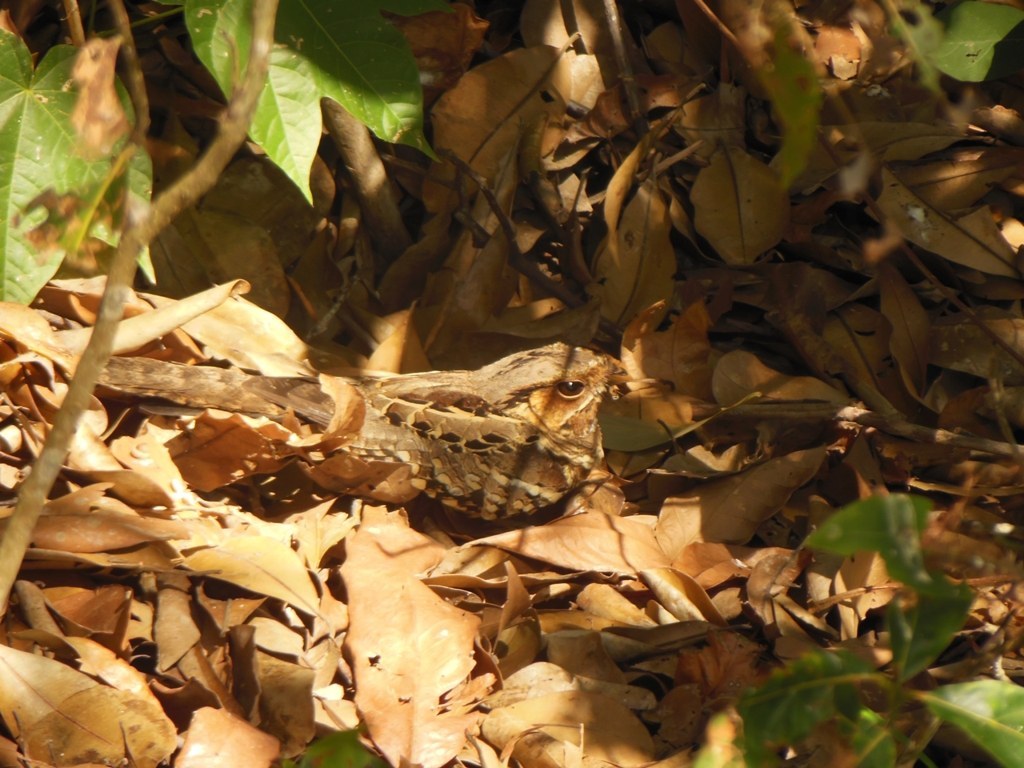
Key Field Marks
Size & Shape
- Medium to fairly large nightjar, roughly 22–30 cm long depending on subspecies, with a notably long tail for the family
- Rounded wings and a long, rounded tail — the longest-tailed nightjar in much of its range
- Flat head with large dark eyes and a tiny bill hiding an enormous gape
Plumage
- Intricately patterned gray, brown, black, and buff plumage, finely vermiculated to resemble bark and dead leaves
- A pale buffy-white band crosses the lower throat like a collar
- In flight, shows a white bar across the primaries and prominent white patches in the outer tail feathers — males show considerably more white in the tail than females
Behavior
- Strictly nocturnal and crepuscular; spends the day roosting motionless on the ground in leaf litter, where camouflage makes it almost invisible
- Frequently encountered at night along roadsides, where its eyes reflect bright orange-red in headlights
- When flushed, flies low and short before dropping back to the ground
- Sallies from a ground perch to catch flying insects
Similar Species
- Common Poorwill: shorter tail with less white, found in more arid, temperate parts of North America (little range overlap), and gives a rhythmic "poor-will" song rather than a whistled "pur-wheeer"
- Chuck-will's-widow: larger and buffier, white in the male's tail is restricted to the tips of the inner feathers rather than broad outer patches, and its song is a rolling "chuck-will's-widow" rather than a rising whistle
- Whip-poor-will: smaller, rounder-winged, with a different "whip-poor-will" song; distinguishing these species is most reliable by voice and tail pattern in flight
Habitat & Range
- Found in woodland edges, brushy scrub, secondary growth, and roadside habitat from southern Texas south through Mexico, Central America, and much of South America
- Resident year-round throughout its range, with no major long-distance migration
Voice & Song
- Distinctive rising whistled song, often rendered "pur-WHEEER" or "whip-wheeeeoo," repeated persistently at dusk and through the night
- Also gives softer, guttural notes while foraging
Frequently asked questions
How can I find a Common Pauraque during the day?
They are extremely difficult to spot by day because they roost motionless on the ground in leaf litter with near-perfect camouflage; night surveys using a flashlight to catch their orange-red eyeshine are far more effective.
What does a Common Pauraque sound like?
Its signature call is a rising, whistled "pur-wheeer," quite different from the repetitive "poor-will" or "whip-poor-will" songs of related nightjars.
How is Common Pauraque different from Common Poorwill?
Pauraque is larger with a much longer tail showing broad white outer patches, prefers subtropical/tropical habitats, and has minimal range overlap with the more northerly, arid-country Poorwill.
Where does the Common Pauraque live?
It ranges from southern Texas through Mexico, Central America, and much of South America, favoring woodland edges, scrub, and roadsides.
Is the Common Pauraque migratory?
No, it is a year-round resident throughout its range rather than a long-distance migrant.