
Common Ostrich Identification Guide
The world's largest living bird, an unmistakable flightless giant of African savanna and desert with a long bare neck and powerful running legs.
Read the full Common Ostrich encyclopedia entry →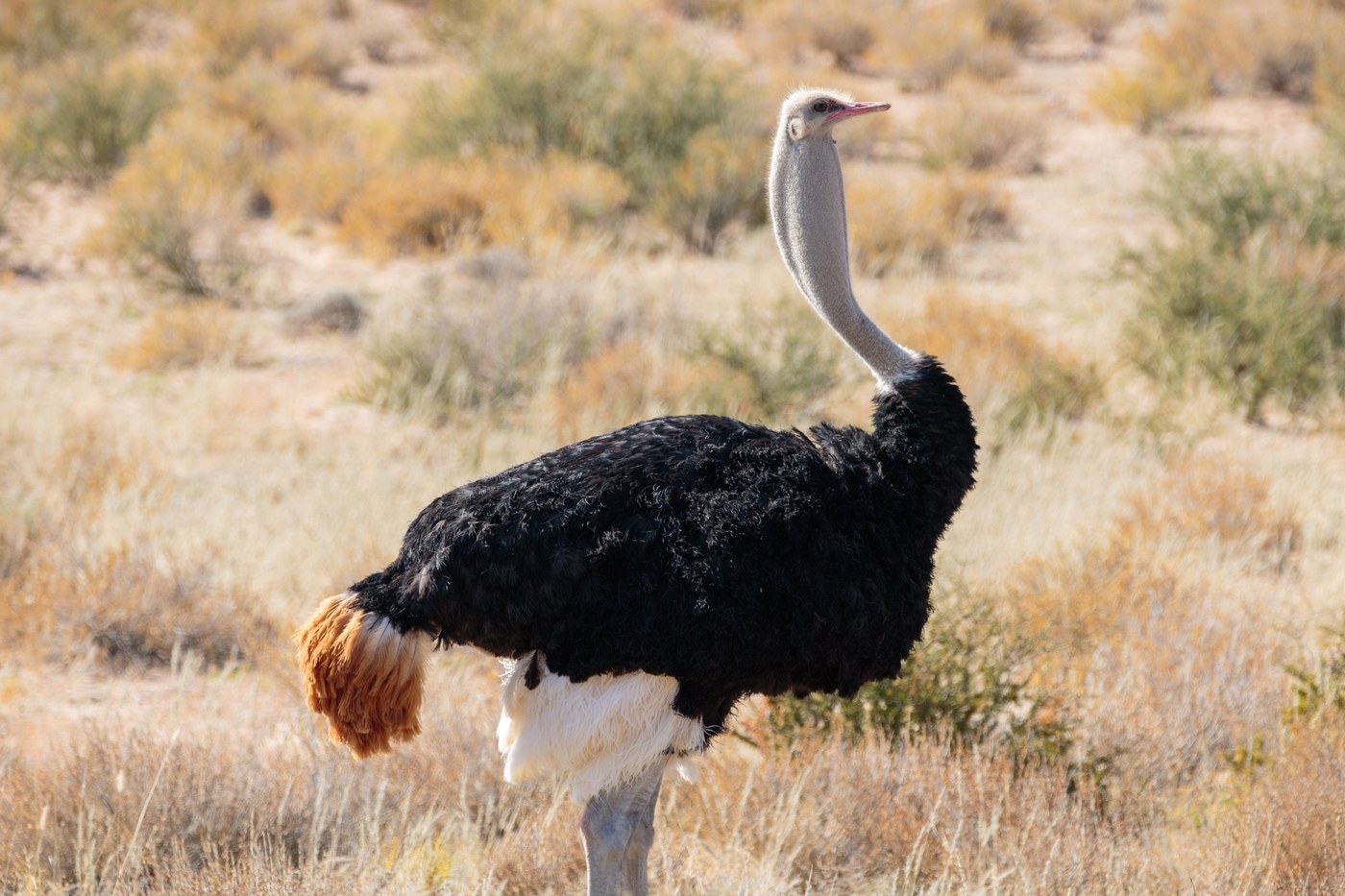
Key Field Marks
Size & Shape
- The largest living bird species: males stand up to 2.7 m (9 ft) tall and can weigh well over 100 kg
- Long, bare, flexible neck and long powerful legs built for running rather than flight
- Small, flattened head with very large eyes — the largest eyes of any land vertebrate
- Only two toes on each foot (unique among birds), with one enlarged nail used for traction and defense
Plumage
- Adult males: mostly glossy black body plumage with striking white plumes on the wings and tail
- Females and juveniles: duller grayish-brown overall, providing better camouflage while incubating on open ground
- Bare skin on the neck and legs varies by population from pinkish to bluish-gray
Behavior
- Flightless but an extremely powerful runner, capable of bursts up to 70 km/h (43 mph), using its wings for balance while running
- Highly gregarious, often seen in loose groups grazing alongside antelope and zebra
- Breeding system is polygynous; a dominant female lays in a shared communal ground nest, incubating by day while the male incubates by night
- Hisses and kicks powerfully when threatened; males give a deep, resonant booming roar during the breeding season
Similar Species
- No other wild bird in its native African range approaches its size, making misidentification essentially impossible
- Emu (Australia) and Rheas (South America) are broadly similar-looking flightless giants but occur on different continents; Emus have shaggy, feathered necks and three toes, while Rheas are smaller, grayer, and also three-toed — confusion only arises with escaped or farmed birds seen outside their natural range
Habitat & Range
- Inhabits open, arid, and semi-arid habitats across sub-Saharan Africa: savanna, grassland, scrubland, and semi-desert
- Several regional populations (sometimes treated as subspecies) occur from the Sahel and East Africa south to southern Africa, differing slightly in neck color and size
- Non-migratory; resident year-round within home ranges that can be extensive in arid country
Voice & Song
- Males produce a deep, far-carrying booming roar during courtship and territorial displays, sometimes mistaken for a lion at a distance
- Both sexes hiss when alarmed or defending a nest
Frequently asked questions
How do I tell a male from a female Common Ostrich?
Males have glossy black body plumage with contrasting white wing and tail plumes, while females and immatures are a duller, more uniform grayish-brown.
Can Common Ostriches fly?
No, they are completely flightless; their wings are used for balance while running, courtship display, and shading chicks rather than flight.
How fast can an ostrich run?
Common Ostriches can reach speeds of roughly 70 km/h (43 mph) in short bursts, making them the fastest running bird.
Where do Common Ostriches live?
They inhabit open, arid, and semi-arid savanna, grassland, and desert-edge habitats across sub-Saharan Africa.
What sound does a Common Ostrich make?
Breeding males give a deep, booming roar-like call, and both sexes hiss loudly when threatened or defending a nest.