
Common Nighthawk Identification Guide
A cryptically patterned, long-winged aerial insectivore best known for its erratic bat-like flight and nasal "peent" call at dusk.
Read the full Common Nighthawk encyclopedia entry →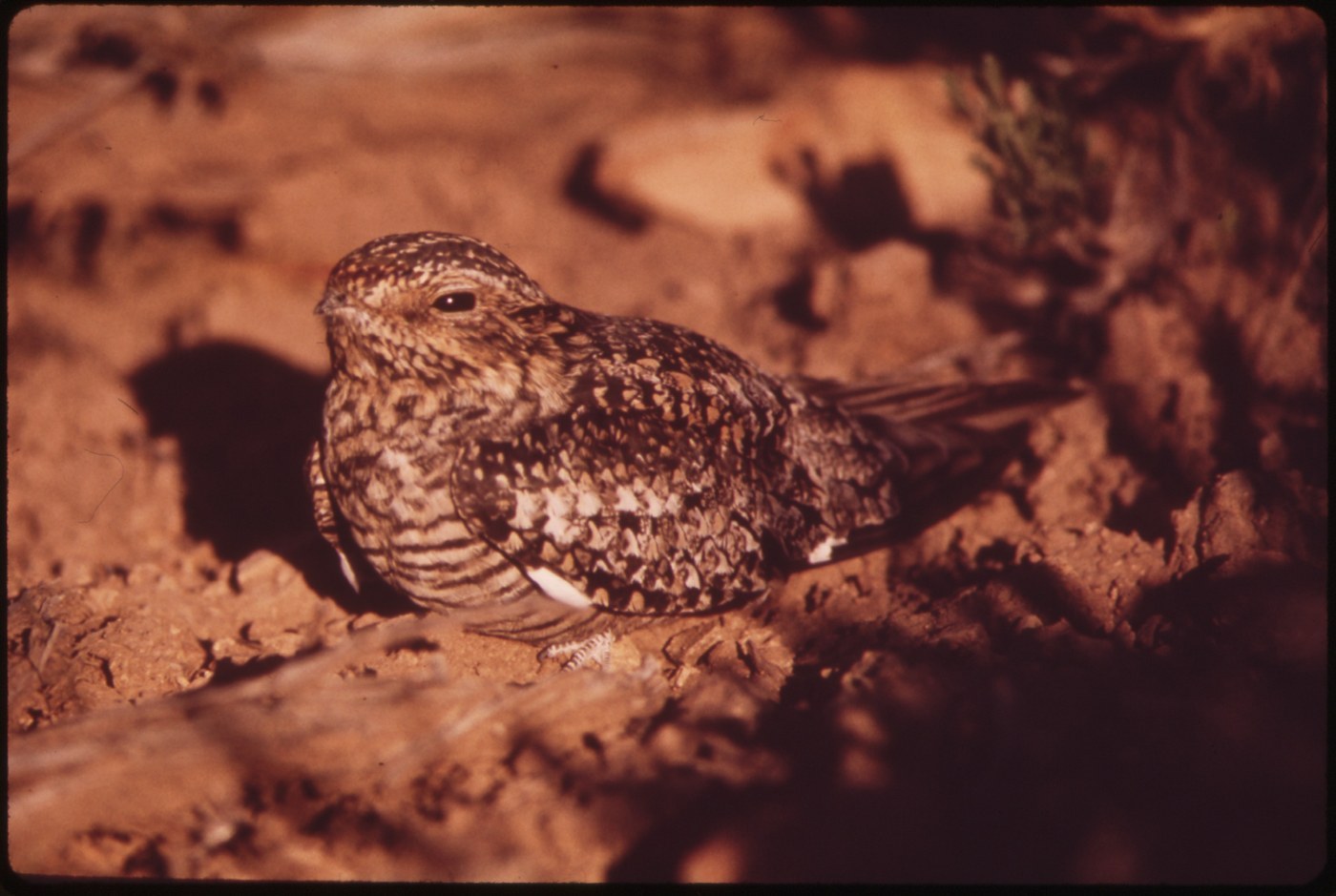
Key Field Marks
Size & Shape
- Slim, medium-sized bird, about 22–24 cm long with long, narrow, pointed wings and a fairly long, notched tail
- Small head, tiny bill, but an enormous gape adapted for catching insects in flight
- Wingspan around 56–61 cm — wings look disproportionately long and angular compared to the body
Plumage
- Cryptic mottled gray, brown, buff, and black plumage that resembles bark or gravel
- A bold white bar crosses each wing near the tip (the "wing patch"), obvious in flight and a key distinguishing mark
- Males show a white throat patch and a white band near the tip of the tail; females have a buffier throat and lack the white tail band
Behavior
- Flies with an erratic, buoyant, batlike wingbeat, often high overhead at dusk and dawn while foraging for flying insects
- Frequently seen in loose, scattered flocks ("kettles") migrating at dusk in late summer and early fall
- Roosts flat and motionless on the ground, gravel roofs, fence posts, or horizontally on tree limbs by day, relying on camouflage
- Nests directly on bare ground or gravel — no nest is built
- Males perform a dramatic courtship dive, pulling out with a deep "boom" produced by air rushing through the wing feathers
Similar Species
- Common Poorwill / Whip-poor-will / Chuck-will's-widow: these nightjars have short, rounded wings (not long and pointed), lack the bold white wing bar, rarely fly high overhead in daylight, and are far more secretive
- Lesser Nighthawk (western/southern range overlap): smaller, buffier overall, the white wing bar sits closer to the wingtip, and its voice is a soft trill rather than a nasal "peent"
- Common Pauraque: bulkier, longer-tailed, roosts on the ground in leaf litter, and gives a whistled "pur-wheeer" rather than a peent
Habitat & Range
- Breeds across most of North America in open habitats: fields, forest clearings, burns, rocky barrens, and cities, where flat gravel rooftops serve as nest sites
- Highly migratory, wintering in South America; migration flocks are often conspicuous at dusk over open country in late summer
- Forages on the wing over open ground, water, and even brightly lit areas such as ball fields and parking lots where insects concentrate
Voice & Song
- Distinctive nasal, buzzy "peent" or "spee-ik" call given in flight, especially around dusk
- The mechanical "boom" sound from a diving male's wings is a courtship display, not a vocalization
Frequently asked questions
How can I tell a Common Nighthawk from a Common Poorwill?
Nighthawks have long, pointed wings with a bold white bar and fly high overhead at dusk, while poorwills have short, rounded wings, no long wing bar, and stay low and secretive, usually near the ground.
What does a Common Nighthawk sound like?
It gives a sharp, nasal "peent" call in flight; displaying males also produce a booming whoosh with their wings during steep courtship dives.
Where do Common Nighthawks nest?
They lay eggs directly on bare ground, gravel, rock, or flat gravel rooftops in cities — they build no nest structure at all.
When is the best time to see Common Nighthawks?
Look for them at dusk and dawn during summer, or in large migrating flocks over open areas in late August and September.
Why does the wing pattern matter for identification?
The bold white bar crossing the primaries is one of the most reliable marks separating Common Nighthawk from similar nightjars, which lack this feature entirely.