
Common Murre Identification Guide
A slender, penguin-like seabird of the Northern Hemisphere with a dagger-shaped bill, dark upperparts, and dense nesting colonies on sea cliffs.
Read the full Common Murre encyclopedia entry →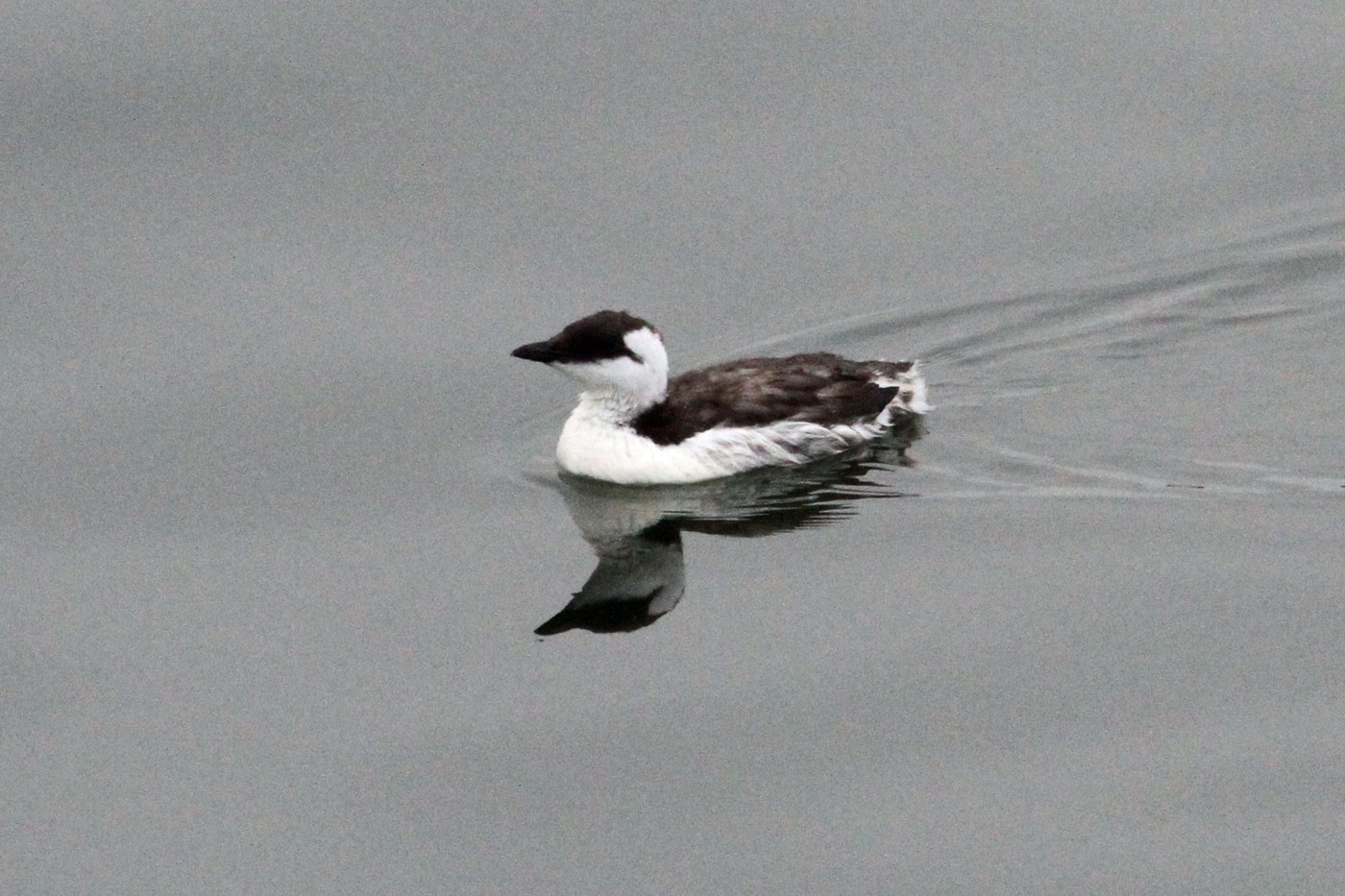
Key Field Marks
- Size & shape: A medium-large auk with a slender, pointed bill, a streamlined, torpedo-shaped body, and an upright penguin-like stance on land, though (unlike penguins) it can fly.
- Plumage (breeding): Dark chocolate-brown to blackish head, neck, and upperparts, sharply demarcated from clean white underparts; a small percentage of birds ("bridled" morph) show a thin white eye-ring and trailing spectacle line.
- Plumage (non-breeding): White extends further up onto the face and throat, leaving a dark line behind the eye — useful for separating winter birds from similarly plumaged relatives.
- Bill: Long, straight, slender, and pointed, entirely dark with no distinctive markings.
- Behavior: Highly colonial, nesting in dense, packed groups on narrow cliff ledges without building a nest; dives and swims underwater using its wings for propulsion to catch fish; flies with fast, whirring wingbeats low over the water.
Separating from Similar Species
- Thick-billed Murre: Shows a shorter, thicker bill with a pale stripe along the gape (cutting edge), a more rounded head, and the dark of the face extends in a smoother curve without the pointed cheek extension seen on Common Murre; the two often nest together on the same cliffs in the North Atlantic and Pacific.
- Razorbill: Has a much deeper, laterally flattened bill with a white vertical line near the tip, a blunter head shape, and a longer, more pointed tail often held cocked up.
- Penguins (general public confusion): Murres can fly and are found only in the Northern Hemisphere, whereas true penguins are flightless and restricted to the Southern Hemisphere — no geographic overlap exists.
Where & When to See It
Common Murres breed in vast, densely packed colonies on sea cliffs and rocky islands across the North Atlantic and North Pacific, from the UK and Scandinavia to Alaska, Canada, and the northern U.S. coasts. Outside the breeding season they disperse widely offshore, sometimes turning up closer to shore or even inland after storms ("wrecks"), and can be seen from headlands, boats, and pelagic trips.
Voice & Song Cues
At breeding colonies, murres are extremely noisy, producing a low, growling "arrr" or purring "murrre" call (the likely source of the name) along with various croaks and grunts; they are largely silent at sea outside the colony.
Frequently asked questions
How do I tell Common Murre from Thick-billed Murre?
Common Murre has a thinner, all-dark, pointed bill and a pointed extension of dark feathering onto the white cheek, while Thick-billed Murre has a shorter, stouter bill with a pale line along the gape and a smoother facial border.
What is the 'bridled' form of Common Murre?
A plumage variant found in a minority of individuals, showing a thin white ring around the eye with a line extending back, giving a spectacled look; it is a normal variation, not a separate subspecies or age class.
Are murres the same as penguins?
No, murres are auks that can fly and live only in the Northern Hemisphere, while true penguins are flightless and found only in the Southern Hemisphere; the similarity is due to convergent evolution for diving.
Where do Common Murres nest?
In dense colonies on narrow ledges of sea cliffs and rocky offshore islands, laying a single egg directly on bare rock without building a nest.
How does Common Murre catch its food?
It dives and swims underwater, propelled by its wings, to pursue and catch small fish and other marine prey, sometimes reaching considerable depths.