
Common Moorhen Identification Guide
A dark, chicken-like waterbird of ponds and marshes across the Old World, recognized by its red-and-yellow bill shield and white flank stripe.
Read the full Common Moorhen encyclopedia entry →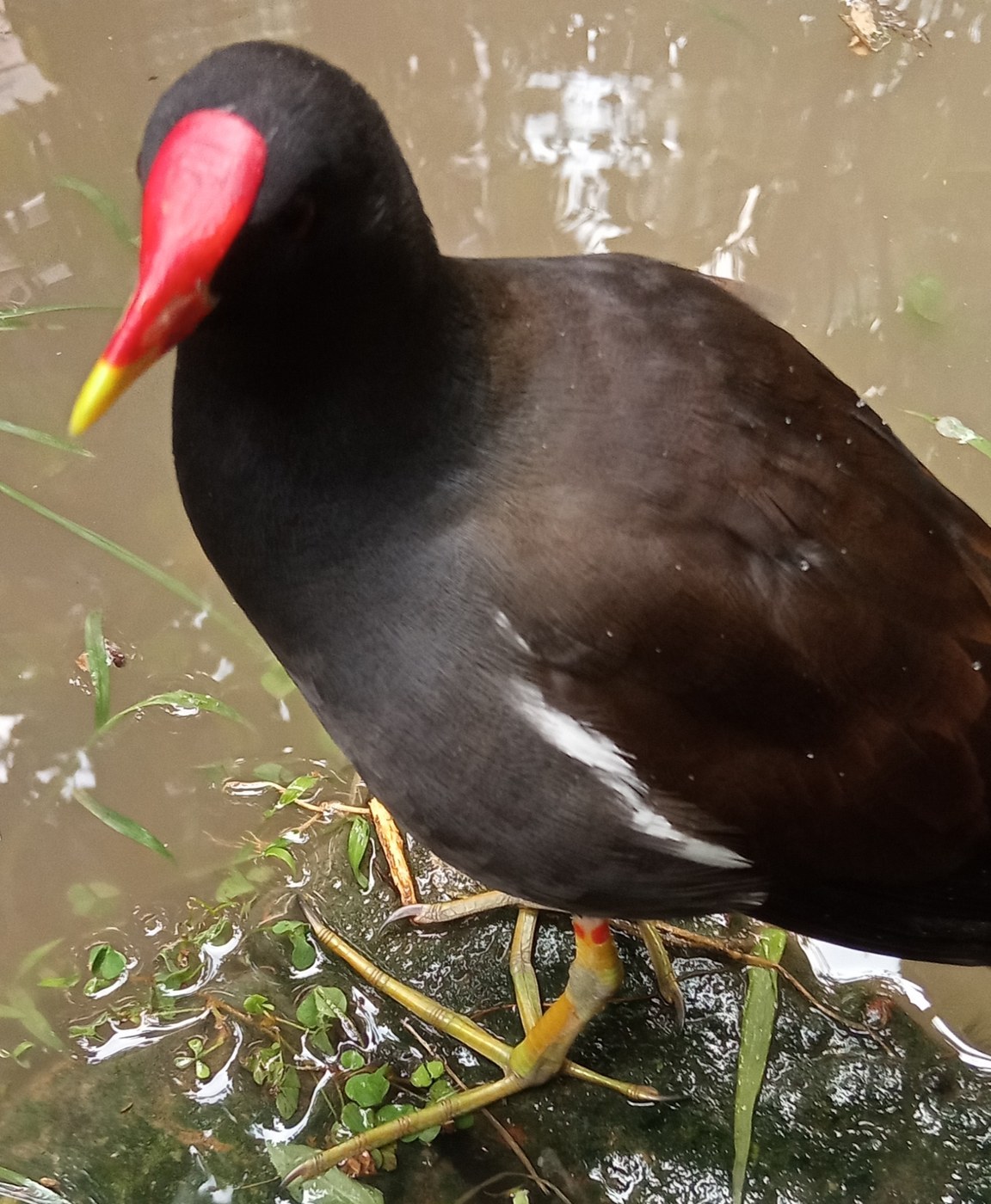
Key Field Marks
- Size & shape: A medium-sized waterbird with a rounded body, short tail often flicked upward, and long legs with long toes adapted for walking on floating vegetation.
- Plumage: Overall sooty black-grey body, slightly browner on the back and wings, with a bold white stripe along the flanks and white undertail coverts split by a dark central line — flashed conspicuously when the tail is raised.
- Bill & frontal shield: Bright red bill with a yellow tip, and a red frontal shield extending up the forehead — a key distinguishing feature from coots.
- Legs: Long yellow-green legs with a small red "garter" band near the top of the tibia, visible at close range.
- Behavior: Swims with a distinctive jerking, head-bobbing motion; walks well on land and atop floating vegetation; frequently flicks its tail to flash the white undertail patch, especially when alarmed or displaying.
Separating from Similar Species
- Eurasian Coot: All-black with a white (not red) bill and frontal shield, lacks the white flank stripe, and has lobed (not simply long) toes; Coot also tends to swim further from cover in open water.
- Purple Swamphen/Gallinule species: Much larger and bulkier with vivid blue-purple plumage and a massive red bill — easily separated by color and size.
- American/Common Gallinule complex (regional taxonomy note): Where ranges or naming overlap, the key shared features (red-and-yellow bill, white flank stripe, white undertail with dark center) remain consistent identification tools within the Moorhen/Gallinule group, with subtle differences in shield shape and habitat used to separate closely related forms.
Where & When to See It
Common Moorhens are found across freshwater wetlands throughout Europe, Africa, and Asia — ponds, lakes, marshes, slow rivers, and even park lakes and ditches with emergent vegetation for cover and nesting. They are often shy but not always secretive, and can become quite tame in urban parks. Populations in milder climates are largely resident, while those in colder northern areas move south in winter when water freezes.
Voice & Song Cues
Vocal and noisy, giving a wide range of loud, sharp, sometimes explosive calls including a harsh "kurrk" or "krrruk," bubbling and clucking notes, and abrupt shrieks, often heard from cover well before the bird is seen.
Frequently asked questions
How do I tell Common Moorhen from Eurasian Coot?
Moorhen has a red bill with a yellow tip and a white stripe along its flanks, while Coot has an all-white bill and shield and lacks any flank stripe.
What is the function of the moorhen's flicking tail?
Raising and flicking the tail flashes the bold white undertail patches, which is thought to signal alarm or communicate with other moorhens, including chicks.
What habitat does Common Moorhen prefer?
Freshwater wetlands with emergent vegetation, including ponds, marshes, slow-moving rivers, and park lakes, where it can find cover and nesting material.
Is Common Moorhen a good swimmer and walker?
Yes, it swims well with a jerky head-bobbing motion and also walks confidently on land and across floating vegetation using its long toes.
Do Common Moorhens migrate?
Populations in mild climates are largely resident year-round, while those breeding in colder northern regions migrate south when wetlands freeze in winter.