
Common Merganser Identification Guide
A large, streamlined fish-eating duck with a slender serrated bill, found on clear rivers and lakes across the Northern Hemisphere.
Read the full Common Merganser encyclopedia entry →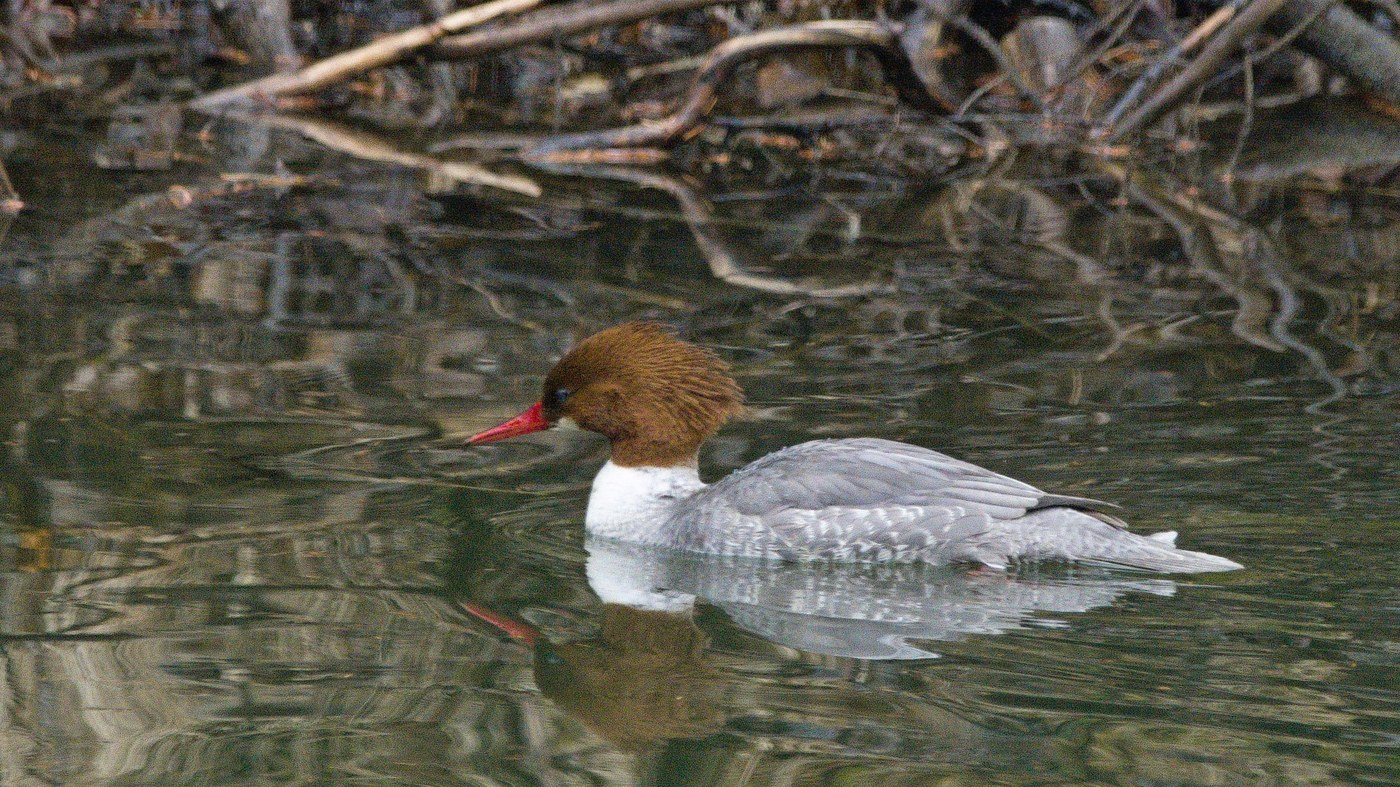
Key Field Marks
- Size & shape: A large, elongated duck with a low-slung, torpedo-like body, a thin neck, and a slim head that lacks a shaggy crest (in males) or shows only a soft, rounded crest (females) — sleeker overall than most other ducks.
- Plumage (male): Clean white body with a subtle pinkish blush, a dark, glossy green-black head, and a black back, creating a strong two-tone contrast visible from a distance.
- Plumage (female/eclipse male): Grey body with a sharply demarcated, rich cinnamon-rufous head and neck, contrasting with a clean white chin/throat patch and a neat (not ragged) crest.
- Bill: Long, thin, and serrated (saw-toothed) for gripping fish, bright red-orange in both sexes, with a dark culmen ridge, hooked slightly at the tip.
- Behavior: Dives underwater to pursue fish, often hunting cooperatively in groups; frequently seen resting on rocks, logs, or riverbanks in tight-knit groups; flies low and fast over water in a direct line.
Separating from Similar Species
- Red-breasted Merganser: Shows a shaggy, spiky double-pointed crest in both sexes (versus the smoother, single-peaked crest of Common Merganser), and males have a streaked, messier breast band and greyer flanks rather than the clean white body of Common Merganser.
- Hooded Merganser: Much smaller, with males showing a large, fan-shaped white-and-black crest that can be raised or flattened; females are dull brown overall with a shaggy cinnamon crest and a much smaller, thinner dark bill.
- Female Common vs. Red-breasted Merganser: The sharp border between the rufous head/neck and white chin/throat, plus a neater crest, favors Common Merganser; Red-breasted shows a more gradual blend between the rufous neck and pale throat and a messier, spikier crest.
Where & When to See It
Common Mergansers breed across forested regions of North America, Europe, and Asia on clear rivers, lakes, and reservoirs, nesting in tree cavities near water. They winter on larger, often ice-free rivers, lakes, and reservoirs further south, generally avoiding open salt water more than Red-breasted Merganser does, and often gather in sizable rafts on large lakes and rivers.
Voice & Song Cues
Generally quiet away from the breeding grounds. Displaying males give a deep, rasping or croaking courtship call, while females give a harsher, guttural "karr" or "gruk" alarm/contact call, particularly when leading young or when disturbed near the nest.
Frequently asked questions
How do you tell male Common Merganser from male Red-breasted Merganser?
Male Common Merganser has a clean white body and a smooth, dark green head without a shaggy crest, while male Red-breasted Merganser has a spiky double crest, a streaked rusty breast band, and greyer flanks.
What is the easiest way to identify a female Common Merganser?
Look for a sharply defined boundary between the cinnamon-rufous head/neck and the white throat/chin patch, along with a neat, smooth (not shaggy) crest.
What kind of bill does Common Merganser have?
A long, thin, serrated red-orange bill adapted for gripping slippery fish, shared by both sexes.
Where do Common Mergansers nest?
They typically nest in large tree cavities close to clear rivers, lakes, or reservoirs in forested landscapes.
Do Common Mergansers prefer fresh or salt water?
They strongly favor freshwater rivers and lakes year-round, generally avoiding the open coastal salt water that Red-breasted Mergansers use more frequently in winter.