
Common Ground Dove Identification Guide
A tiny, chunky North American dove with scaly-patterned plumage, a short dark tail, and a habit of walking rather than flying when disturbed.
Read the full Common Ground Dove encyclopedia entry →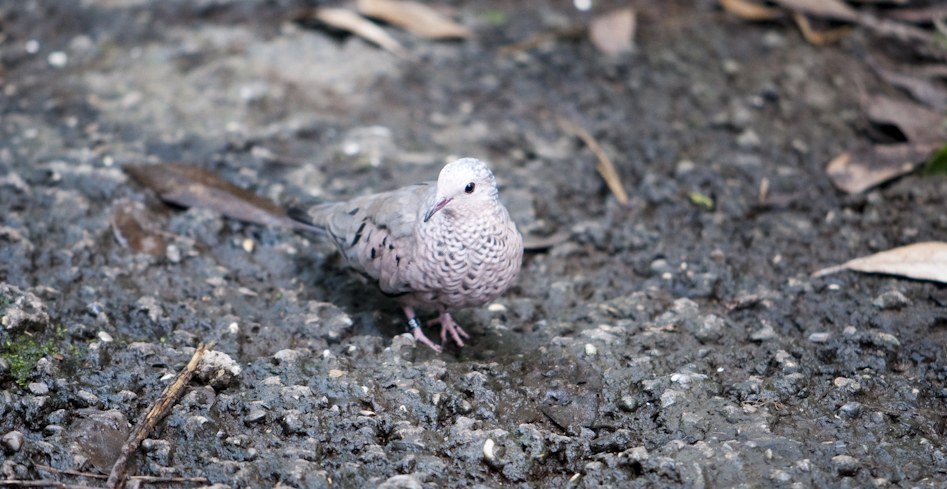
Key Field Marks
- Size & shape: One of the smallest doves in North America, barely larger than a sparrow, with a plump, short-tailed, short-necked profile.
- Plumage: Overall grayish-brown to pinkish-buff with a distinctive scaly (scalloped) pattern on the breast and nape created by dark feather edges; males show a soft pinkish wash on the head and breast.
- Wings: Show rufous-chestnut primary feathers, flashing conspicuously in flight — a strong confirming mark not shared by most similar small doves.
- Bill: Short and stubby, pinkish-orange with a dark tip.
- Behavior: Spends most of its time on the ground walking and pecking for seeds with a bobbing head motion; when flushed, flies low and fast for a short distance before dropping back down and typically prefers to walk or run away rather than fly.
Separating from Similar Species
- Inca Dove: Also small and scaly-patterned, but Inca Dove has a proportionally longer, squared tail with white outer tail feathers and lacks the rufous wing flash; Ground Dove looks stubbier and rounder overall.
- Mourning Dove: Much larger, with a long pointed tail and unpatterned plumage — easily eliminated by size and shape alone.
- Ruddy Ground Dove (in range overlap in the far south): Male Ruddy Ground Dove is more uniformly rufous-chestnut overall without the scaly breast pattern; females are similar to Common Ground Dove but slightly larger with a less contrasting pattern — check wing color and range.
Where & When to See It
Common Ground Doves are resident (non-migratory) across the southern United States from Florida and the Gulf Coast west to California, and south through Mexico, Central America, and into South America and the Caribbean. They favor open, scrubby habitats: dry brushland, agricultural edges, roadsides, sandy pine woods, and residential areas with bare ground and low cover. Look for them low to the ground or perched on low wires and fences year-round.
Voice & Song Cues
The song is a soft, repeated, rising "coo-oo" or "woo-oo" note, given monotonously and often confused with a distant owl or another dove; it is quieter and higher-pitched than the multi-note coo of a Mourning Dove.
Frequently asked questions
How can I tell Common Ground Dove from Inca Dove?
Common Ground Dove has a shorter, rounder tail and shows rufous-chestnut primaries in flight, while Inca Dove has a longer, squared tail edged in white and lacks the rufous wing flash.
What is the scaly pattern seen on this dove?
Dark crescent-shaped edges on the breast and neck feathers create a scalloped or scaly look, most visible at close range on both sexes, though stronger on males.
Where does Common Ground Dove live?
It is a year-round resident of open, scrubby, and semi-arid habitats across the southern U.S., Mexico, Central America, the Caribbean, and parts of South America.
Does the Common Ground Dove migrate?
No, it is largely non-migratory and can be found in the same areas throughout the year.
What does the Common Ground Dove's call sound like?
A soft, repetitive rising 'coo-oo' note that can be mistaken for a distant owl; it is delivered steadily, often from a low perch or the ground.