
Common Greenshank Identification Guide
A tall, elegant Eurasian wader with long greenish legs, a slightly upturned bill, and a distinctive ringing three-note flight call.
Read the full Common Greenshank encyclopedia entry →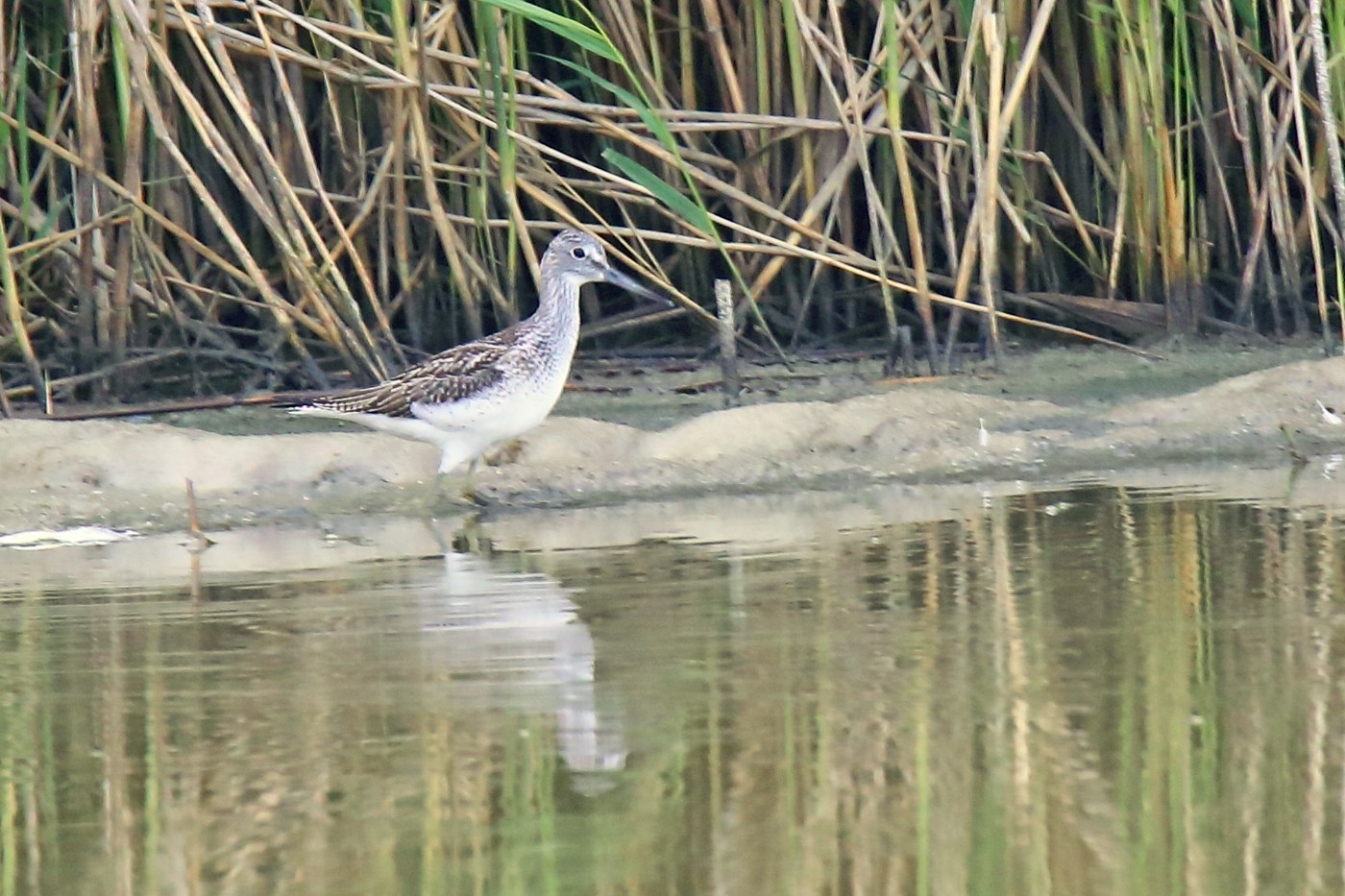
Key Field Marks
- Size & shape: A large, slender shorebird, roughly the size of a Greater Yellowlegs, with long legs, a long neck, and an upright, elegant stance.
- Plumage: Pale grey-brown above with white underparts; breeding adults show darker streaking and barring on the back and flanks, while non-breeding birds are plainer pale grey above and white below. In flight shows a conspicuous white wedge extending up the back to between the wings, with no wing stripe.
- Bill: Long, stout, and slightly upturned (recurved), grey at the base shading to dark at the tip — a key distinguishing feature from straight-billed relatives.
- Legs: Long, greenish-grey to olive legs (not bright yellow), extending well past the tail in flight.
- Behavior: Forages actively, often running through shallow water while sweeping its bill side to side to catch small fish and invertebrates; frequently bobs its head and tail.
Separating from Similar Species
- Greater Yellowlegs (in areas of overlap/vagrancy): Yellowlegs has bright yellow legs (not greenish) and a straighter, more needle-like bill without the upward kink.
- Marsh Sandpiper: Much smaller and daintier, with a straight, needle-fine bill and proportionally longer legs; Greenshank is noticeably bulkier with a heavier, upturned bill.
- Spotted Redshank (non-breeding): Shows a straighter bill with a red base and longer, more attenuated look; Redshank's legs are more reddish-orange rather than green.
- Redshank: Smaller, with bright red-orange legs and a shorter, straight bill, plus a bold white trailing edge to the wing in flight (absent in Greenshank).
Where & When to See It
Common Greenshanks breed across the boreal and subarctic zones of northern Europe and Asia, nesting on bogs and moorland near water. They are long-distance migrants, wintering from southern Europe and Africa across the Middle East, South and Southeast Asia, and Australia. During migration and winter, look for them on coastal mudflats, estuaries, salt pans, and inland wetlands, usually singly or in small loose groups.
Voice & Song Cues
The flight call is a loud, ringing, far-carrying "tew-tew-tew," typically given in a triple or multiple note series — one of the most recognizable wader calls in its range and often the first clue to its presence before it is seen.
Frequently asked questions
What is the best single field mark for Common Greenshank?
The combination of a long, slightly upturned bill and greenish (not yellow or red) legs is the most reliable combination, backed up by the distinctive triple 'tew-tew-tew' flight call.
How does Common Greenshank differ from Greater Yellowlegs?
Greenshank has greenish legs and a subtly upturned bill, while Greater Yellowlegs has bright yellow legs and a straight bill; the two are geographically separated except for rare vagrancy.
Does Common Greenshank show any wing pattern in flight?
It shows a plain, unmarked upperwing with a prominent white wedge running up the lower back, but no white wing-stripe, unlike Redshank.
What habitat is best for finding Common Greenshanks?
Coastal mudflats, estuaries, salt pans, and shallow freshwater or brackish wetlands during migration and winter; boggy tundra and moorland pools during the breeding season.
Is Common Greenshank found in North America?
No, it is a Eurasian species; the closest ecological counterpart in the New World is the Greater Yellowlegs, though Common Greenshank occurs as a very rare vagrant to places like Alaska.