Common Gallinule Identification Guide
A chicken-like marsh bird of the Americas told by its red-and-yellow bill shield, white flank stripe, and jerky, head-bobbing swimming style.
Read the full Common Gallinule encyclopedia entry →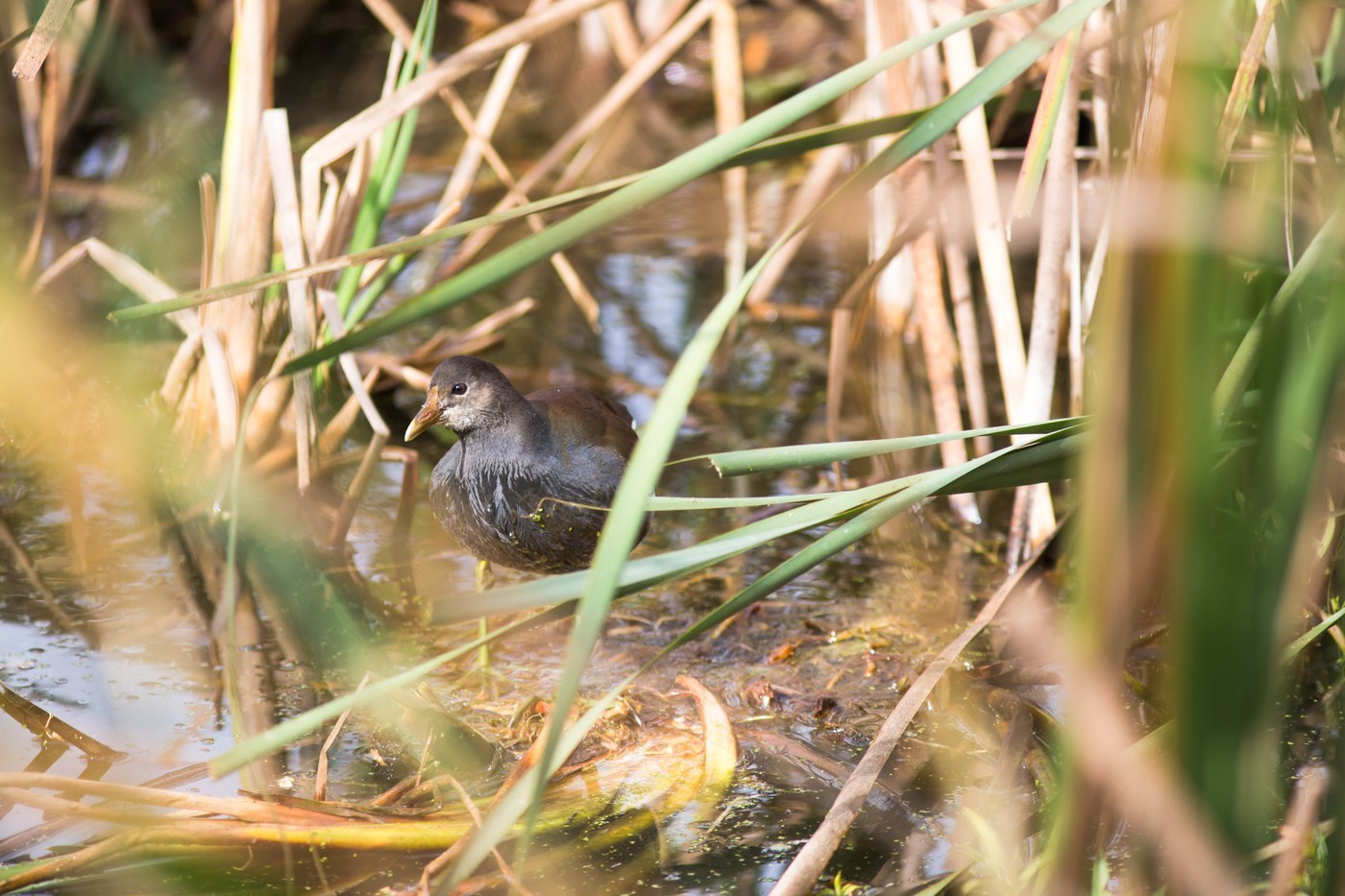
Key Field Marks
- Medium-sized waterbird (about 32–37 cm) with an overall slate-gray to blackish body and browner wings and back
- Bright red frontal shield extending onto the base of the bill, with the bill tip yellow
- A white stripe runs along each flank, and the undertail coverts are white split by a black central stripe, often flicked and flashed while swimming
- Long, greenish-yellow legs with a reddish "garter" band above the leg joint (visible at close range)
How to Tell It Apart from Similar Species
- American Coot: overall uniformly dark slate-gray to blackish with no brown tones, a white (not red-and-yellow) bill with a dark subterminal band, no white flank stripe, and lobed (not simply long) toes; coots also tend to favor more open water
- Purple Gallinule: unmistakably different once seen well — bright purple-blue head and underparts, greenish back, and a pale powder-blue frontal shield rather than red
Habitat, Range & Season
- Found throughout much of the Americas, from the southern United States and Canada border areas south through Central America to Argentina
- Inhabits freshwater marshes, ponds, and lake edges with dense emergent or floating vegetation such as cattails and lily pads
- Northern populations are migratory, moving south for winter; populations in warmer regions are largely resident
Voice
- Loud, harsh cackling, squawking, and whinnying calls, often given from cover within marsh vegetation
Behavior Notes
- Swims with a distinctive jerky, head-bobbing motion and frequently pumps its tail, flashing the white undertail coverts
- Walks readily across floating vegetation using its long toes, and stays closer to cover than the more open-water-loving American Coot
- Note: this species was formerly lumped with the Old World Common Moorhen (Gallinula chloropus) before being split as a separate species
Frequently asked questions
How do I tell a Common Gallinule from an American Coot?
Look at the bill and flanks: Common Gallinule has a red bill shield with a yellow tip and a white stripe along the flank, while American Coot has an all-white bill with a dark band near the tip and no white flank stripe.
Is Common Gallinule the same bird as Common Moorhen?
They were once considered the same species. The American populations were split off as Common Gallinule (Gallinula galeata), while Common Moorhen (Gallinula chloropus) now refers to the Old World populations.
What habitat does the Common Gallinule prefer?
Freshwater marshes, ponds, and lake edges with dense vegetation like cattails and lily pads, where it stays closer to cover than open-water species such as coots.
What does a Common Gallinule sound like?
It gives loud, harsh cackling, squawking, and whinnying calls, often from within dense marsh vegetation even when the bird itself is hidden from view.
Common Gallinule identified by the community
Recent Common Gallinule sightings identified with Bird Identifier.