
Common Eider Identification Guide
A large, bulky North Atlantic and Arctic sea duck immediately recognized by its wedge-shaped head profile that blends the sloping forehead smoothly into the long bill.
Read the full Common Eider encyclopedia entry →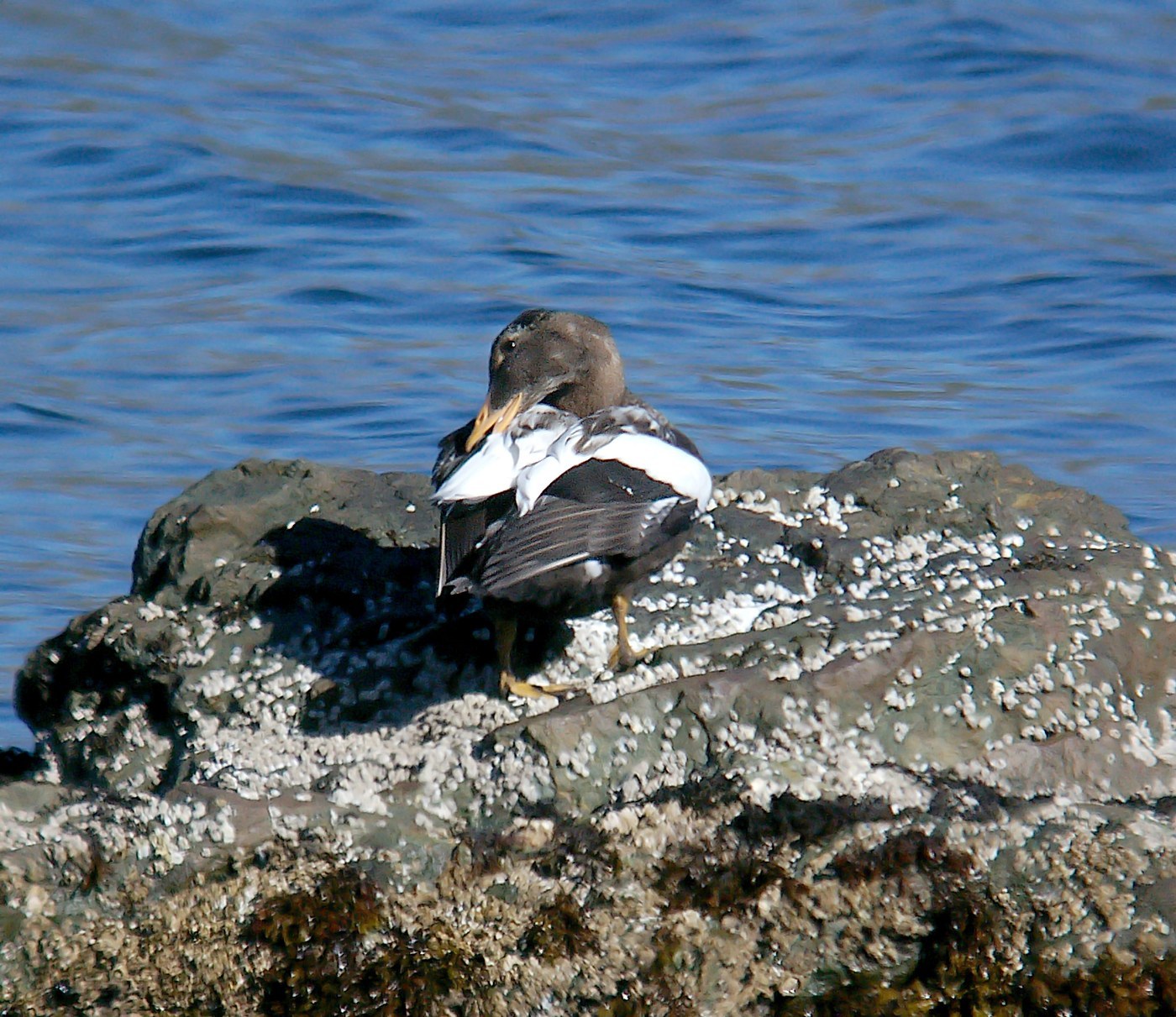
Key Field Marks
- Large, heavy-bodied sea duck (about 50–71 cm), the biggest duck species found across much of the Northern Hemisphere
- Distinctive wedge-shaped head and bill profile: the forehead slopes evenly down into the long bill with no break, unlike most other ducks — present in both sexes and the single best identification feature
- Male: mostly white back, breast, and neck; black belly and flanks; black crown split by a white forehead stripe; pale green wash on the nape
- Female: warm brown plumage finely barred all over, but retains the same diagnostic sloping head/bill shape as the male
How to Tell It Apart from Similar Species
- King Eider: male shows an orange knob at the base of the bill and a black V-shaped mark on the throat, with a more rounded (not sloping) forehead; female King Eider has a more rounded head profile, a shorter bill, and crescent-shaped (rather than straight) barring on the flanks
- Scoters (Black, Surf, White-winged): lack the wedge-shaped head/bill profile entirely, and have a much more rounded head with a distinctly separate bill
Habitat, Range & Season
- Found along coasts of the North Atlantic and Arctic Ocean, including northern Europe, Greenland, northeastern North America, and Arctic Siberia
- Breeds on coastal islands, rocky shorelines, and tundra near the sea
- Winters offshore in large rafts, often just beyond the surf zone
Voice
- Males give a distinctive, far-carrying crooning "ah-ooo" call, especially during courtship displays
- Females give lower, growling or grunting calls
Behavior Notes
- Dives to feed on mussels and other mollusks, which it swallows whole and crushes in its gizzard
- Highly social, forming large flocks and rafts near shore, especially in winter
- Flies low over the water in long lines, often just above the wave tops
Frequently asked questions
What is the single best way to identify a Common Eider?
Look at the head and bill profile — the forehead slopes smoothly and continuously into a long bill with no break or dip, creating a distinctive wedge shape found in both males and females.
How do I tell Common Eider from King Eider?
Common Eider has a smoothly sloping forehead-to-bill profile, while King Eider has a more rounded forehead and, in males, an orange knob at the base of the bill; female King Eiders also show crescent-shaped flank barring versus straight barring in Common Eider.
What does a Common Eider sound like?
Males give a distinctive, soft crooning "ah-ooo" call during courtship, one of the more recognizable duck calls along northern coasts.
Where can I find Common Eiders?
They live along North Atlantic and Arctic coastlines, nesting on coastal islands and tundra and wintering offshore in large rafts, often visible from headlands and coastal viewpoints.