
Common Cuckoo Identification Guide
A slender, hawk-shaped brood parasite of Europe and Asia, best known for the male's unmistakable two-note "cuck-oo" call and its barred underparts that mimic a sparrowhawk.
Read the full Common Cuckoo encyclopedia entry →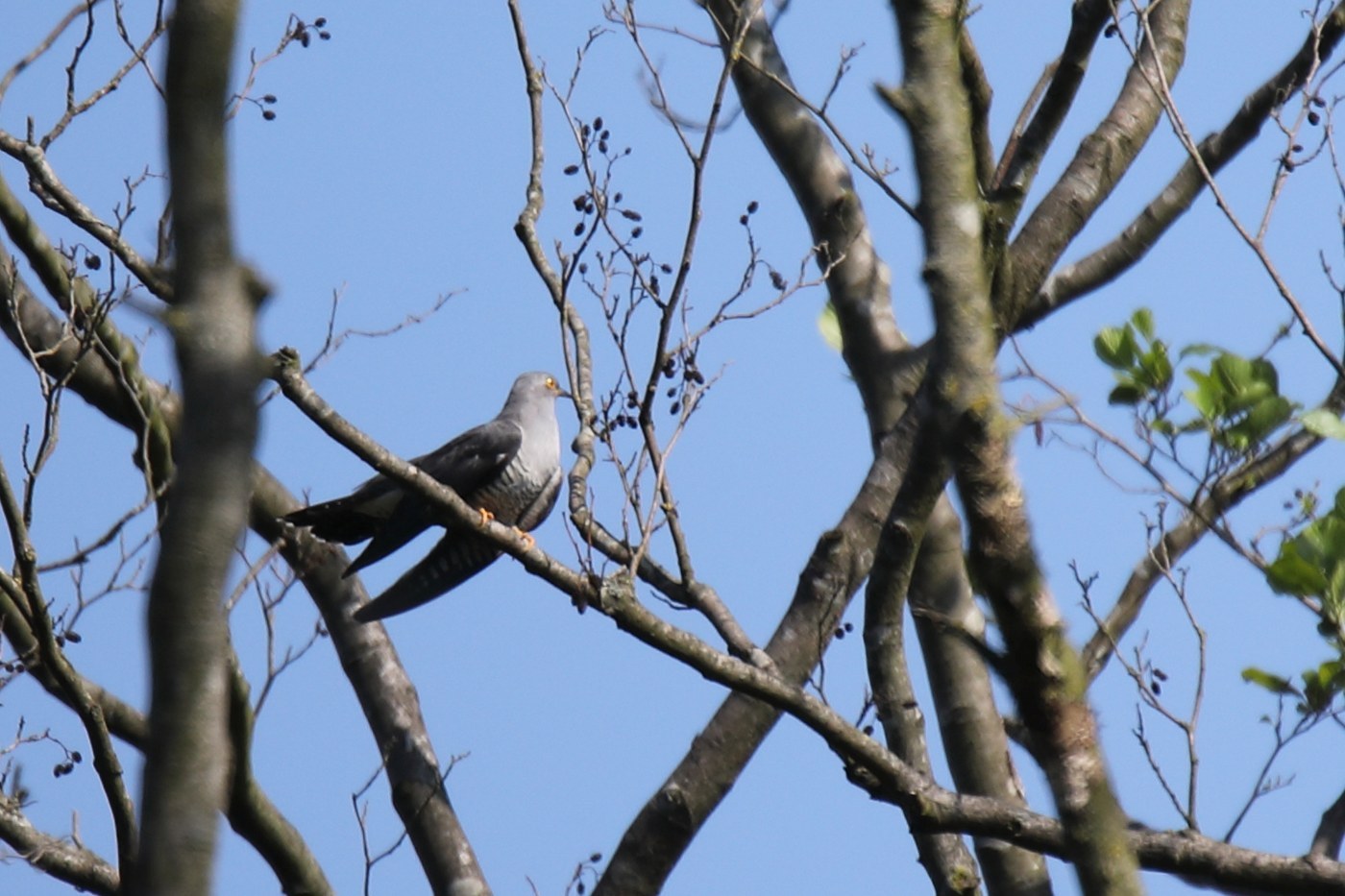
Key Field Marks
- Medium-sized (about 32–34 cm), slender-bodied bird with long, pointed wings and a long tail, giving a hawk- or falcon-like silhouette in flight
- Adult male and gray-morph female: blue-gray head, throat, and upperparts, with fine dark barring across white underparts; yellow eye-ring and yellow legs
- Rufous (hepatic) morph female: rufous-brown with barring over the entire body, lacking the gray head and throat
- Flight is direct with shallow, rapid wingbeats interspersed with glides on flat or slightly drooped wings
How to Tell It Apart from Similar Species
- Eurasian Sparrowhawk: the cuckoo's barred underparts closely mimic a sparrowhawk's plumage, which is thought to help reduce mobbing by potential host species. Distinguish them by wing shape — the cuckoo has longer, more pointed wings and a slimmer body, while the sparrowhawk has shorter, rounded wings and a stockier build with a hooked bill
- Oriental Cuckoo: very similar in appearance; best separated by voice (a distinctive hollow four-note call rather than the two-note "cuck-oo") and by finer details of underpart barring, along with range
Habitat, Range & Season
- Breeds across nearly all of Europe and much of temperate Asia, in woodland edge, reedbeds, farmland, heath, and moorland — wherever suitable host species are found
- Winters in sub-Saharan Africa
- A summer visitor to its breeding range, typically arriving in spring
Voice
- The male's far-carrying, two-note "cuck-oo" call is one of the most recognizable bird sounds in Europe and gives the species its name
- The female gives a distinctive bubbling, chuckling call, quite different from the male's call
Behavior Notes
- A brood parasite: females lay eggs singly in the nests of host species such as warblers, pipits, and dunnocks, and the hatchling ejects the host's own eggs or chicks
- Often mobbed by small songbirds due to its sparrowhawk-like appearance
Frequently asked questions
Why does the Common Cuckoo look like a bird of prey?
Its gray upperparts and finely barred white underparts closely resemble a Eurasian Sparrowhawk, which is thought to help distract or intimidate potential host birds while the female cuckoo searches for nests to parasitize.
How do I tell a Common Cuckoo from a Sparrowhawk in flight?
Cuckoos have longer, more pointed wings and a slimmer, more streamlined body with shallow, rapid wingbeats, while sparrowhawks have shorter, rounded wings, a stockier build, and a more powerful, bounding flight.
What does the Common Cuckoo's call sound like?
The male gives the familiar, far-carrying two-note "cuck-oo" call; the female instead gives a bubbling, chuckling call that sounds quite different.
Does the Common Cuckoo build its own nest?
No, it is a brood parasite — the female lays her eggs in the nests of host species like warblers, pipits, and dunnocks, which then raise the cuckoo chick.