
Common Crane Identification Guide
A towering gray Eurasian crane with a red crown patch, black-and-white striped neck, and a bushy tertial bustle, best known for its far-carrying bugling calls in migrating flocks.
Read the full Common Crane encyclopedia entry →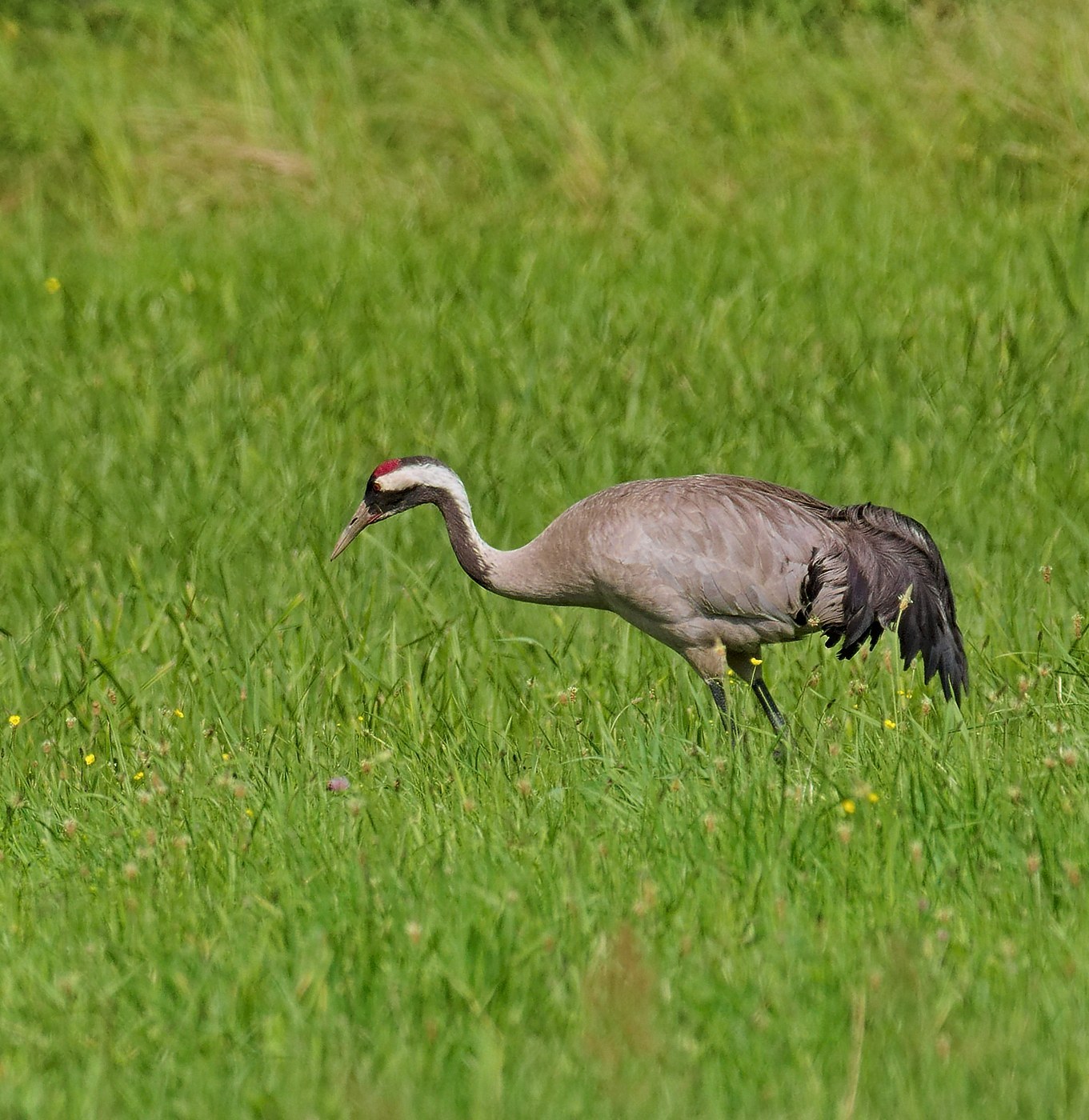
Key Field Marks
- Very large bird, standing about 110–130 cm tall, with a long neck and long legs
- Overall slate-gray body plumage; black primary (flight) feathers
- Bold black-and-white pattern on the head and neck, with a white stripe running from behind the eye down the side of the neck
- A small bare red patch on the crown, visible at close range on adults
- Distinctive bushy, curved tertial feathers that droop over the tail forming a puffy "bustle" — very useful for silhouette identification even at a distance
How to Tell It Apart from Similar Species
- Grey Heron: superficially similar in gray coloration and long legs/neck, but a heron flies with its neck folded back in an S-shape, while cranes fly with the neck fully extended straight out; herons also lack the crane's bustle and red crown patch
- Demoiselle Crane: smaller and more uniformly gray, lacks the red crown patch entirely, and instead shows long white plume feathers trailing behind the eye
- Sandhill Crane (North America, not normally range-overlapping): tends to show browner or rust-stained plumage from preening with iron-rich mud, and its bare red skin is confined mostly to the forecrown rather than being a more rounded crown patch
Habitat, Range & Season
- Breeds in northern and eastern Europe and across much of northern Asia, in bogs, wet meadows, and taiga wetlands
- Winters in the Iberian Peninsula, North Africa, and parts of East Asia
- Migrates in large, often very vocal flocks, typically flying in long lines or V-formations
Voice
- Loud, far-carrying, trumpeting or bugling "krooh" calls, frequently given in flight and by flocks at stopover sites, audible from great distances
Behavior Notes
- Forages in fields and wetlands for grain, roots, invertebrates, and small animals
- Performs elaborate, energetic dancing displays involving leaping, wing-spreading, and bowing, especially during pair formation
Frequently asked questions
How do I tell a Common Crane from a Grey Heron at a distance?
Look at flight posture: cranes fly with the neck fully outstretched, while herons fold their neck back into an S-shape. Cranes also show a bushy tertial bustle over the tail and a red crown patch that herons lack.
What is the bustle on a Common Crane?
It refers to the bushy, curved tertial feathers that droop over the tail, giving the bird a distinctive puffy rear end — a useful silhouette clue even when other details aren't visible.
Where can I see large flocks of Common Cranes?
Major migration stopover and wintering sites include parts of Iberia, North Africa, and staging areas in central and eastern Europe, where flocks gather in fields and wetlands.
What does a Common Crane sound like?
A loud, far-carrying trumpeting or bugling call, often given repeatedly by flocks in flight and audible from a long distance.