
Common Black Hawk Identification Guide
A stocky, broad-winged raptor of streams and rivers, told from vultures and other hawks by its all-black body, single broad white tail band, and yellow legs.
Read the full Common Black Hawk encyclopedia entry →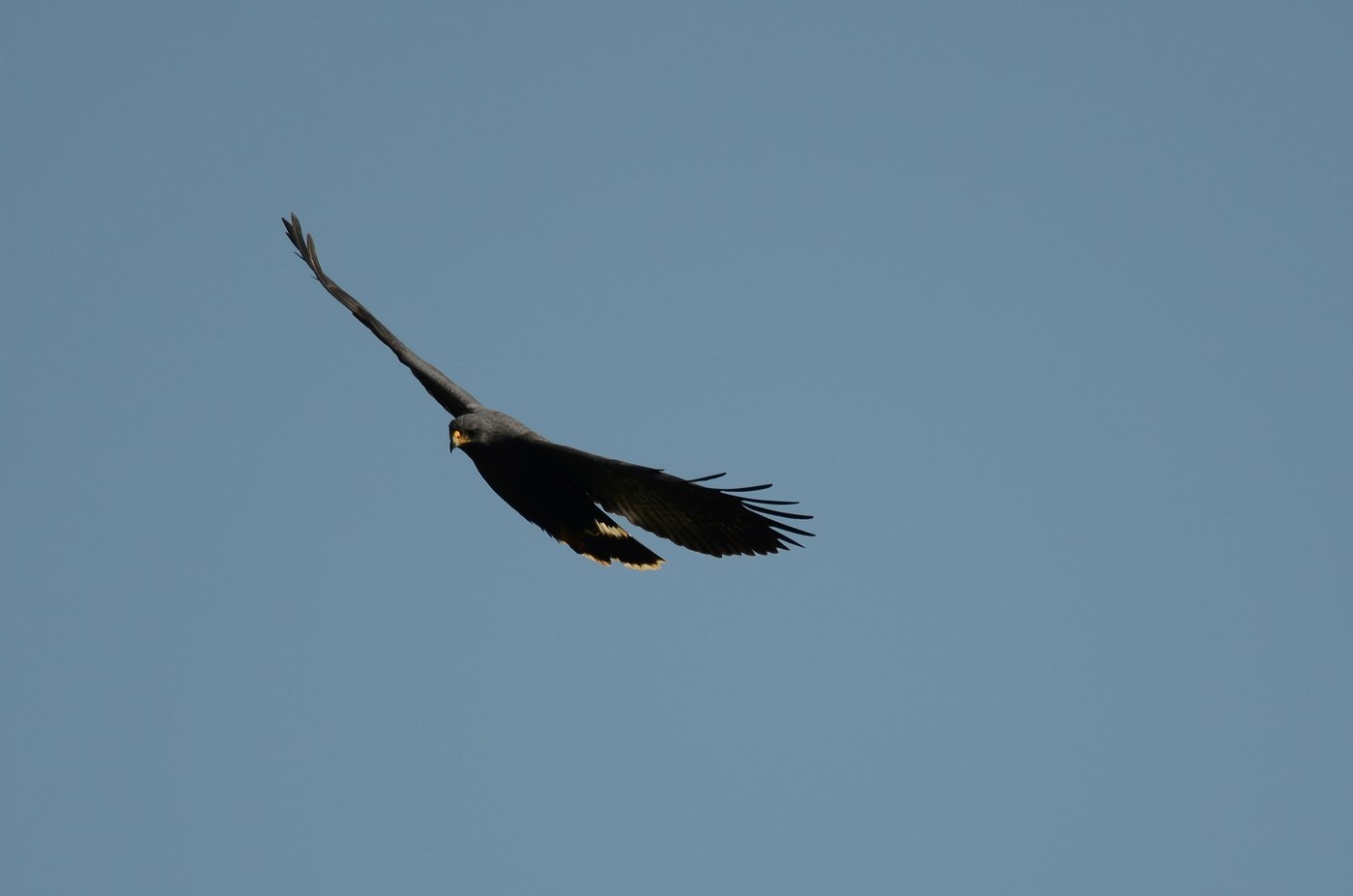
Key Field Marks
- Large, heavy-bodied buteo-like hawk (about 53 cm) with notably broad, rounded wings and a short tail
- Adult: overall sooty black body and wing coverts, a single broad white band across an otherwise black tail, bright yellow legs, cere, and lores
- In flight, wings are held flat (not raised in a dihedral), and the wingbeats are slow and heavy, almost vulture-like in silhouette
- Juvenile: brown overall with heavy dark streaking below, a boldly banded tail (multiple narrow bands rather than one broad one), and a pale face — best identified by structure (broad wings, short tail) and riverine habitat rather than plumage alone
How to Tell It Apart from Similar Species
- Turkey Vulture: has a small, bare red (adult) head, holds its wings in a strong dihedral, teeters unsteadily in flight, and shows a two-toned silvery-and-black underwing rather than solid black
- Zone-tailed Hawk: also glides in a dihedral and teeters like a Turkey Vulture (a mimicry strategy), but shows several narrow white tail bands (not one broad band) and grayish flight feathers with dark barring
- Black Vulture: has a short, square (not fan-shaped) tail, pale patches at the wingtips only, a bare gray head, and lacks yellow legs
Habitat, Range & Season
- Found along permanent rivers, streams, and wetlands with adjacent trees, from the southwestern United States (Arizona, New Mexico, Texas) south through Mexico and Central America to northern South America
- The small U.S. population is migratory, arriving in spring and departing by early fall; birds farther south are largely resident
Voice
- A loud series of shrill, whistled notes, often rendered as "kleee-kleee-kleee," given especially near the nest or in territorial disputes
Behavior Notes
- Hunts fish, crabs, frogs, and other prey by watching from a low perch over water or wading in shallows
- Strongly tied to riparian corridors; rarely found far from water
Frequently asked questions
How can I tell a Common Black Hawk from a Turkey Vulture?
Common Black Hawk flies with flat wings and steady wingbeats and has a bare-skinned yellow face with a solid black body, while Turkey Vulture holds its wings in a strong V, teeters unsteadily, and has a small bare red head with two-toned underwings.
What's the difference between Common Black Hawk and Zone-tailed Hawk?
Common Black Hawk has one broad white tail band and flies with flat wings, whereas Zone-tailed Hawk has several narrow white tail bands and mimics a Turkey Vulture's dihedral, teetering flight.
Where is the best habitat to find Common Black Hawk?
Look along wooded rivers and streams, especially in the desert Southwest of the U.S. and through Mexico and Central America — it is rarely seen away from water.
Is the Common Black Hawk a migratory bird?
The small breeding population in the southwestern United States migrates south for winter, while populations farther south in Mexico, Central America, and South America are largely year-round residents.