
Collared Aracari Identification Guide
A small, boldly patterned toucan of Central American forests, identified by its black head, chestnut nape collar, red rump, and large pale bicolored bill with a black-toothed cutting edge.
Read the full Collared Aracari encyclopedia entry →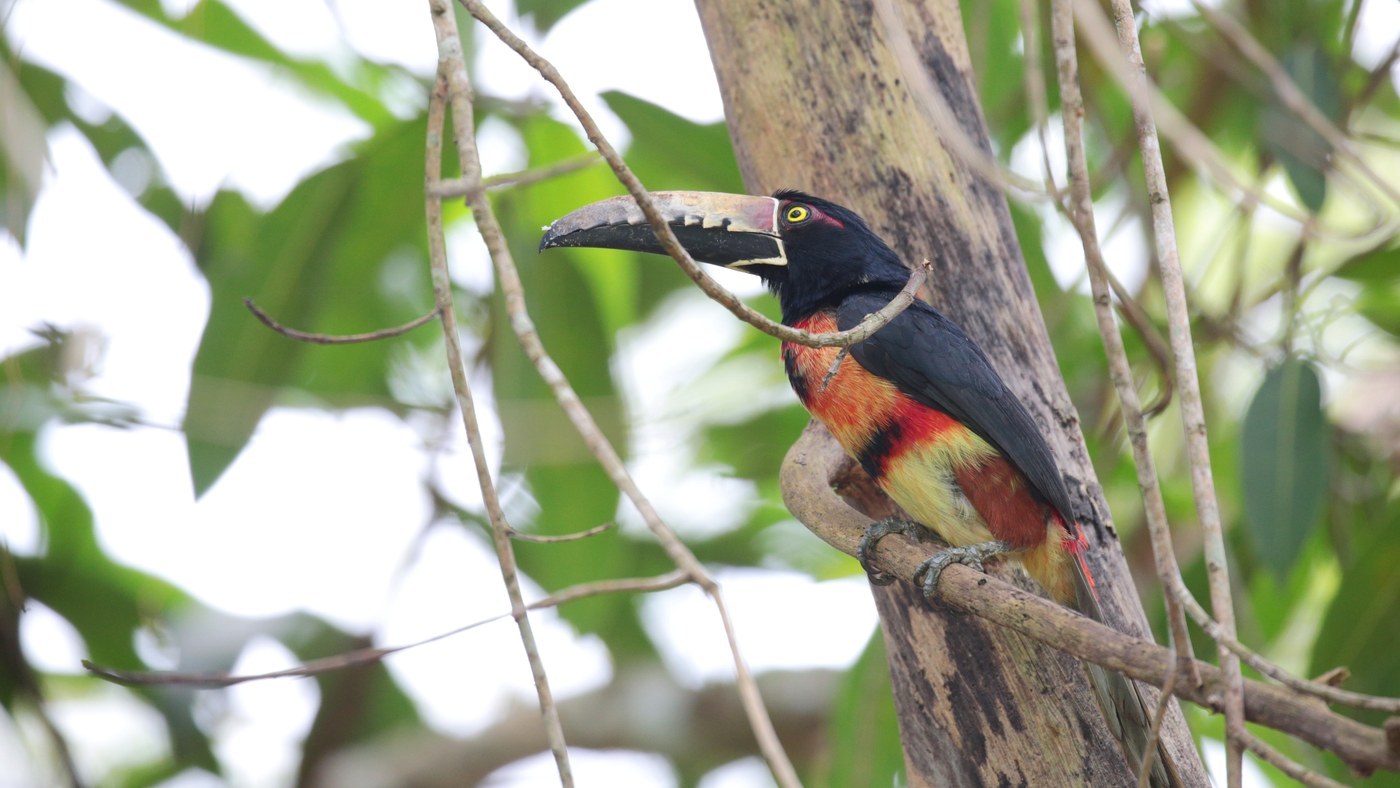
Key Field Marks
- Size & shape: A small toucan (about 41-46 cm, including a proportionally large bill) with a slim body and long tail relative to its bulkier toucan relatives.
- Head & bill: Black head and throat, with a large, laterally flattened bill that is mostly pale yellowish-horn (maxilla) with a black culmen ridge, a black spot near the base, and a black-serrated cutting edge, while the lower mandible (mandible) is mostly black.
- Collar & body: A narrow chestnut-brown band across the nape/hindneck gives the species its name; the back and wings are glossy green-black, and there's a red rump patch visible especially in flight or when perched with wings folded.
- Underparts: Bright yellow with a black band/patch across the belly and a broken red band lower on the belly — the exact pattern of black and red spotting/banding on the yellow underparts is useful for confirming species among aracaris.
- Eye: Pale, whitish to yellow eye set in bare, colorful facial skin, contrasting with the black head.
Separating It From Similar Species
- Fiery-billed Aracari: Found further south and west (Pacific slope of Costa Rica and western Panama) and shows a mostly orange-red to reddish maxilla rather than the pale yellowish bill with black markings of Collared Aracari; ranges are largely separate (parapatric) with limited overlap.
- Other aracaris/toucans: Larger toucans (e.g., Keel-billed Toucan) are noticeably bulkier with far more colorful, multi-hued bills and lack the chestnut nape collar; smaller toucanets lack the bold yellow underparts with black/red banding.
Habitat, Range & Season
- Resident from southern Mexico through Central America (Belize, Guatemala, Honduras, Nicaragua, Costa Rica, Panama) into northwestern Colombia.
- Inhabits humid lowland and foothill forest, forest edge, secondary growth, and semi-open areas with scattered fruiting trees, generally below about 1,200-1,600 m elevation.
- Non-migratory; resident year-round throughout its range.
- Highly social, typically encountered in small noisy flocks of half a dozen or more moving through the canopy and forest edge, often visiting fruiting trees.
Voice
- Calls are sharp, squeaky, high-pitched notes — often rendered as a repeated "pseek" or "sik" — quite different from the deeper croaks of larger toucans; flocks are often located by their persistent calling as they move through the canopy.
Frequently asked questions
How do I identify a Collared Aracari?
Look for a black head, a chestnut band across the nape, yellow underparts crossed by black and red bands, a red rump, and a large pale yellowish bill marked with black along the ridge and base.
How is Collared Aracari different from Fiery-billed Aracari?
Fiery-billed Aracari has a mostly orange-red bill and occurs on the Pacific slope of Costa Rica and western Panama, while Collared Aracari has a pale yellowish bill with black markings and a broader, more northerly range.
What habitat does the Collared Aracari live in?
Humid lowland and foothill forest, forest edges, and semi-open areas with fruiting trees, from southern Mexico through Central America to northwestern Colombia.
Do Collared Aracaris travel in flocks?
Yes, they are highly social and usually seen in small, noisy flocks moving through the forest canopy, often drawn to fruiting trees.