
Cocoi Heron Identification Guide
South America's largest heron and counterpart to the Great Blue Heron, distinguished by its crisp white head and neck set against a black cap, black flanks, and gray body.
Read the full Cocoi Heron encyclopedia entry →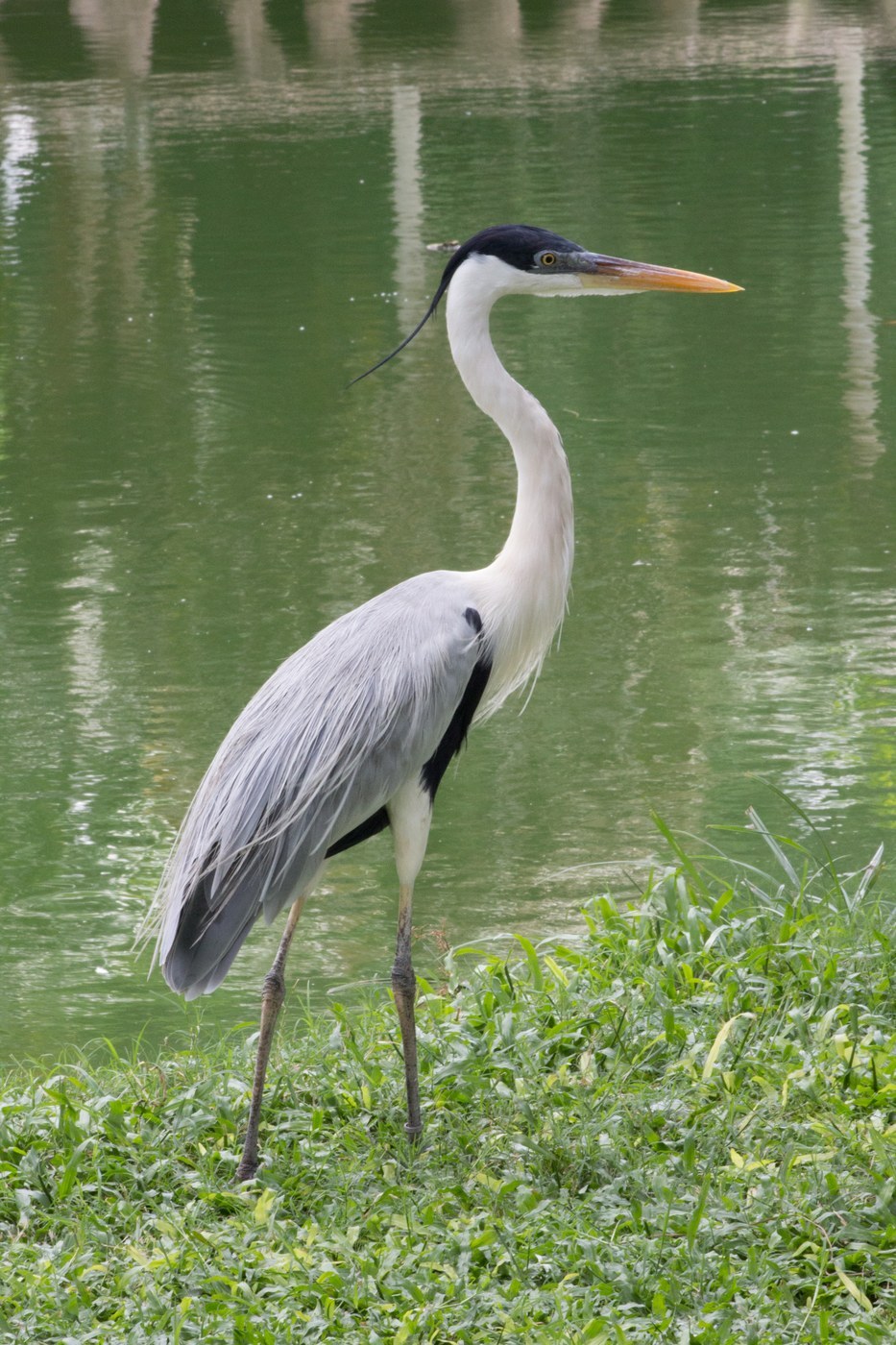
Key Field Marks
- Size & shape: A very large heron (95-127 cm) with the classic long-legged, long-necked, dagger-billed heron silhouette; among the largest herons in the Americas.
- Head & neck: Gleaming white crown and face bordered by a black cap that extends into long black plumes trailing off the back of the head; the foreneck is white, often with fine dark streaking down the front.
- Body: Blue-gray back and wings, with contrasting black flanks and thighs and a whitish belly — a much more strongly patterned, higher-contrast look than the more uniformly gray Great Blue Heron.
- Bill & legs: Long, heavy, yellowish bill (duskier at the tip in some individuals) and long grayish-black legs.
- Behavior: A patient, solitary stand-and-wait hunter along water edges, spearing fish, amphibians, and other prey with a rapid strike; often seen standing motionless in shallow water or flying with slow, deep wingbeats and a folded S-shaped neck typical of herons.
Separating It From Similar Species
- Great Blue Heron: Cocoi Heron is essentially the South American ecological equivalent, but shows a cleaner white face/foreneck, more sharply defined black cap and flanks, and an overall crisper black-and-white-and-gray pattern versus the more uniformly grayish-brown, less contrasty Great Blue Heron (rare as a vagrant/winterer in northern South America but generally allopatric).
- Whistling Heron: Much smaller, plumper, buffier overall, with a short thick bill and blue facial skin — a very different overall impression.
- Great Egret: All white, with no gray body or black cap, and a more slender build.
Habitat, Range & Season
- Widespread and common throughout most of South America, from Colombia and Venezuela south to Tierra del Fuego, and on the Galápagos and other offshore islands.
- Found in a wide range of wetland habitats: rivers, lake edges, marshes, mangroves, flooded fields, estuaries, and coastal mudflats, from lowlands well up into montane wetlands.
- Largely resident, though some local or altitudinal movements occur in response to water levels and season.
Voice
- Gives deep, harsh croaking and guttural squawks, especially when flushed or at breeding colonies, generally similar in tone to other large herons.
Frequently asked questions
What is the best way to tell Cocoi Heron from Great Blue Heron?
Cocoi Heron shows a cleaner white head and foreneck with a more sharply defined black cap and black flanks, giving a crisper, higher-contrast look than the more uniformly gray-brown Great Blue Heron; the two also occupy largely separate ranges.
Where does the Cocoi Heron live?
Throughout most of South America, from Colombia and Venezuela south to Tierra del Fuego, in a wide range of freshwater and coastal wetlands.
How big is a Cocoi Heron?
It is one of the largest herons in the Americas, standing up to about 1.1-1.3 meters tall with a long neck and legs typical of the heron family.
How does a Cocoi Heron hunt?
Like most large herons, it stands motionless or wades slowly in shallow water, then strikes rapidly with its long bill to spear fish, amphibians, and other small aquatic prey.