
Coal Tit Identification Guide
A tiny woodland tit of Eurasia identified by its black head and bib set off by white cheeks and a distinctive white patch on the back of the neck, lacking any yellow in the plumage.
Read the full Coal Tit encyclopedia entry →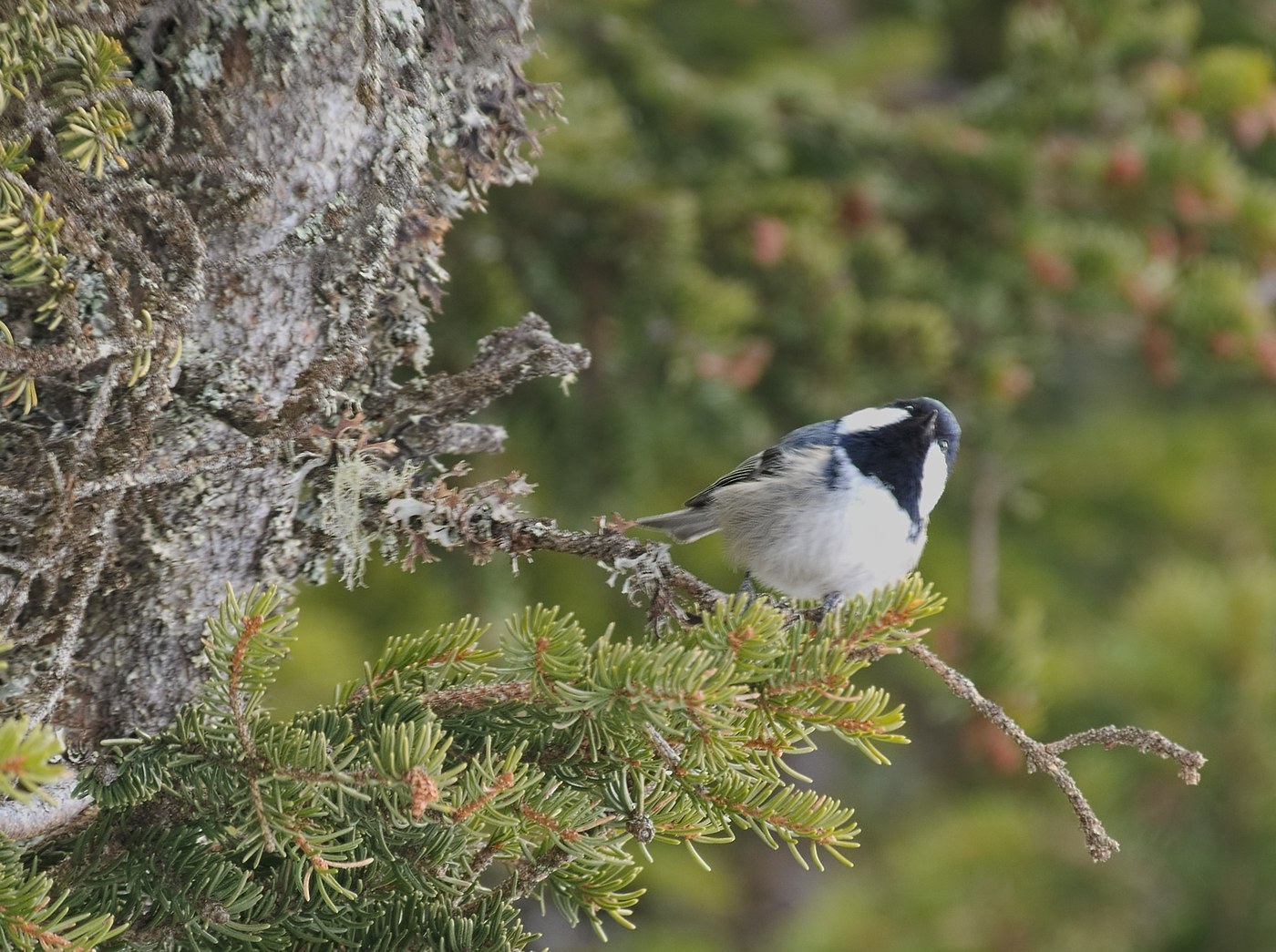
Key Field Marks
- Size & shape: One of the smallest tits (10-11.5 cm), with a fairly large head, short tail, and a fine, narrow bill well suited to extracting seeds from conifer cones.
- Head pattern: Glossy black cap and bib contrasting with white cheeks, and a diagnostic white patch on the nape (back of the neck) — visible from behind and a quick way to rule out other black-capped tits.
- Body plumage: Olive-gray to buffy-brown upperparts and pale buffy underparts, with no yellow anywhere in the plumage — a useful distinction from Great Tit and Blue Tit.
- Wings: Shows two thin whitish wing bars.
- Behavior: Active and acrobatic, often feeding high in conifers, frequently hovering briefly at branch tips or cone clusters; readily joins mixed tit flocks in winter.
Separating It From Similar Species
- Marsh Tit / Willow Tit: Both lack the white nape patch and any wing bars, and their black caps are duller/matte rather than glossy; Coal Tit's white nape spot is the clearest distinguishing mark.
- Great Tit: Much larger, with bright yellow underparts and a black central breast stripe — easily separated by size and color alone.
- Blue Tit: Has a blue cap and yellow underparts, entirely different color scheme from the black-and-white-and-buff Coal Tit.
Habitat, Range & Season
- Widespread resident across Europe, and temperate Asia, strongly associated with coniferous and mixed woodland (pine, spruce, fir), though also found in broadleaf woodland, parks, and gardens, especially where conifers are present.
- Non-migratory across most of its range, though northern populations may show irruptive movements southward in years of poor cone crops.
- Regular visitor to garden bird feeders, especially for sunflower seeds, which it often carries off to cache.
Voice
- Song is a thin, high-pitched, repetitive "see-see, see-see" or "if-he, if-he," similar in rhythm to Great Tit's "teacher-teacher" song but noticeably higher-pitched, faster, and more piping.
- Calls include a thin, high "tsee" contact note.
Frequently asked questions
What is the easiest field mark to identify a Coal Tit?
A bold white patch on the back of the neck (nape), combined with a glossy black cap and bib, white cheeks, and no yellow anywhere in the plumage.
How is Coal Tit different from Marsh Tit and Willow Tit?
Coal Tit has a distinctive white nape patch and wing bars that both Marsh Tit and Willow Tit lack; those two species also have duller, matte black caps rather than Coal Tit's glossy black.
What habitat is best for finding Coal Tits?
Coniferous and mixed woodland with pine, spruce, or fir is prime habitat, though they also use broadleaf woods, parks, and gardens with conifers present.
Does Coal Tit visit garden feeders?
Yes, it regularly visits feeders for sunflower seeds and often caches surplus food for later, a common habit among tits.