
Clay-colored Sparrow Identification Guide
A small, pale prairie sparrow known for its crisp facial pattern — a broad gray-buff nape and a brown cheek patch outlined in dark lines — paired with an unstreaked buffy breast.
Read the full Clay-colored Sparrow encyclopedia entry →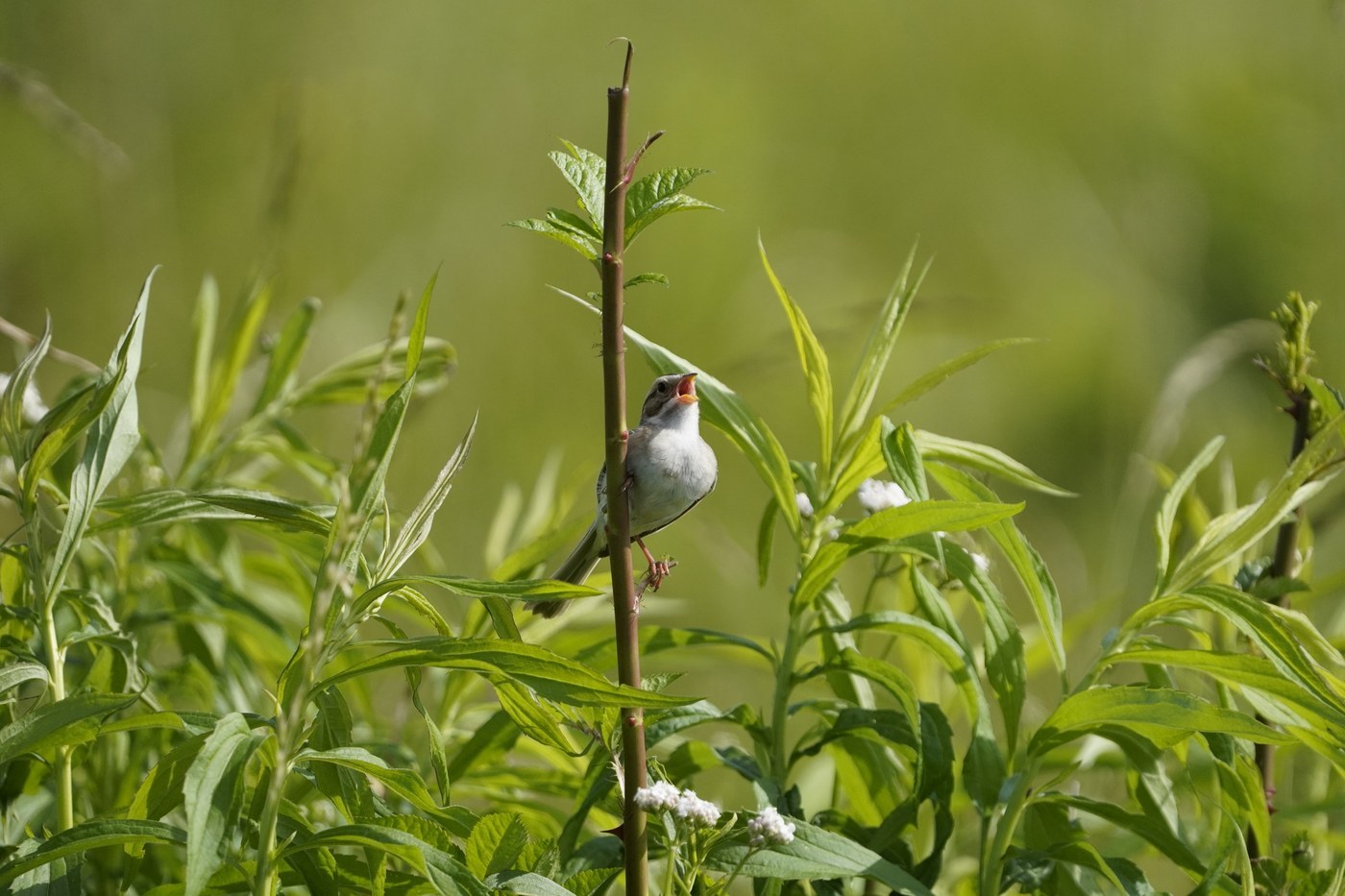
Key Field Marks
- Size & shape: A small, slim sparrow (about 13 cm) with a fairly plain, buffy-brown appearance and a small, pinkish, conical bill.
- Head pattern: Crisp and distinctive — a pale central crown stripe between darker brown lateral crown stripes, a broad, plain grayish or buffy-gray nape/collar that stands out from the streaked back, a brown cheek (auricular) patch outlined above by a dark postocular stripe and below by a dark malar/mustachial stripe, and a pale eyebrow.
- Underparts: Clean, unstreaked buffy-gray breast and whitish belly — no breast streaking, which helps rule out many other sparrows.
- Upperparts: Brown, crisply streaked with black on the back; overall a "clean," well-defined look compared to the smudgier pattern of similar species.
Separating It From Similar Species
- Chipping Sparrow: Breeding Chipping Sparrow shows a bright rufous cap and a black eyeline running through the eye to the bill, plus a gray (not buffy) unstreaked nape; Clay-colored Sparrow's cap is brown-and-buff striped, not solid rufous, and its face pattern is more sharply outlined.
- Brewer's Sparrow: Paler and plainer overall, with a finely streaked crown lacking a strong pale central stripe, a less contrasting face pattern, and a plainer, less boldly outlined cheek patch; Brewer's favors sagebrush habitat farther west.
- Field Sparrow: Has a plain grayish face, pink bill, and a distinct white eye-ring, without the strong dark cheek outline of Clay-colored.
Habitat, Range & Season
- Breeds in brushy, shrubby grassland and prairie habitat — overgrown fields, shrubby edges, and low brush on the northern Great Plains and prairie provinces of the U.S. and Canada.
- A migrant through the central U.S., moving to winter in weedy fields, brushy grassland, and thorn scrub from Texas and Mexico south to Central America.
- Often found in loose flocks, sometimes mixed with other sparrows, during migration and winter.
Voice
- Song is a series of flat, insect-like buzzes — often described as several unmusical "zzz-zzz-zzz" buzzes given slowly in a row — quite different from the more musical trills of Chipping Sparrow.
Frequently asked questions
What is the best field mark for Clay-colored Sparrow?
A broad, plain gray-buff nape contrasting with a streaked back, combined with a brown cheek patch sharply outlined by dark lines and an unstreaked buffy breast.
How do I tell Clay-colored Sparrow from Chipping Sparrow?
Breeding Chipping Sparrow has a solid rufous cap and a black eyeline through the eye to the bill; Clay-colored Sparrow has a striped brown-and-buff crown and a more sharply outlined brown cheek patch, without the solid rufous cap.
What does a Clay-colored Sparrow sound like?
A slow series of flat, buzzy, insect-like notes — zzz-zzz-zzz — quite unmusical compared to the trilling song of a Chipping Sparrow.
Where does Clay-colored Sparrow breed?
In brushy prairie and shrubby grassland habitat across the northern Great Plains of the U.S. and the Canadian prairie provinces.