
Clark's Nutcracker Identification Guide
A pale gray, jay-sized corvid of high western mountains, easily known by its black-and-white wings and tail and its strong association with whitebark pine forests.
Read the full Clark's Nutcracker encyclopedia entry →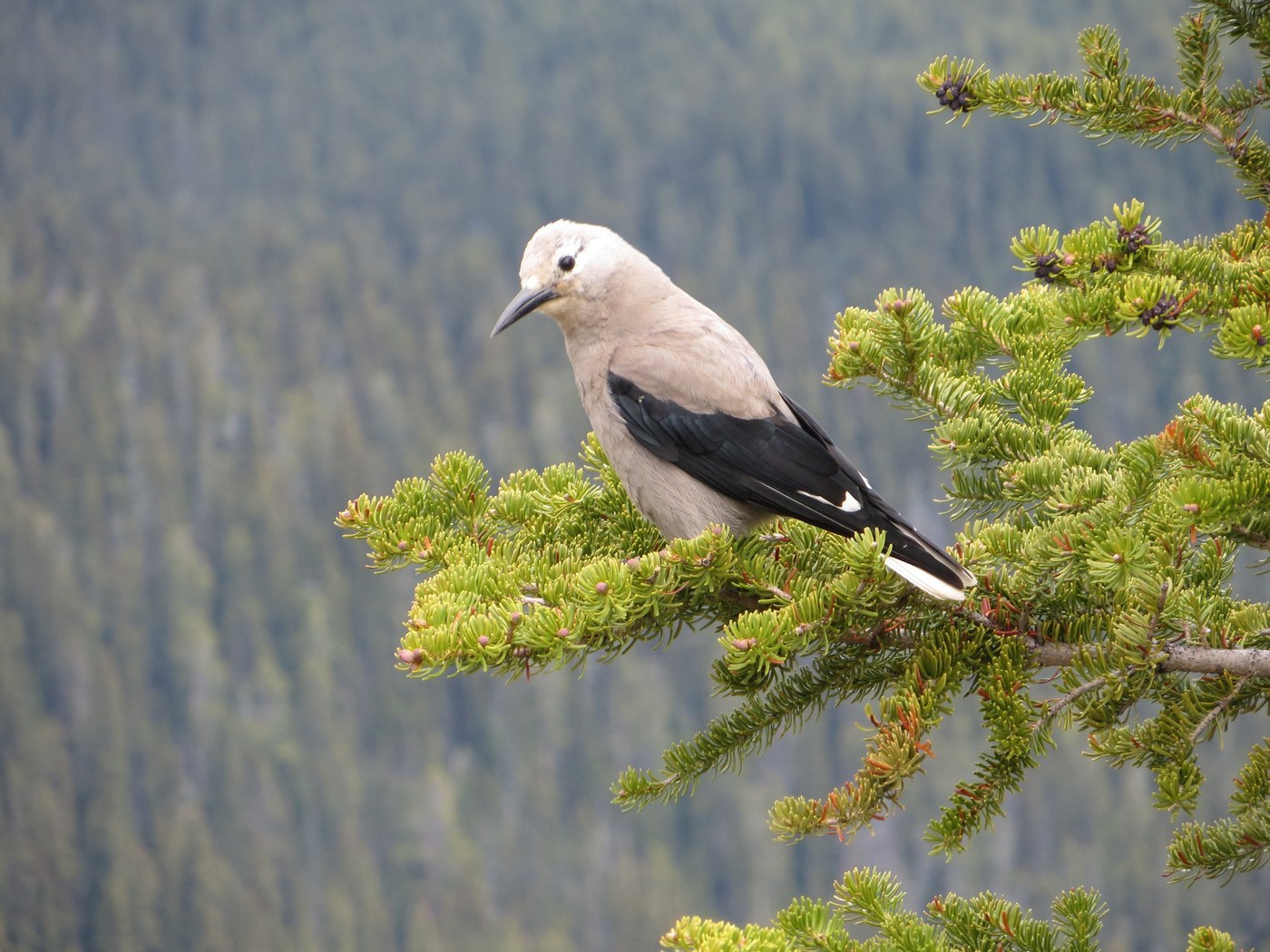
Key Field Marks
- Size & shape: A stocky, crow-like bird (28-30 cm) but slimmer than a true crow, with a long, straight, sharply pointed black bill adapted for prying seeds from conifer cones.
- Plumage: Overall soft pale gray body, with black wings showing a bold white trailing patch on the secondaries, and a black-and-white tail (white outer feathers, black center) — obvious in flight.
- Flight: Strong, direct, somewhat crow-like but with noticeably broader, more rounded wings; often flies long distances between foraging and caching sites.
- Behavior: Highly vocal and conspicuous, often seen perched atop conifers or flying across open mountain terrain; famous for caching tens of thousands of pine seeds each autumn in scattered locations, then relocating them by memory through winter — a key seed-dispersal partner for whitebark pine.
Separating It From Similar Species
- Gray Jay (Canada Jay): Smaller, fluffier, with an all-dark bill, no white in the wings, and a shorter tail; lacks the sharp black-and-white wing/tail pattern of the nutcracker.
- Pinyon Jay: Overall dull blue, not gray, with no black-and-white wing or tail pattern, and a shorter, less dagger-like bill; found in lower-elevation pinyon-juniper woodland rather than high subalpine forest.
- American Crow/Raven: Much larger and entirely black, with none of the pale gray body or white wing/tail markings.
Habitat, Range & Season
- Resident of high-elevation coniferous forests in the mountains of western North America, from British Columbia and Alberta south through the Rockies, Cascades, and Sierra Nevada to the southwestern U.S.
- Strongly tied to whitebark pine, limber pine, and other large-seeded pines near and above treeline; also found in mixed subalpine forest.
- Largely non-migratory, but will make irruptive movements to lower elevations in years of poor cone crops, sometimes appearing well outside typical range.
Voice
- A loud, harsh, grating "khaaa" or "kra-a-a" call, often repeated, audible over long distances across open mountain terrain — frequently the first clue to its presence before it is seen.
Frequently asked questions
What does a Clark's Nutcracker sound like?
A loud, harsh, grating khaaa or kra-a-a call, often repeated and carrying a long way across open mountain terrain.
Where is the best place to find a Clark's Nutcracker?
High-elevation subalpine forests in western mountain ranges, especially areas with whitebark or limber pine near or above treeline, from British Columbia south through the Rockies and Sierra Nevada.
How does Clark's Nutcracker differ from a Gray Jay?
Clark's Nutcracker is larger with a longer, sharp black bill and bold black-and-white wings and tail, while Gray Jay is smaller, fluffier-plumaged, and shows no black-and-white wing or tail pattern.
Why is Clark's Nutcracker important to whitebark pine forests?
It caches huge numbers of pine seeds each fall for winter food and forgets some of them, effectively planting new whitebark pine trees — making it a key seed disperser for the species.