
Clapper Rail Identification Guide
A large, secretive salt-marsh rail of the Atlantic and Gulf coasts, best known by its harsh clattering call and long, slightly downcurved bill.
Read the full Clapper Rail encyclopedia entry →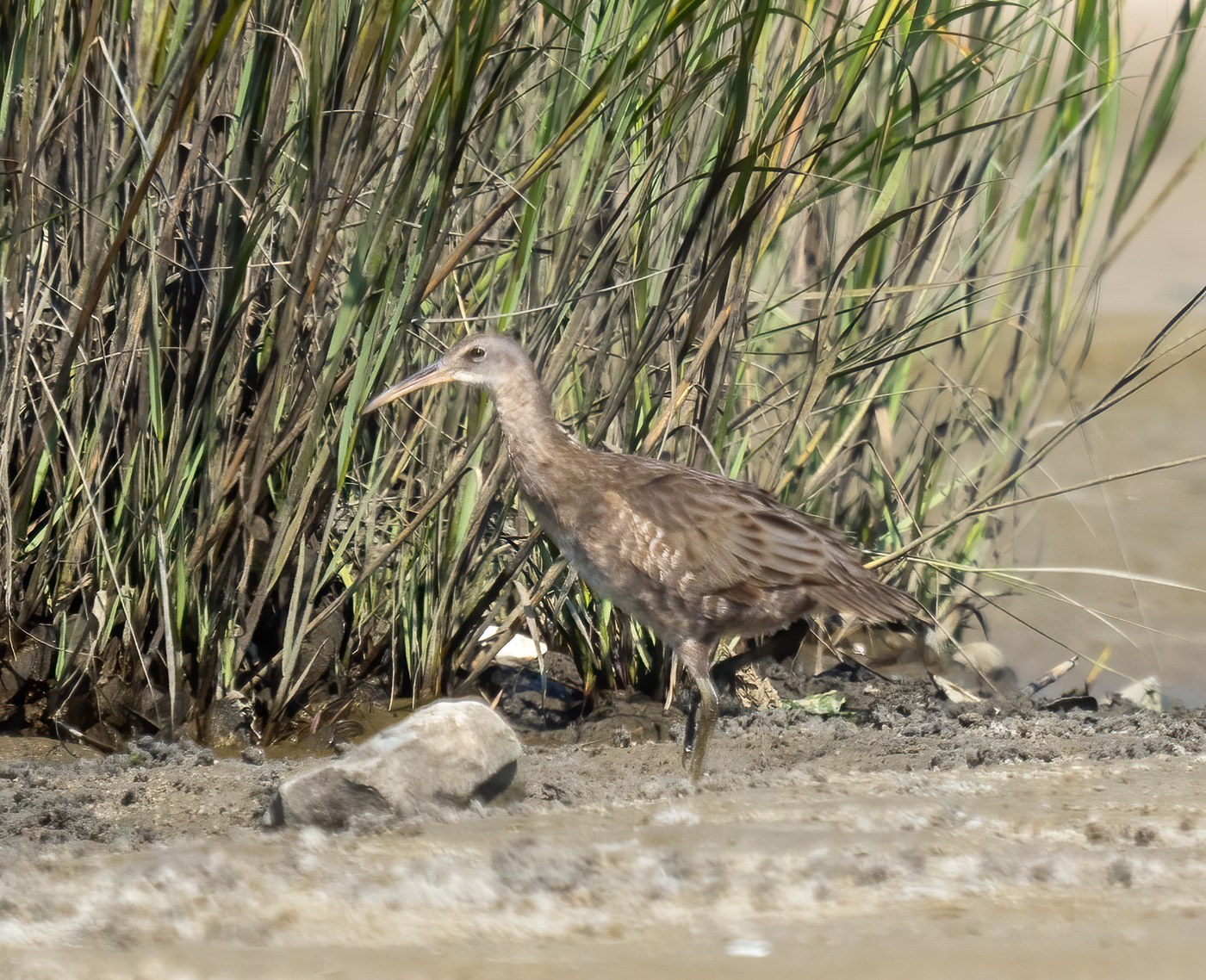
Key Field Marks
- Size & shape: A chicken-sized rail (32-41 cm) with a plump, laterally compressed body, long legs, a short cocked-up tail, and a long, slightly downcurved orange-based bill.
- Plumage: Overall dull grayish-brown to olive-brown above, with grayish or buffy-brown underparts (much less richly colored than King Rail); flanks are barred black-and-white, and the undertail coverts are white and often flicked while walking.
- Behavior: Extremely secretive, usually staying hidden in dense marsh vegetation; more often heard than seen. When it does emerge, it walks with a jerky gait, tail flicking, along mudflats and creek edges, especially at dawn, dusk, or around high tide when marsh grass is flooded.
Separating It From Similar Species
- King Rail: King Rail is brighter rufous-orange on the breast and face and favors freshwater and brackish marshes, while Clapper Rail is duller gray-brown and restricted to salt and brackish coastal marsh. Where ranges overlap the two can hybridize, and drab individuals can be genuinely difficult to separate without a good view or vocal confirmation.
- Virginia Rail: Much smaller, with a shorter bill and rustier, more uniformly colored underparts; Virginia Rail is also found in freshwater marshes.
- Sora: Smaller and stockier still, with a short yellow bill, black face patch, and no resemblance in overall structure.
Habitat, Range & Season
- A characteristic bird of salt and brackish tidal marshes dominated by cordgrass (Spartina), found along the U.S. Atlantic coast from New England south through Florida, around the Gulf Coast, and along the Pacific coast in southern California and Baja California.
- Largely resident in the southern part of its range; northern populations withdraw somewhat in winter, though many stay year-round in mild coastal marshes.
- Rarely strays far from tidal marsh habitat.
Voice
- The signature call is a harsh, staccato series of "kek-kek-kek-kek" notes, often given in a rattling burst — the source of the name "clapper" — frequently triggered at dawn/dusk or by loud noises such as thunder or gunshots.
- Also gives a lower, grunting "kek-kek-kerr" duetting call between paired birds.
Frequently asked questions
What is the easiest way to detect a Clapper Rail?
Listen rather than look — its harsh, clattering series of kek-kek-kek notes at dawn, dusk, or in response to a loud noise is usually the first and only clue it's present in a salt marsh.
How do I tell Clapper Rail from King Rail?
Clapper Rail is duller grayish-brown overall and lives in salty coastal marsh, while King Rail is brighter rufous and prefers freshwater marsh; the two can hybridize where their ranges meet.
What habitat should I search for Clapper Rails?
Search dense stands of cordgrass (Spartina) in tidal salt and brackish marshes along the coast, particularly along tidal creeks and mudflats at high tide.
Is the Clapper Rail migratory?
Populations in the northern part of the range move south for winter, but many Clapper Rails along the southern Atlantic, Gulf, and Pacific coasts are year-round residents.