
Cirl Bunting Identification Guide
A rare, sedentary bunting of southern Europe recognized by the male's black-and-yellow face pattern and olive breast band, best told from Yellowhammer by its grey (not chestnut) rump.
Read the full Cirl Bunting encyclopedia entry →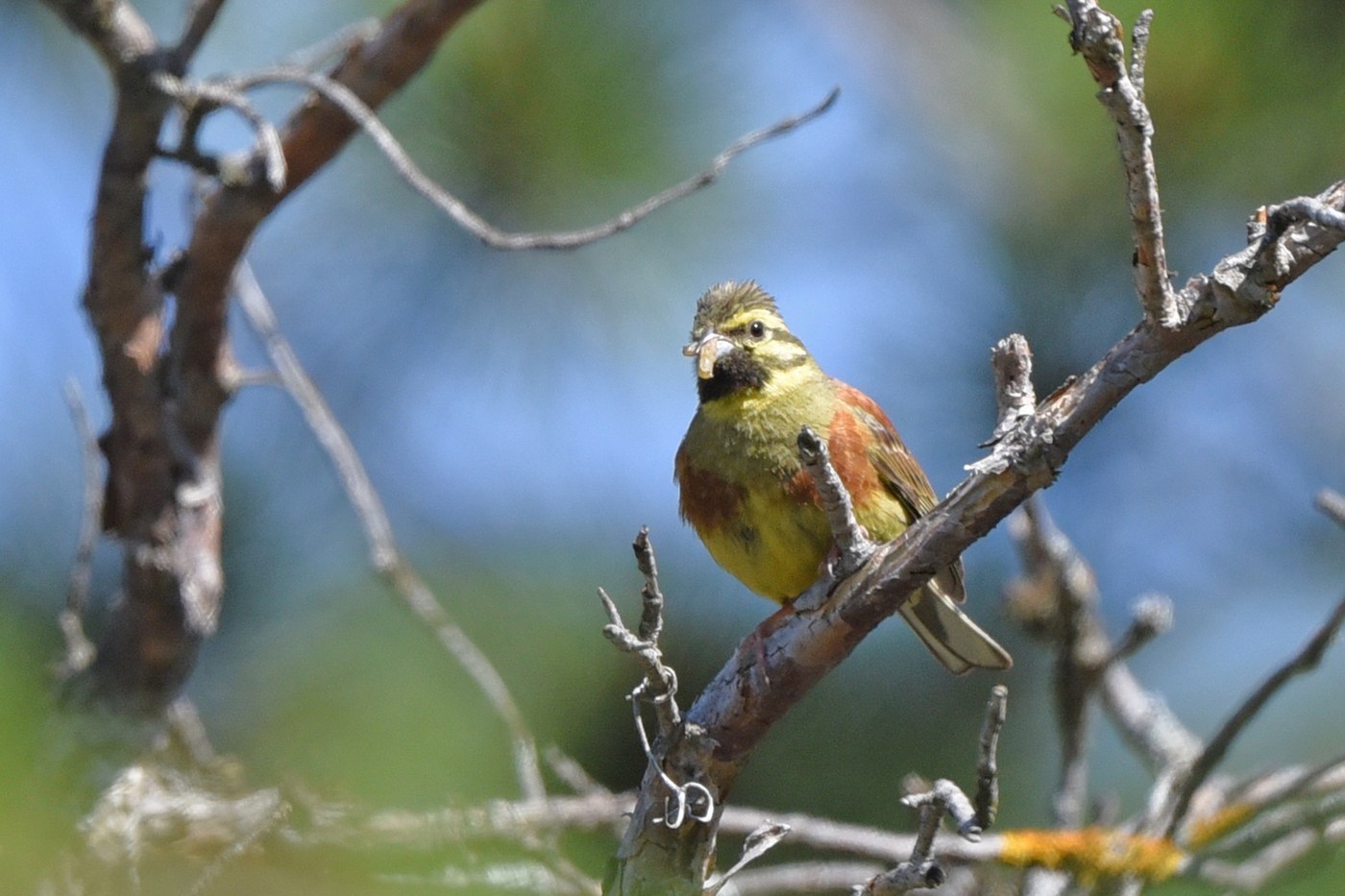
Key Field Marks
- Size & shape: A compact, sparrow-sized bunting (about 15-16.5 cm) with a stout seed-eating bill and a fairly long, notched tail — very similar in structure to a Yellowhammer.
- Male plumage: Bold black throat and eye-stripe crossing a bright yellow face, a grey-green crown, and an olive-green breast band separating the yellow throat from chestnut-brown flanks. The back is streaked chestnut and black.
- Female/immature plumage: Much duller and streakier than the male, with a greyish-olive head, faint dark moustachial and eye-stripe, and diffusely streaked underparts — easily confused with a female Yellowhammer.
- Rump colour (the best year-round clue): Cirl Bunting shows a plain grey-green rump, while Yellowhammer shows a bright chestnut/rufous rump — visible in flight or when the bird is perched with wings relaxed.
- Bill: Grey, conical, slightly less bulky than Yellowhammer's pinkish bill.
Separating It From Similar Species
- Yellowhammer: The classic confusion species. Focus on the rump (chestnut in Yellowhammer vs grey-green in Cirl) and, on males, the solid black throat and olive breast band of Cirl Bunting versus the all-yellow head and unmarked underparts of Yellowhammer.
- Female buntings generally: Streaky female Cirl and Yellowhammer Buntings overlap greatly; check rump colour and listen for the diagnostic song, and note habitat (Cirl favors warm, bushy farmland with tall hedges and bare ground, rather than open arable land).
Habitat, Range & Season
- Resident (non-migratory) across southern and western Europe and the Mediterranean basin.
- In Britain, restricted to a small, carefully conserved population in South Devon, England — the northern edge of its range — where reintroduction and farmland conservation schemes have helped it recover.
- Prefers warm, sheltered mixed farmland with tall thick hedgerows, scrubby field margins, orchards, and areas of bare or short grass for foraging, often near the coast.
- A year-round resident where present; no strong migratory movements, though some short-distance dispersal occurs.
Voice
- Song is a fast, dry, mechanical rattle on a single pitch, reminiscent of a Lesser Whitethroat's rattle or a bunch of keys being shaken — noticeably faster and more monotonous than the Yellowhammer's familiar "a little bit of bread and no cheese" song, which slows and rises at the end.
- Calls include a thin "sip" or "zit" contact note.
Frequently asked questions
How do I tell a Cirl Bunting from a Yellowhammer?
Check the rump: Cirl Bunting has a grey-green rump while Yellowhammer has a bright chestnut rump. Male Cirl Buntings also show a black throat and olive breast band that Yellowhammers lack.
Where is the best place to see Cirl Buntings in Britain?
South Devon, England holds nearly the entire UK population, concentrated on farmland managed under conservation agreements near the south coast.
What does a Cirl Bunting sound like?
Its song is a fast, dry, rattling trill on one pitch, similar to a Lesser Whitethroat's rattle, and lacks the rising, drawn-out final note of a Yellowhammer's song.
Are female Cirl Buntings hard to identify?
Yes — females are streaky and dull, closely resembling female Yellowhammers. The grey-green rump is the most reliable mark, along with a subtler head pattern and habitat choice.