
Cinnamon Teal Identification Guide
A small western dabbling duck whose breeding male is unmistakable in deep cinnamon-red, while females require close attention to bill shape to separate from Blue-winged Teal.
Read the full Cinnamon Teal encyclopedia entry →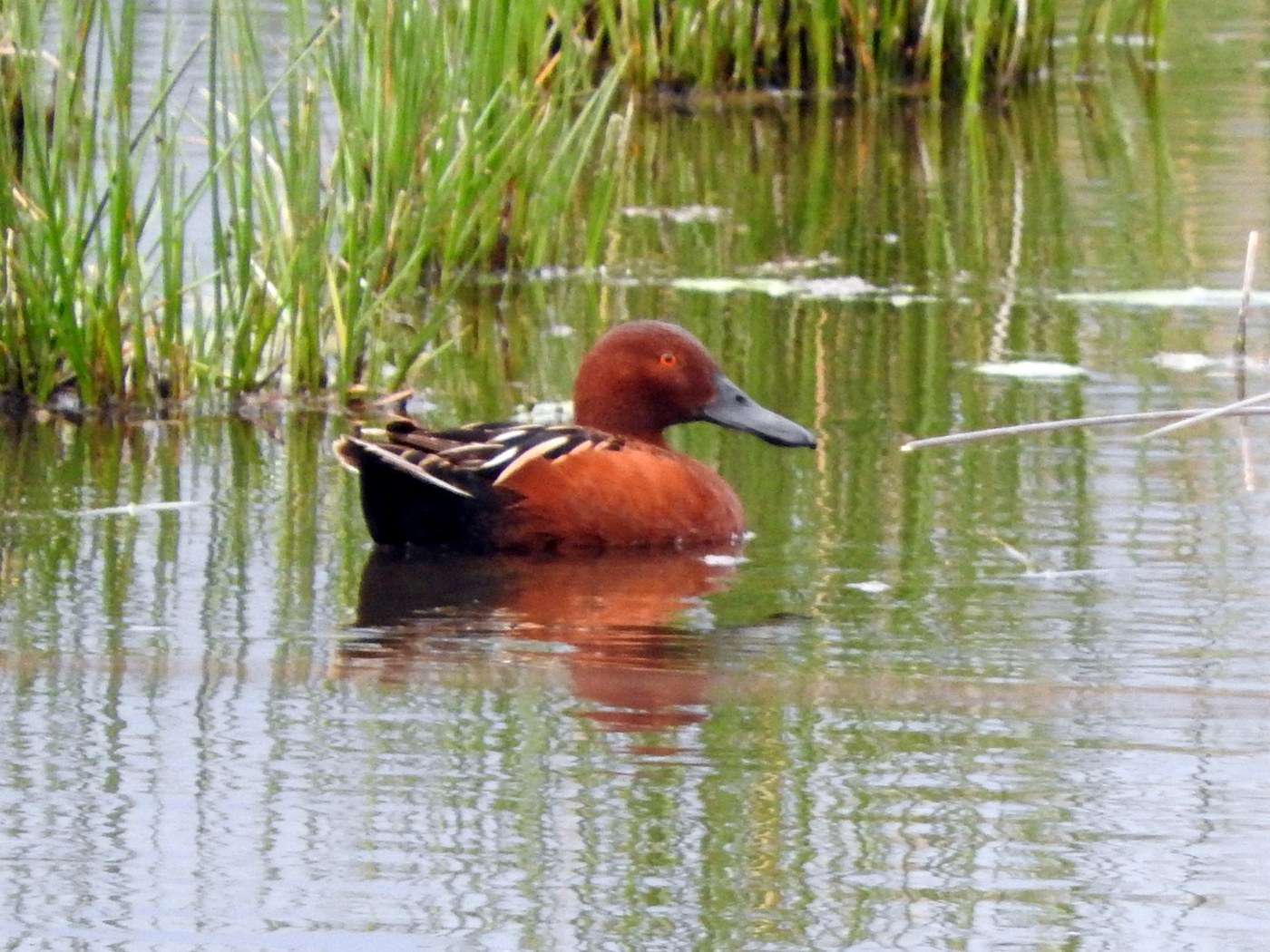
Key Field Marks
- Small dabbling duck, close in size to Blue-winged Teal, with a relatively long, spatulate (broad-tipped) bill.
- Breeding male: deep, rich cinnamon-red head, neck, breast, and underparts, with a red eye and a black bill; in flight shows a pale powder-blue patch on the upperwing coverts and a glossy green speculum, bordered by white.
- Eclipse male and female: mottled brown overall, closely resembling female Blue-winged Teal; the pale blue wing patch is still present in flight in both sexes.
- Females tend to look slightly warmer brown and plainer-faced than female Blue-winged Teal, without as much contrast around the bill base.
Separating It From Similar Species
- Blue-winged Teal (female/eclipse male): the classic confusion species; Cinnamon Teal has a longer, more spatulate bill (broader toward the tip) versus the shorter, more evenly proportioned bill of Blue-winged Teal, and often a plainer face lacking Blue-winged's more defined pale spot at the base of the bill.
- Northern Shoveler (female): much larger overall with a dramatically oversized, spoon-shaped bill, easily separating it from the smaller-billed Cinnamon Teal.
- Breeding male Cinnamon Teal is essentially unmistakable due to its uniform cinnamon-red body, unlike any other North American duck.
- Because female teal identification is difficult, bill shape and overall structure are more reliable than plumage tone alone.
Habitat, Range & Season
- Breeds in shallow freshwater marshes, ponds, and wetland edges with dense emergent vegetation across the western United States and adjacent Canada.
- A separate, disjunct population breeds in wetlands of the Andes and lowlands of South America.
- North American breeders winter mainly in Mexico, Central America, and the southwestern United States.
- Often associates with Blue-winged Teal in mixed flocks during migration, which increases the identification challenge.
Voice
- Males give a low, rattling chatter, often during courtship.
- Females give quacking calls similar to other teal, generally softer and lower than a Mallard's.
Frequently asked questions
How can I tell a female Cinnamon Teal from a female Blue-winged Teal?
Focus on bill shape: Cinnamon Teal has a longer, more spatulate bill that widens toward the tip, while Blue-winged Teal has a shorter, more evenly proportioned bill and usually a more contrasting facial pattern.
What does a breeding male Cinnamon Teal look like?
It is essentially unmistakable — an overall deep cinnamon-red body with a red eye, black bill, and a pale blue wing patch visible in flight.
Where do Cinnamon Teal breed in North America?
In shallow freshwater marshes and ponds across the western United States and adjacent parts of Canada, generally west of the Great Plains.
Do Cinnamon Teal and Blue-winged Teal often occur together?
Yes, they frequently mix in the same wetlands and migratory flocks, which is exactly why careful attention to bill shape and structure is needed to separate females of the two species.