
Chukar Identification Guide
A plump, sandy-brown gamebird of arid western hillsides, identified by its bold black facial "necklace" and neatly barred flanks.
Read the full Chukar encyclopedia entry →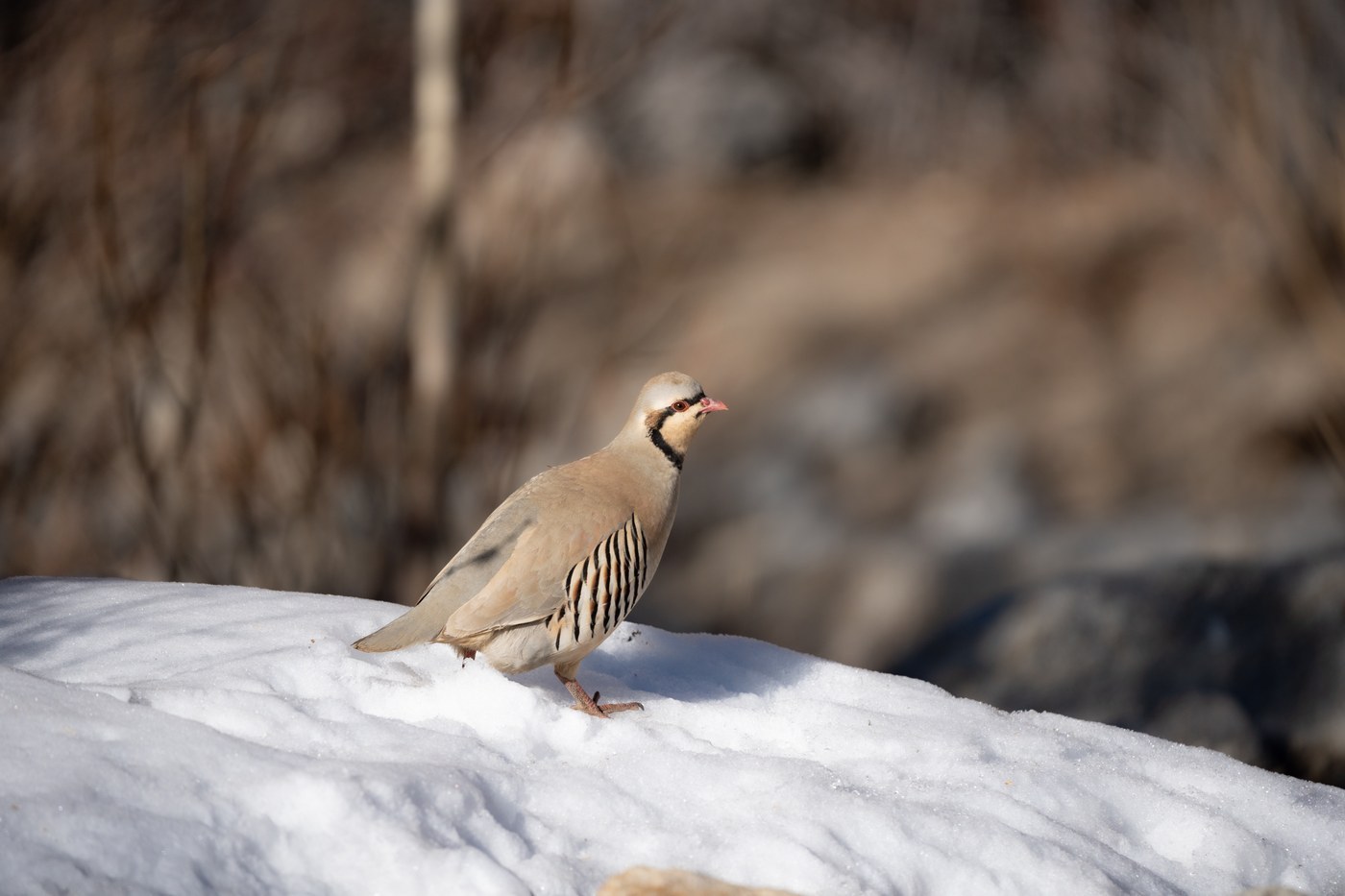
Key Field Marks
- Plump, rounded gamebird about 13–14 inches long, with a sandy gray-buff body and pinkish-buff face.
- Bold black band runs from the forehead through the eye and down around the throat, forming a distinct "necklace" that outlines the pale face and throat — the species' most distinctive feature.
- Flanks show a series of neat, bold black-and-white (and chestnut) vertical bars, easily visible at rest.
- Bright red bill and legs.
- Sexes look similar, though males may show a small leg spur.
Separating It From Similar Species
- Gray Partridge: lacks the black facial necklace and barred flanks entirely, instead showing a plain gray-orange face, an orange-buff patch on the head, and a dark horseshoe mark on the belly; also has different, more northerly and agricultural range preferences within its introduced range.
- Gambel's Quail and California Quail: both show a forward-curving head plume that Chukar entirely lacks, along with different body patterning; range and habitat also differ, with quail more associated with desert scrub and chaparral than open rocky hillsides.
- No other gamebird in its range combines the black facial/throat necklace with strongly barred flanks, making adult Chukar fairly straightforward to identify once seen well.
Habitat, Range & Season
- Native to rocky, arid hillsides and mountain slopes from the Middle East through Central Asia to the Himalayas.
- Widely and successfully introduced to arid, rocky terrain in the western United States (including the Great Basin, Snake River canyons, and similar habitats), where it is now well established and resident year-round.
- Favors steep, rocky slopes with sparse grass and scrub, often near a water source; frequently seen running rather than flying when disturbed.
- Forms coveys outside the breeding season, sometimes numbering a dozen or more birds.
Voice
- Gives a loud, repeated "chuk-chuk-chukar" or "chukar-chukar" call, often from a rocky perch, which is the source of the species' name.
- Also gives a rapid cackling call when flushed, along with a whirring burst of wingbeats.
Frequently asked questions
What is the most distinctive field mark of a Chukar?
The bold black band running from the eyes down around the throat like a necklace, combined with strongly barred black-and-white flanks.
Where can Chukar be found in North America?
It was introduced from Eurasia and is now well established on steep, rocky, arid hillsides of the western United States, particularly the Great Basin region.
How does Chukar differ from Gray Partridge?
Chukar has a distinctive black facial necklace and barred flanks that Gray Partridge lacks; Gray Partridge instead shows a plain orange-buff face patch and a dark belly patch.
Does Chukar prefer to fly or run when disturbed?
Chukar typically runs uphill on its strong legs when disturbed, only flushing into fast, whirring flight, often downhill, as a last resort.