
Chuck-will's-widow Identification Guide
The largest nightjar in North America, a cryptically patterned, nocturnal bird best identified by its far-carrying "chuck-will's-widow" song rather than by sight.
Read the full Chuck-will's-widow encyclopedia entry →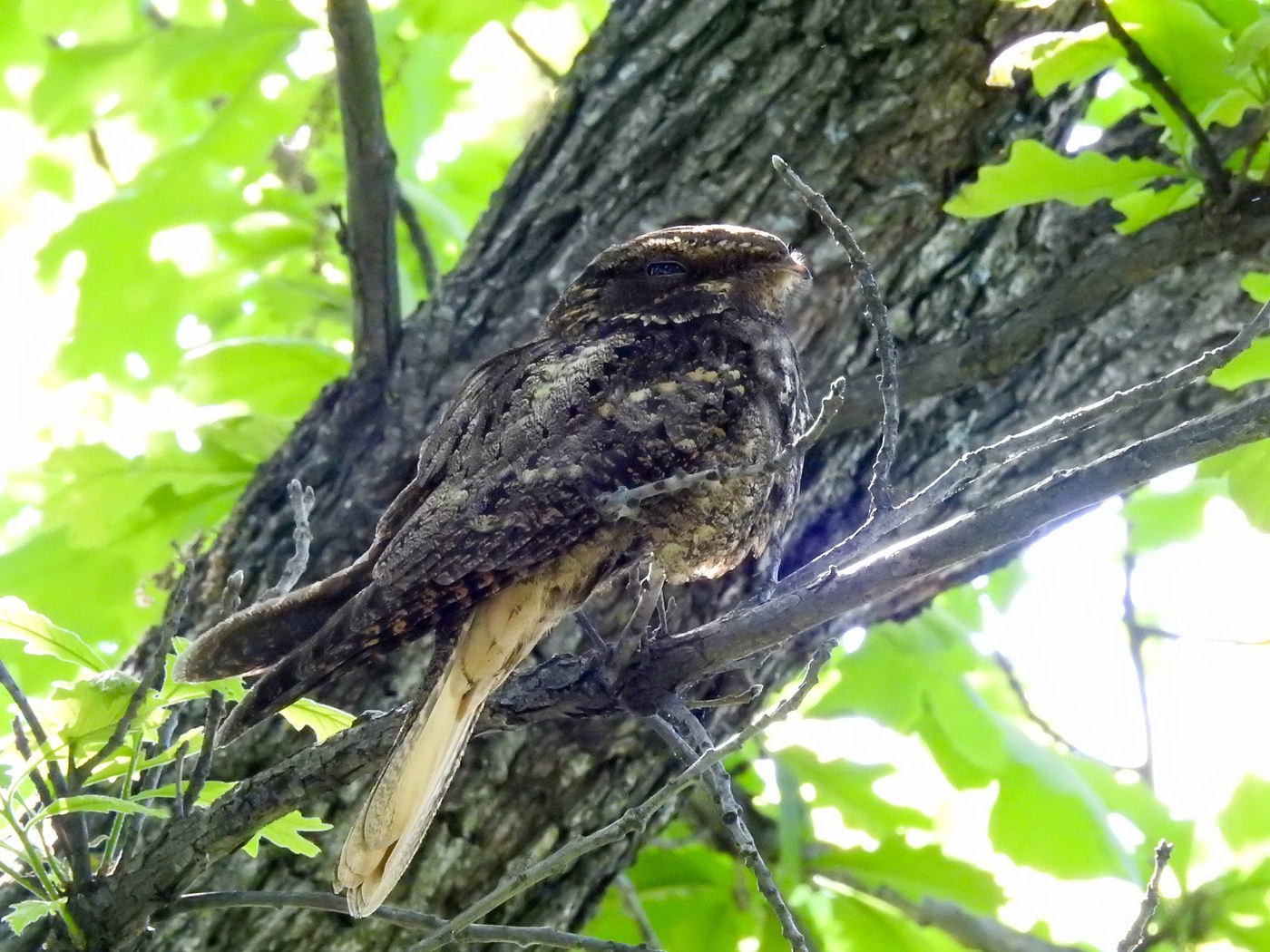
Key Field Marks
- Large nightjar, the biggest in North America, roughly 12 inches long with a wide wingspan and a big, flat head.
- Cryptic, mottled plumage in shades of brown, buff, black, and gray, providing near-perfect camouflage against leaf litter and bark.
- Enormous gape and tiny bill, adapted for catching flying insects and even small birds and bats in flight.
- Short legs, rarely walks; spends daylight hours motionless on the ground or lengthwise along a horizontal branch.
- In flight, shows limited white in the tail, restricted to the inner webs of the outer tail feathers on males (much less white than Whip-poor-will), and none on females.
Separating It From Similar Species
- Eastern Whip-poor-will: smaller and grayer overall with a more contrasting buffy throat band that is more white, and shows much more extensive white in the outer tail feathers (especially obvious in flushed males); Whip-poor-will's song is faster and higher-pitched.
- Common Nighthawk: has long pointed wings with a bold white wing-patch, is often seen flying and foraging in open sky well before dusk (unlike the more strictly nocturnal Chuck-will's-widow), and gives a nasal peent call rather than a whistled song.
- Because all nightjars are extremely difficult to spot at rest, voice is by far the most reliable way to confirm Chuck-will's-widow's presence.
Habitat, Range & Season
- Breeds in dry, open pine and pine-oak woodlands, sandy scrub, and mixed forest edges across the southeastern United States.
- Roosts on the ground or on horizontal branches during the day; becomes active at dusk, hunting insects (and occasionally small birds or bats) in flight.
- Winters in the Caribbean, Central America, and northern South America; northernmost populations are the most migratory.
- Present on breeding grounds roughly April through September.
Voice
- Song is a loud, rolling "chuck-will's-WID-ow", repeated over and over, lower-pitched and slower-paced than the similar song of Whip-poor-will.
- Most often heard at dusk, dawn, and on moonlit nights.
Frequently asked questions
What is the best way to detect a Chuck-will's-widow?
Listen for its repeated, rolling song, "chuck-will's-WID-ow," given at dusk and through the night — the birds are so well camouflaged that they are rarely spotted visually.
How is Chuck-will's-widow different from Whip-poor-will?
Chuck-will's-widow is larger and more rufous-buff overall, has a slower, lower song, and shows much less white in the tail than Whip-poor-will.
Where do Chuck-will's-widows nest?
They lay eggs directly on leaf litter on the ground in dry pine and pine-oak woodlands of the southeastern U.S., without building a nest structure.
Are Chuck-will's-widows active during the day?
No, they roost motionless on the ground or along branches during daylight and become active at dusk and after dark, hunting flying insects.