
Chimney Swift Identification Guide
A small, sooty, cigar-shaped aerial bird of eastern North America that flies almost constantly on stiff, flickering wingbeats and never perches in the open.
Read the full Chimney Swift encyclopedia entry →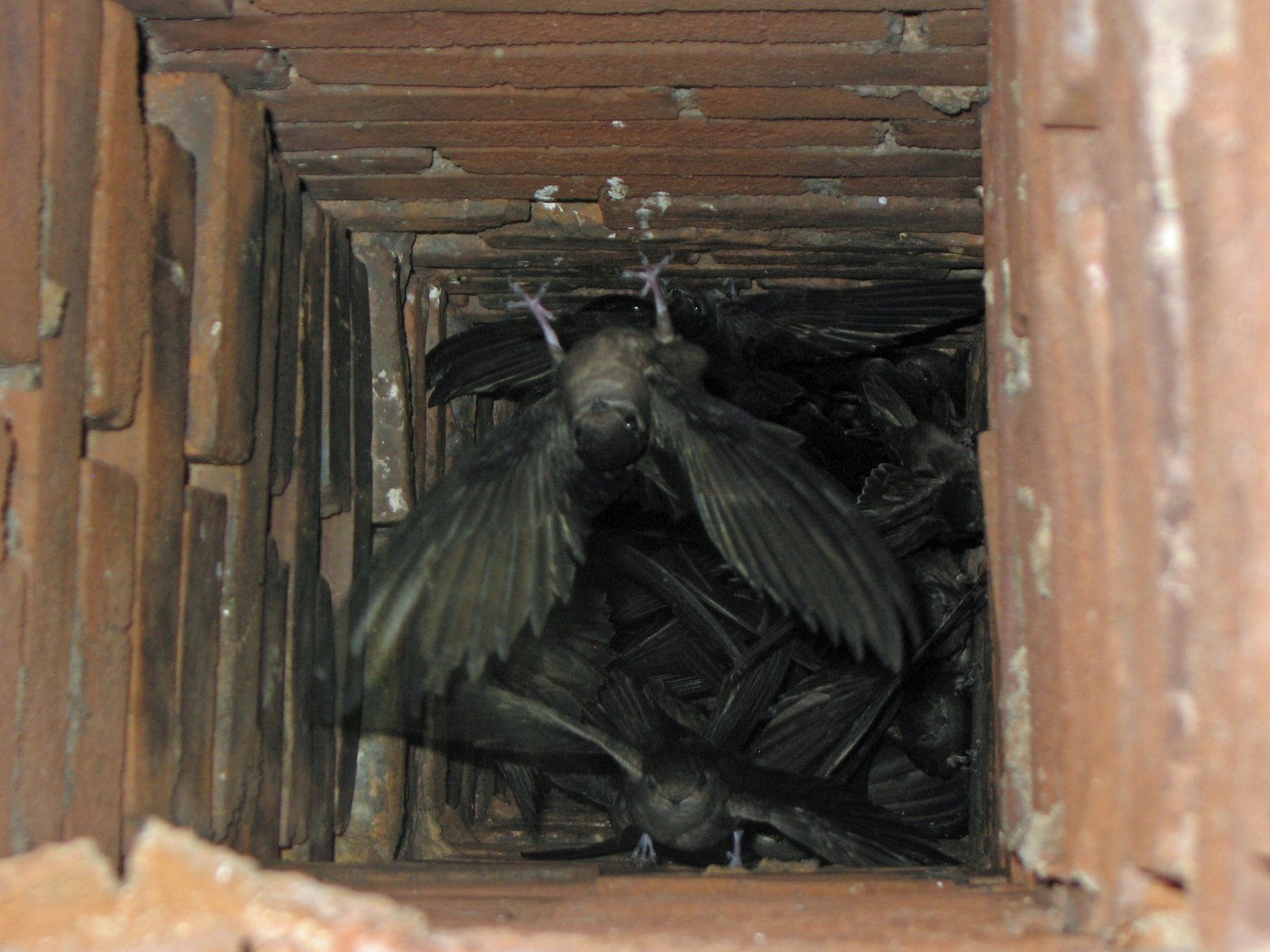
Key Field Marks
- Small, dark gray-brown bird with a compact, cigar-shaped body, short spiny tail, and long, narrow, curved (scythe-like) wings.
- Appears essentially tailless in flight since the short tail is usually held closed.
- Flight is distinctive: rapid, stiff, fluttery wingbeats alternating with short glides, often described as looking like a "flying cigar."
- No visible legs or feet in flight (they are tiny and used only for clinging to vertical surfaces, not for perching or walking).
- Plumage is uniformly sooty gray-brown, slightly paler on the throat.
Separating It From Similar Species
- Swallows (Barn, Tree, Purple Martin, etc.): have longer, often forked tails, glide more smoothly on flatter wings, and regularly perch on wires, branches, or fences — something a Chimney Swift essentially never does.
- Vaux's Swift: very similar in shape but found in western North America; Chimney Swift is the expected swift across the eastern half of the continent, with only limited range overlap.
- Overall silhouette (bow-and-arrow shape, stiff wingbeats, tailless look) combined with constant flight is usually enough to separate swifts from all swallows at a glance.
Habitat, Range & Season
- Almost entirely aerial; found over towns, cities, and open country wherever it can forage for flying insects.
- Nests and roosts colonially in chimneys, and historically in hollow trees, using twigs glued together with saliva to form a small half-cup nest stuck to a vertical surface.
- Breeds across the eastern United States and southeastern Canada, generally April through September.
- Migrates in flocks and winters in the upper Amazon basin of South America (particularly Peru).
- Spectacular pre-migration roosts can gather thousands of swifts, which pour into large chimneys at dusk in a swirling funnel.
Voice
- Gives a rapid, high-pitched, chattering twitter or chippering call, almost constantly while in flight, especially in flocks.
Frequently asked questions
Why does a Chimney Swift look tailless?
Its short, spiny tail is usually held closed in flight and is much shorter than the wings, giving the whole bird a stubby, cigar-like silhouette.
How do I tell a Chimney Swift from a swallow?
Swifts have stiffer, more fluttery wingbeats, narrower curved wings, and essentially never perch in the open, while swallows have longer forked tails and regularly perch on wires or branches.
Where do Chimney Swifts nest?
They build small twig nests glued with saliva to the inside of chimneys or, historically, hollow trees, since they cannot perch on horizontal surfaces.
When and where can I see large flocks of Chimney Swifts?
During fall migration (August–September), large numbers often gather at dusk and funnel into big chimneys to roost communally, a spectacle sometimes called a "swift night out."