
Chilean Flamingo Identification Guide
A pale pink South American flamingo distinguished from its relatives by gray legs with contrasting red "knees" and a pink bill with a black tip.
Read the full Chilean Flamingo encyclopedia entry →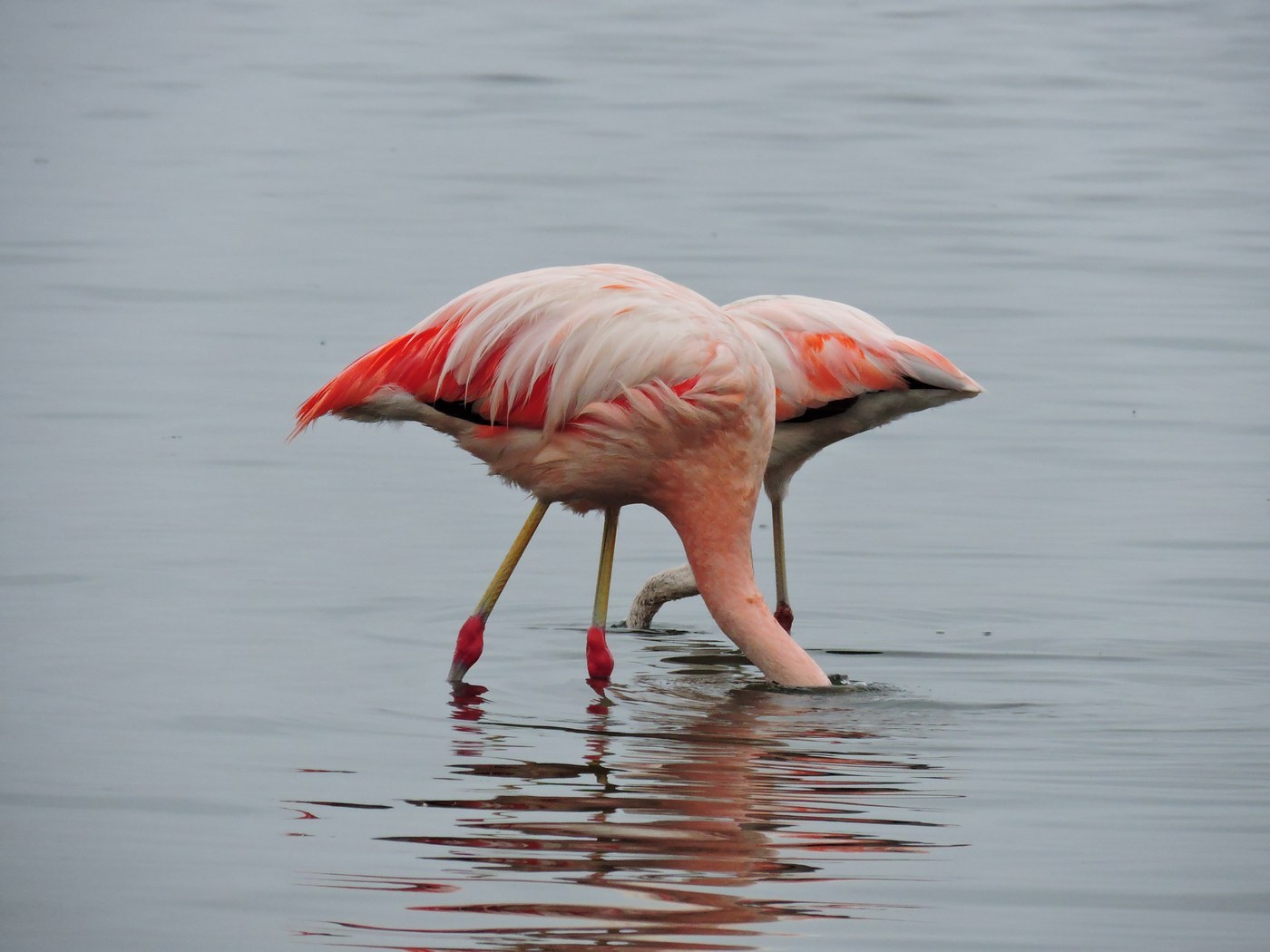
Key Field Marks
- Large, tall wading bird with a long S-curved neck, stilt-like legs, and a distinctively down-curved bill used for filter feeding.
- Overall plumage is a pale to medium pink, generally less saturated than American Flamingo.
- Legs are gray with red "knees" (the exposed tibiotarsal joint) — this is the single most useful field mark separating Chilean Flamingo from other flamingo species.
- Bill is pink at the base with a black tip.
- In flight, shows black flight feathers contrasting with pink wing coverts and a long trailing neck and legs.
Separating It From Similar Species
- American (Caribbean) Flamingo: much deeper reddish-pink to orange overall, with all-pink (not gray) legs and a bill that is more extensively black-tipped; American Flamingo is generally the most vividly colored of the group.
- Greater Flamingo: very pale pinkish-white body with all-pink legs (no red knee patch) and a smaller area of black on the bill tip.
- Andean and James's (Puna) Flamingos: found at high-altitude Andean lakes alongside Chilean Flamingo but show yellow legs (Andean) or brick-red/yellow legs with a shorter, more strongly downcurved bill (James's); Chilean Flamingo's gray legs with red knees are unique among these species.
- Because flamingo color intensity depends heavily on diet (carotenoid pigments), leg color and bill pattern are more reliable than overall body-color saturation.
Habitat, Range & Season
- Breeds and forages at high-altitude saline and alkaline lakes in the Andes as well as coastal lagoons, estuaries, and salt pans at lower elevations in Chile, Peru, Bolivia, Argentina, and Uruguay.
- Often found in large, dense flocks that can number in the thousands at major breeding lakes.
- Also widely kept in zoos and wildfowl collections worldwide, so escaped or feral individuals occasionally turn up far outside the native range.
Voice
- Gives loud, goose-like honking and gabbling calls, especially in flight or when flocks are disturbed.
- Flocks are often noisy, with constant low chattering while feeding.
Frequently asked questions
What is the best field mark for identifying a Chilean Flamingo?
Gray legs with contrasting red "knee" joints are the most reliable mark, since overall pink coloration varies with diet and can overlap with other flamingo species.
How does Chilean Flamingo differ from American Flamingo?
Chilean Flamingo is paler pink with gray legs and red knees, while American Flamingo is a deeper reddish-orange with entirely pink legs.
Where do Chilean Flamingos live in the wild?
High-altitude Andean salt lakes and coastal lagoons across Chile, Peru, Bolivia, Argentina, and Uruguay.
Why might I see a Chilean Flamingo outside South America?
The species is popular in zoo and wildfowl collections, so individuals occasionally escape and are seen as vagrants or feral birds far from their native range.