
Chestnut-mandibled Toucan Identification Guide
A large Central and northern South American toucan with a yellow-orange throat, a yellow-green upper bill, and a distinctive chestnut-brown lower mandible.
Read the full Chestnut-mandibled Toucan encyclopedia entry →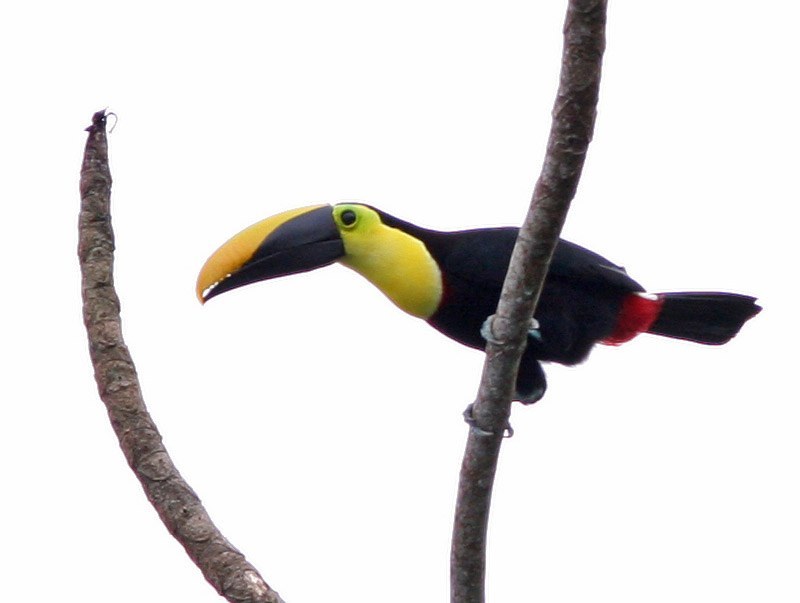
Key Field Marks
- Large toucan with black body plumage and a bright yellow-orange throat and upper breast, bordered below by a band of red.
- Large bill with a mostly yellow-green upper mandible (maxilla) and a chestnut-brown lower mandible — the feature that gives the species its name and its most useful field mark.
- Bare blue skin around the eye.
- White patch on the rump, visible from behind or in flight.
- Often treated taxonomically as part of the Yellow-throated Toucan complex (Ramphastos ambiguus), alongside the very similar Black-mandibled Toucan of South America.
Similar Species
- Keel-billed Toucan: Overlaps in parts of Central America but shows a boldly multicolored bill (green, orange, red, and blue) rather than the simpler yellow-green-and-chestnut pattern of Chestnut-mandibled Toucan, and is somewhat smaller.
- Black-mandibled Toucan: Extremely similar and now often considered the same species (or a close South American counterpart); ranges are largely separated, with Chestnut-mandibled in Central America and Black-mandibled farther south in South America.
- Channel-billed Toucan: A different, smaller-billed South American species with a raised ridge on the culmen and a mostly black-and-pale bill lacking the chestnut lower mandible.
Habitat & Range
- Found in humid lowland and foothill forest, forest edge, and adjacent clearings from Honduras south through Costa Rica and Panama into northwestern Colombia and Ecuador.
- Ranges higher in elevation than some other lowland toucans, occurring well into foothill forest.
Behavior
- Frugivorous, plucking fruit with the long bill tip and tossing it back to swallow; also takes insects, eggs, and small vertebrates opportunistically.
- Usually seen in pairs or small groups moving through the canopy, hopping between branches and making short flights between trees.
Voice
- A loud, far-carrying, repeated yelping or croaking call, often described as sounding like "Dios te dé" ("God give you"), frequently heard at dawn and used to locate the species even before it is seen.
Frequently asked questions
What does "chestnut-mandibled" refer to?
It refers to the lower mandible (bill half) being chestnut-brown, contrasting with the mostly yellow-green upper mandible — the key field mark that separates it from similar large toucans.
How do I tell Chestnut-mandibled Toucan from Keel-billed Toucan?
Keel-billed Toucan has a boldly multicolored bill with green, orange, red, and blue patches, while Chestnut-mandibled Toucan's bill is simpler: yellow-green above and chestnut-brown below.
Where does the Chestnut-mandibled Toucan live?
In humid lowland and foothill forest from Honduras through Costa Rica and Panama into northwestern Colombia and Ecuador.
What does the Chestnut-mandibled Toucan sound like?
A loud, repeated yelping or croaking call, often likened to the phrase "Dios te dé," commonly heard carrying through the forest at dawn.