
Chestnut-fronted Macaw Identification Guide
A small, mostly green macaw of South American lowlands, told by its maroon-chestnut forehead patch, pale bare facial skin, and reddish underwing coverts.
Read the full Chestnut-fronted Macaw encyclopedia entry →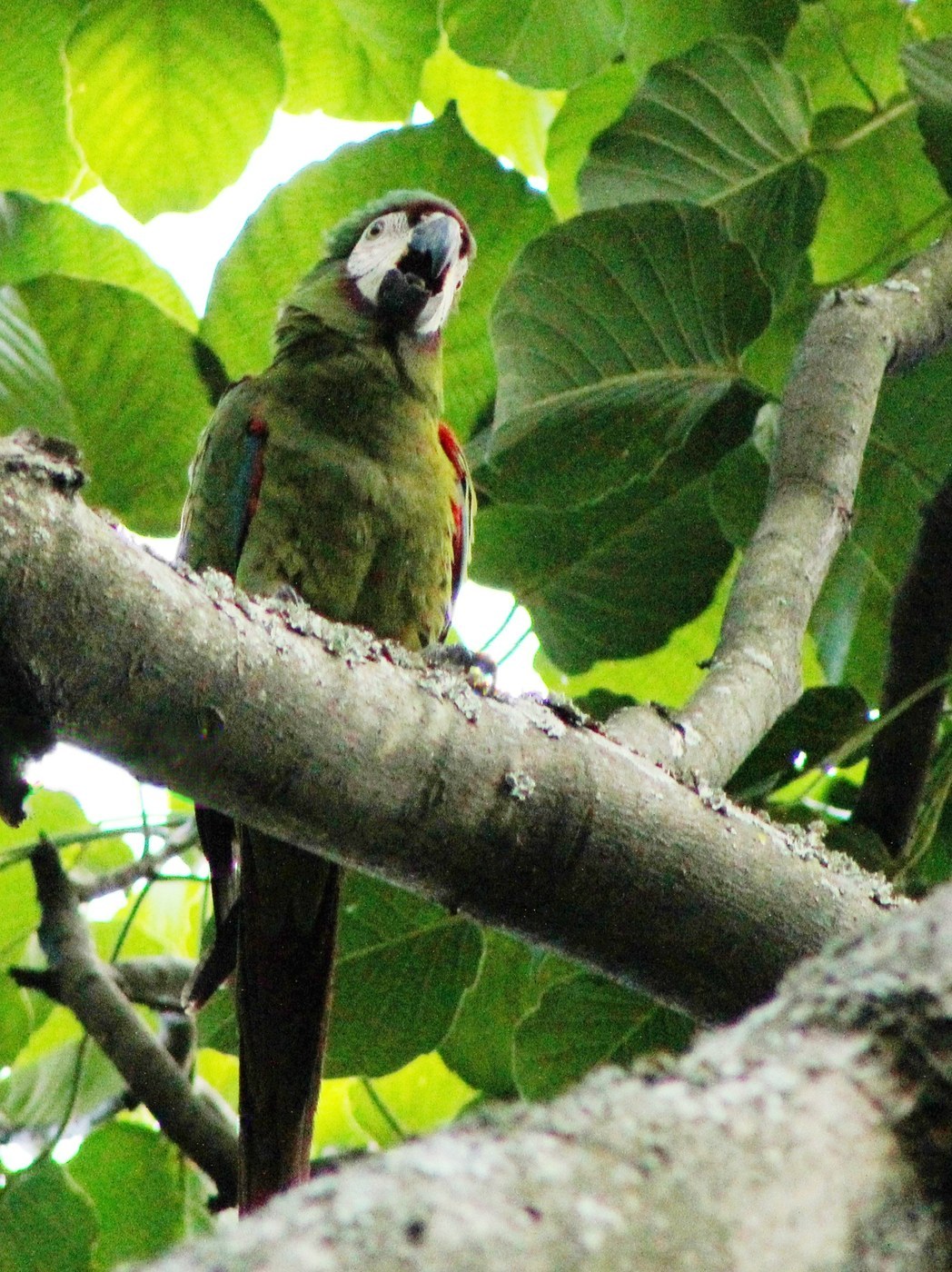
Key Field Marks
- Small macaw (among the smallest of the true Ara macaws), overall green plumage.
- Distinctive chestnut or maroon patch on the forehead, contrasting with the green crown.
- Bare, whitish facial skin marked with fine, thin lines of tiny dark feathers.
- Blue tinge on the flight feathers and crown area.
- Reddish patch on the underwing coverts and bend of the wing, most visible in flight.
- Long, pointed tail that appears brownish-red beneath in flight.
Similar Species
- Red-shouldered Macaw (Red-shouldered/Noble Macaw): Considerably smaller still, with a blue (not chestnut) forehead patch — the smallest of the "mini-macaws."
- Military Macaw: Much larger overall, with a red forehead rather than chestnut, and a longer tail.
- Other all-green Amazona parrots: Lack the long pointed macaw tail and bare facial skin pattern; body shape alone usually separates macaws from amazons at a glance.
Habitat & Range
- Found in lowland tropical forest, forest edge, gallery forest, savanna woodland, and palm groves across much of northern and central South America, from Panama south through the Amazon basin to Bolivia and Brazil.
- Often near water courses and in semi-open, disturbed, or edge habitats rather than deep unbroken forest interior.
Behavior
- Typically encountered in pairs or small flocks, flying with quick, shallow wingbeats distinctive of the species.
- Feeds on fruit, seeds, and nuts in the canopy and subcanopy.
- Often noisy and conspicuous in flight, less so when perched quietly feeding.
Voice
- Harsh, raspy screeches and guttural squawks, frequently given in flight; a common call is a dry, repeated "krak-krak" note.
Frequently asked questions
How do I tell a Chestnut-fronted Macaw from a Red-shouldered Macaw?
Chestnut-fronted Macaw has a chestnut/maroon forehead patch and is noticeably larger than Red-shouldered Macaw, which is one of the smallest macaws and shows a blue forehead patch instead.
What color is the forehead of a Chestnut-fronted Macaw?
A distinctive chestnut or maroon patch, contrasting with the otherwise green head and crown — this is the key field mark for the species.
Where does the Chestnut-fronted Macaw live?
It ranges across lowland tropical forest, forest edge, and savanna woodland from Panama through the Amazon basin to Bolivia and Brazil, often near water and in semi-open habitats.
What does the Chestnut-fronted Macaw's underwing look like in flight?
It shows a reddish patch on the underwing coverts near the bend of the wing, useful for confirming identification of birds seen flying overhead.