
Chestnut-collared Longspur Identification Guide
A Great Plains grassland sparrow-relative whose breeding males show a black belly and chestnut nape, while all plumages reveal a distinctive white tail with a dark central triangle in flight.
Read the full Chestnut-collared Longspur encyclopedia entry →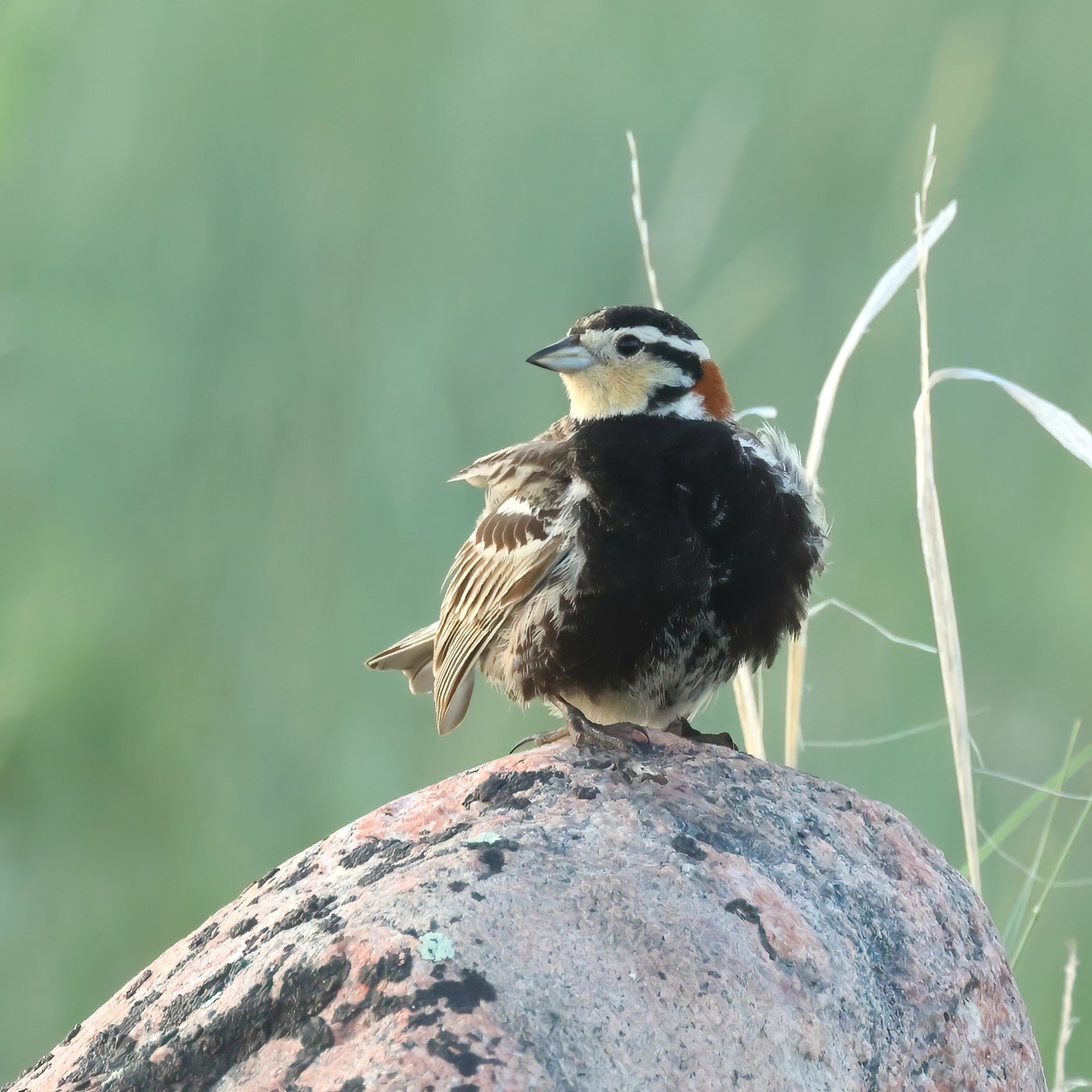
Key Field Marks
- Small, ground-dwelling songbird with a short, conical bill and a fairly short tail for a longspur.
- Breeding male: solid black underparts, black crown, white face, and a bright chestnut nape/collar that gives the species its name.
- Female and nonbreeding/winter birds: streaky brown and buffy overall, sparrow-like, with far more subtle chestnut on the nape (or none obvious).
- In all plumages, the tail is mostly white with a dark, wedge-shaped triangle concentrated at the tip and center — a key mark visible when the bird flushes and flies.
Similar Species
- McCown's Longspur (Thick-billed Longspur): Larger bill; tail pattern differs, showing more of an inverted-T or anchor-shaped dark mark rather than the solid dark triangle at the tip shown by Chestnut-collared — careful comparison of the tail pattern is the most reliable separator among nonbreeding birds.
- Lapland Longspur: Larger and bulkier, with a different tail pattern (dark central tail feathers, white outer feathers without the same triangular tip shape) and typically found in more varied open-country habitat, including agricultural fields, in winter.
- Smith's Longspur: Buffier overall with a distinctly different face pattern and tail pattern; ranges and habitats overlap only locally.
Habitat & Range
- Breeds in native shortgrass and mixed-grass prairie of the northern Great Plains, including Montana, the Dakotas, and adjacent Canadian prairie provinces.
- Strongly tied to short, sparse grass structure, often avoiding taller or denser grassland used by other grassland specialists.
- Winters in shortgrass fields, plowed or overgrazed pasture, and similar open habitats in the southern Great Plains, Texas, and northern Mexico, frequently in mixed longspur flocks.
Behavior
- Runs and walks on the ground rather than hopping, typical of longspurs.
- Males perform a fluttering flight display over territory, singing while airborne.
- Forms large flocks in winter, often together with other longspur species, foraging on bare or sparsely vegetated ground.
Voice
- Flight song is a sweet, jingling, warbling series delivered during a hovering display flight.
- Common call is a soft rattling or "kiddle" note, often given by flushing or flying flock members.
Frequently asked questions
How do I identify a nonbreeding Chestnut-collared Longspur?
Look at the tail pattern in flight: Chestnut-collared Longspur shows a mostly white tail with a dark triangular patch concentrated at the tip, different from the tail patterns of McCown's and Lapland Longspurs.
What does a breeding male Chestnut-collared Longspur look like?
A solid black belly and crown, a white face, and a bright chestnut band across the nape — quite distinctive on the breeding grounds.
Where can I find Chestnut-collared Longspurs?
Search native shortgrass and mixed-grass prairie in the northern Great Plains (Montana, the Dakotas, and the Canadian prairies) in summer, and shortgrass fields or bare agricultural ground in Texas and northern Mexico in winter.
How is Chestnut-collared Longspur different from McCown's Longspur?
Besides the tail pattern, McCown's has a noticeably larger, thicker bill, and breeding males lack the chestnut collar, instead showing a gray nape and different face pattern.