
Chestnut-breasted Mannikin Identification Guide
A small, gregarious estrildid finch with a black face, a chestnut breast band edged in black, and a stubby gray bill, found in Australian and New Guinean grasslands and wetlands.
Read the full Chestnut-breasted Mannikin encyclopedia entry →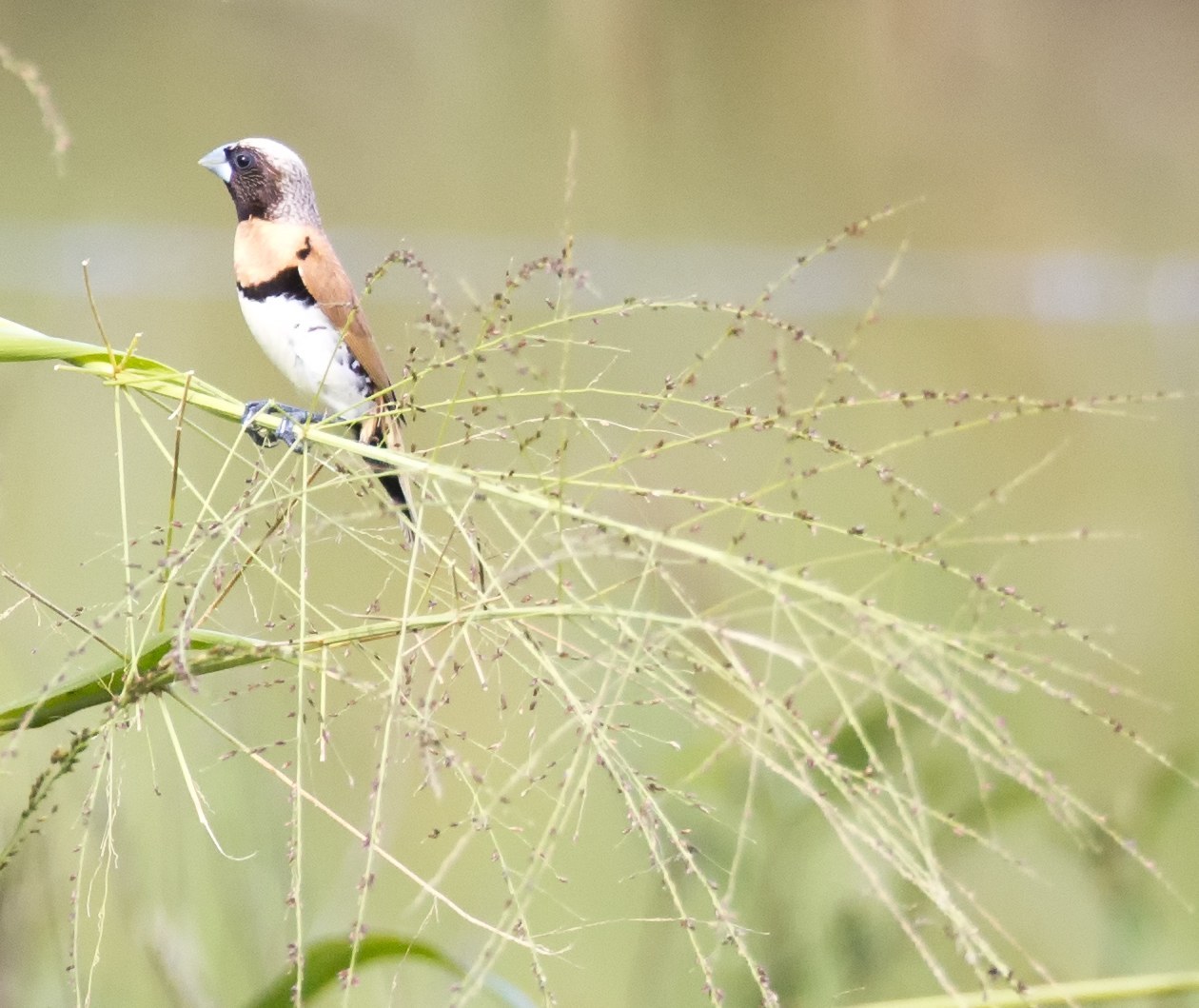
Key Field Marks
- Small, compact finch with a short, stubby, conical bill (grayish, blackish above and paler bluish-gray below).
- Black face, chin, and forehead.
- Broad chestnut breast band bordered below by a narrow black band separating it from the pale belly.
- Cream to white belly and undertail area.
- Chestnut-brown back, wings, and tail; black undertail coverts.
Similar Species
- Scaly-breasted Munia (Nutmeg Mannikin): Shows a scaly, scalloped pattern on the breast and flanks rather than a solid chestnut band with a black border, and has a chestnut head and upperparts rather than a black face.
- Other Lonchura mannikins/munias: Generally distinguished by combination of head color, breast pattern (banded vs. scaled vs. plain), and bill color; the solid chestnut band edged in black is the key mark for this species.
Habitat & Range
- Native to northern and eastern Australia and New Guinea, with introduced populations established elsewhere in the Pacific.
- Found in grasslands, reedbeds, sedge marshes, sugarcane fields, and the edges of wetlands and rice paddies.
- Often near water, favoring rank grass and seeding vegetation.
Behavior
- Highly social, usually seen in flocks that move together through grass and reeds, feeding on seeds.
- Builds a large, domed nest of grass with a side entrance, often in reeds, sugarcane, or dense grass tussocks.
- Flocks give near-constant soft contact calls while foraging, helping keep the group together in dense vegetation.
Voice
- Soft, high-pitched, buzzy contact calls and short "tit" or "chirp" notes given constantly within flocks; not known for a loud or elaborate song.
Frequently asked questions
How do I tell a Chestnut-breasted Mannikin from a Scaly-breasted Munia?
Chestnut-breasted Mannikin has a black face and a solid chestnut breast band edged in black, while Scaly-breasted Munia has a chestnut head/upperparts and a scaly, scalloped pattern across the breast and flanks rather than a solid band.
Where is the Chestnut-breasted Mannikin found?
It is native to northern and eastern Australia and New Guinea, typically in grasslands, reedbeds, and wetland-edge habitats, with some introduced populations elsewhere in the Pacific.
Does the Chestnut-breasted Mannikin flock?
Yes, it is highly gregarious and almost always seen in flocks moving and feeding together in grassy or reedy habitat.
What does the Chestnut-breasted Mannikin eat?
It feeds primarily on grass and sedge seeds, often foraging low in rank grass, reeds, or cultivated grain crops like sugarcane.