
Cerulean Warbler Identification Guide
A tiny, sky-blue canopy warbler of mature eastern forests, best known by its short tail, white double wingbars, and rapid buzzy ascending song.
Read the full Cerulean Warbler encyclopedia entry →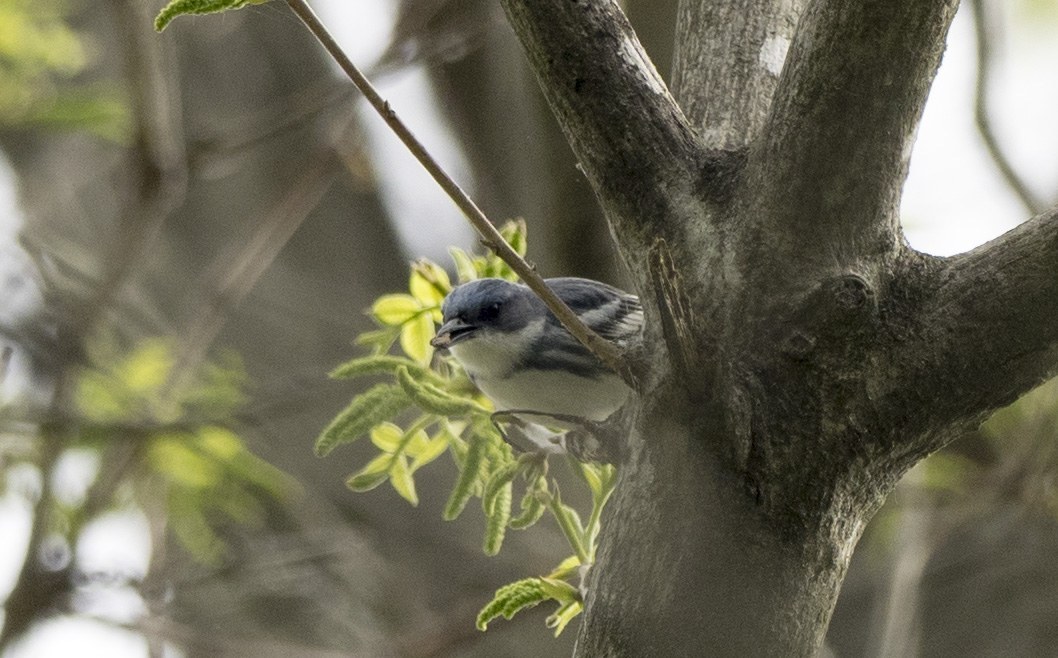
Key Field Marks
- Very small warbler with a notably short tail relative to other wood-warblers.
- Adult male: bright sky-blue upperparts, white underparts, a dark blue-black necklace across the upper breast, and blue-black streaking along the flanks.
- Adult female: blue-green above, pale creamy-yellow below with faint streaking on the flanks, and a pale yellowish eyebrow (supercilium).
- Both sexes show two crisp white wingbars on blue-gray wings.
- Forages actively high in the forest canopy, often appearing as a quick, pale flash overhead.
Similar Species
- Black-throated Blue Warbler: Male has a solid black face, throat, and sides (not a necklace) with dark blue upperparts; female is plain olive with a distinctive small white "handkerchief" wing spot, unlike the streaked, eyebrowed female Cerulean.
- Northern Parula: Shows a yellow-green patch on the back and a broken white eye-ring, plus a yellow throat and chestnut-and-black breast band on males — Cerulean lacks the back patch and yellow throat.
- Blackburnian Warbler: Much more orange on the throat and face; easily separated by color alone.
Habitat & Range
- Breeds in mature, structurally complex deciduous forest, especially in the central Appalachians, the Ohio and Mississippi River valleys, and parts of the Midwest.
- Prefers tall canopy trees, often on slopes or near forest gaps, and forages and nests high overhead, making it a notoriously difficult species to see well.
- Winters in the foothills of the Andes in Colombia, Venezuela, Ecuador, and Peru, on shade-coffee farms and montane forest.
- Population has declined steeply over recent decades due to loss of mature forest on both breeding and wintering grounds.
Behavior
- Forages methodically along canopy branches for insects, moving with quick, deliberate hops.
- Male sings from high exposed perches, often unseen from the ground.
Voice
- A rapid, buzzy, ascending song, often rendered as a series of buzzy notes accelerating and rising in pitch, ending in a sharp upslurred trill ("zray zray zray zree zreeeee"), quite distinctive once learned even though the bird itself is hard to spot.
Frequently asked questions
Why is the Cerulean Warbler so hard to see?
It forages and sings almost exclusively high in the forest canopy, so most encounters are brief glimpses of a small blue bird moving through the treetops or a distinctive buzzy song heard from below.
How do I distinguish a female Cerulean Warbler from a female Black-throated Blue Warbler?
Female Cerulean is blue-green above with pale yellowish underparts, faint flank streaking, and a pale eyebrow, while female Black-throated Blue is plain olive-brown with a small, sharply defined white wing spot and no streaking.
Where does the Cerulean Warbler breed?
Its breeding stronghold is mature deciduous forest in the central Appalachians and the Ohio and Mississippi River valleys, where it favors tall canopy trees on slopes and near gaps.
What does a Cerulean Warbler's song sound like?
A fast series of buzzy notes that speeds up and rises in pitch, finishing with a sharp upslurred trill — often the easiest way to detect this canopy-dwelling species.