Cedar Waxwing Identification Guide
A sleek, crested, cinnamon-brown bird with a black mask and a yellow-tipped tail, usually found in tight flocks stripping berries from trees.
Read the full Cedar Waxwing encyclopedia entry →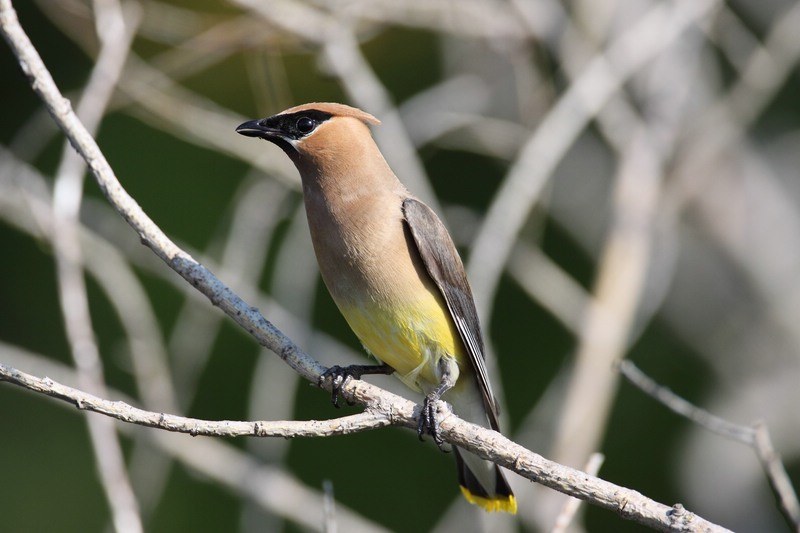
Key Field Marks
- Medium-small, sleek songbird (about 15-18 cm) with a prominent pointed crest.
- Warm cinnamon-brown head and breast fading to soft gray on the wings and pale yellow on the belly.
- Black mask outlined in white across the eyes.
- Bright yellow band across the tip of the tail.
- Waxy red tips on the secondary feathers in adults (variable, sometimes absent in young birds).
- Sharp, pointed wings and a short, squared tail give a smooth, streamlined silhouette in flight.
Similar Species
- Bohemian Waxwing: Larger and grayer overall, with rufous (not white) undertail coverts and bold white and yellow markings in the wing; found mainly in the north and west, often with Cedar Waxwings in winter flocks — check undertail color to separate them.
- Northern Mockingbird: Superficially similar gray tone but lacks the crest, mask, and yellow tail tip, and shows large white wing patches in flight.
Habitat & Range
- Breeds across southern Canada and the northern half of the U.S., particularly in open woodlands, orchards, and suburban areas with fruiting trees and shrubs.
- Highly nomadic outside the breeding season, wandering widely in search of fruit; winters from the northern U.S. south to Central America.
- Frequently seen in flocks descending on berry-laden trees (cedar, hawthorn, holly, crabapple) and stripping them bare within minutes.
Behavior
- Very social; typically encountered in tight, coordinated flocks that move, perch, and feed together.
- Feeds heavily on fruit for much of the year, switching to flying insects caught on the wing (flycatcher-style sallies) during the breeding season.
- One of the latest-nesting songbirds in North America, timing breeding to coincide with summer fruit abundance.
Voice
- A very high, thin, buzzy trilled whistle, often transcribed as "seee" or "bzeee," given constantly by flock members in flight and while perched — listen for the high-pitched trill overhead as a flock passes.
Frequently asked questions
How can I tell a Cedar Waxwing from a Bohemian Waxwing?
Check the undertail coverts: Cedar Waxwing has pale yellowish-white undertail coverts, while Bohemian Waxwing has rusty-rufous undertail coverts and is grayer overall with more white and yellow in the wing.
Why do Cedar Waxwings travel in flocks?
Their diet is dominated by fruit, which is patchily distributed, so flocking helps them locate and exploit berry-rich trees efficiently; they often strip a tree of fruit together in a short visit.
What is the red tip on the wing?
Adult waxwings often have small waxy red appendages on the tips of the secondary feathers, giving the species its name; the number and presence of these tips increases with age.
What does a Cedar Waxwing sound like?
Listen for a very high, thin, buzzy trilled "seee" call, quite unlike the songs of most other backyard birds — it's easy to overlook because of its high pitch.
Cedar Waxwing identified by the community
Recent Cedar Waxwing sightings identified with Bird Identifier.