
Cave Swallow Identification Guide
A small, square-tailed swallow with a pale cinnamon-buff throat and rusty forehead, best told from Cliff Swallow by its paler face pattern.
Read the full Cave Swallow encyclopedia entry →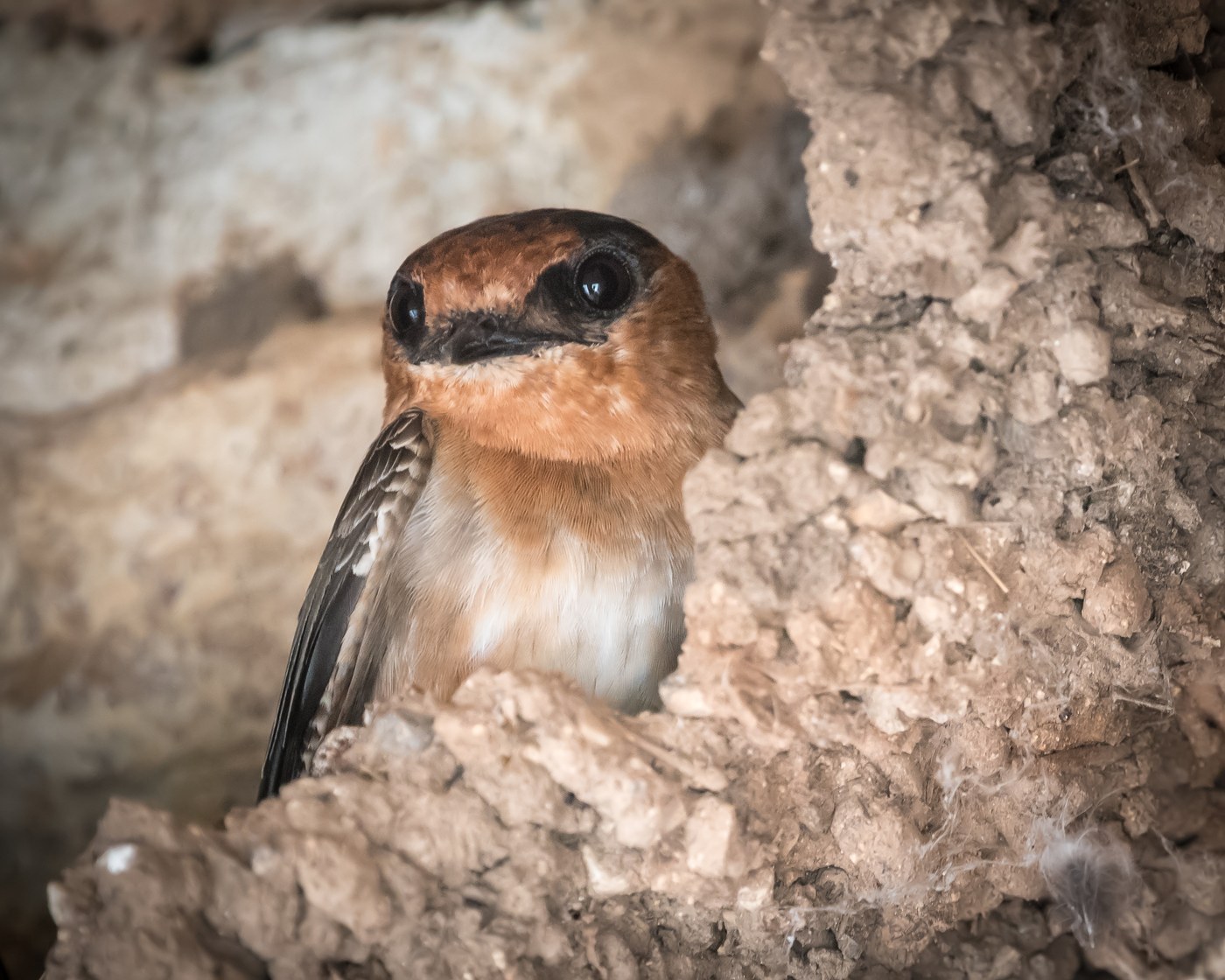
Key Field Marks
- Small swallow, roughly 12-14 cm long, with a compact body and a squared-off, only slightly notched tail.
- Pale cinnamon-buff throat and upper breast (not dark chestnut).
- Rufous-chestnut forehead patch, contrasting with a steel-blue crown and back.
- Buffy-orange rump, paler and less contrasting than in some relatives.
- Pale grayish underparts grading to buff on the flanks.
- Short, slightly forked tail lacking the deep fork of Barn Swallow.
Similar Species
- Cliff Swallow: Very similar shape, but has a dark chestnut throat and a whitish (not rufous) forehead patch — essentially the reverse face pattern of Cave Swallow.
- Barn Swallow: Longer, deeply forked "swallow-tail," glossy blue-black upperparts, and cinnamon underparts overall (not just the throat).
- Bank Swallow: Brown above with a distinct dark breast band and white throat/belly; lacks any rufous on the face.
Habitat & Range
- Nests colonially in caves, sinkholes, culverts, and increasingly under highway bridges and in road culverts.
- Established populations in South Texas, southeastern New Mexico, and Florida, with Caribbean and Mexican populations as well.
- Florida birds are largely resident; Texas populations are migratory, wintering mainly in Mexico and Central America.
- Well known among birders as a classic late-fall vagrant, showing up well outside its normal range (Great Lakes, Northeast) into November and December, often the last swallow species seen in a season.
Behavior
- Highly colonial; builds open cup or gourd-shaped mud nests on vertical rock or concrete surfaces, often mixed with Cliff Swallow colonies.
- Forages on the wing over open country, catching flying insects in agile, fluttering flight.
Voice
- A dry, twittering series of squeaky and chattering notes, less musical than Barn Swallow's song; flight calls are short, sharp chips given in flocks.
Frequently asked questions
How do I tell a Cave Swallow from a Cliff Swallow?
Look at the face: Cave Swallow has a pale cinnamon-buff throat and a rusty-chestnut forehead, while Cliff Swallow has a dark chestnut throat and a whitish forehead patch — essentially the opposite pattern.
Why do Cave Swallows show up so late in fall in northern states?
Some populations migrate late and are prone to overshooting or drifting off course, making Cave Swallow a well-known late-autumn vagrant in the Great Lakes and Northeast, often the last swallow of the season.
Where do Cave Swallows nest?
They nest colonially on vertical surfaces inside caves, sinkholes, and culverts, and increasingly under bridges and in highway overpasses.
Are Cave Swallows found year-round in the same place?
It depends on the population — Florida birds are largely resident, while Texas and New Mexico breeders migrate south to Mexico and Central America for winter.