
Cattle Egret Identification Guide
A small, stocky white egret that forages in fields alongside livestock, easily told from other egrets by its short thick bill and compact build.
Read the full Cattle Egret encyclopedia entry →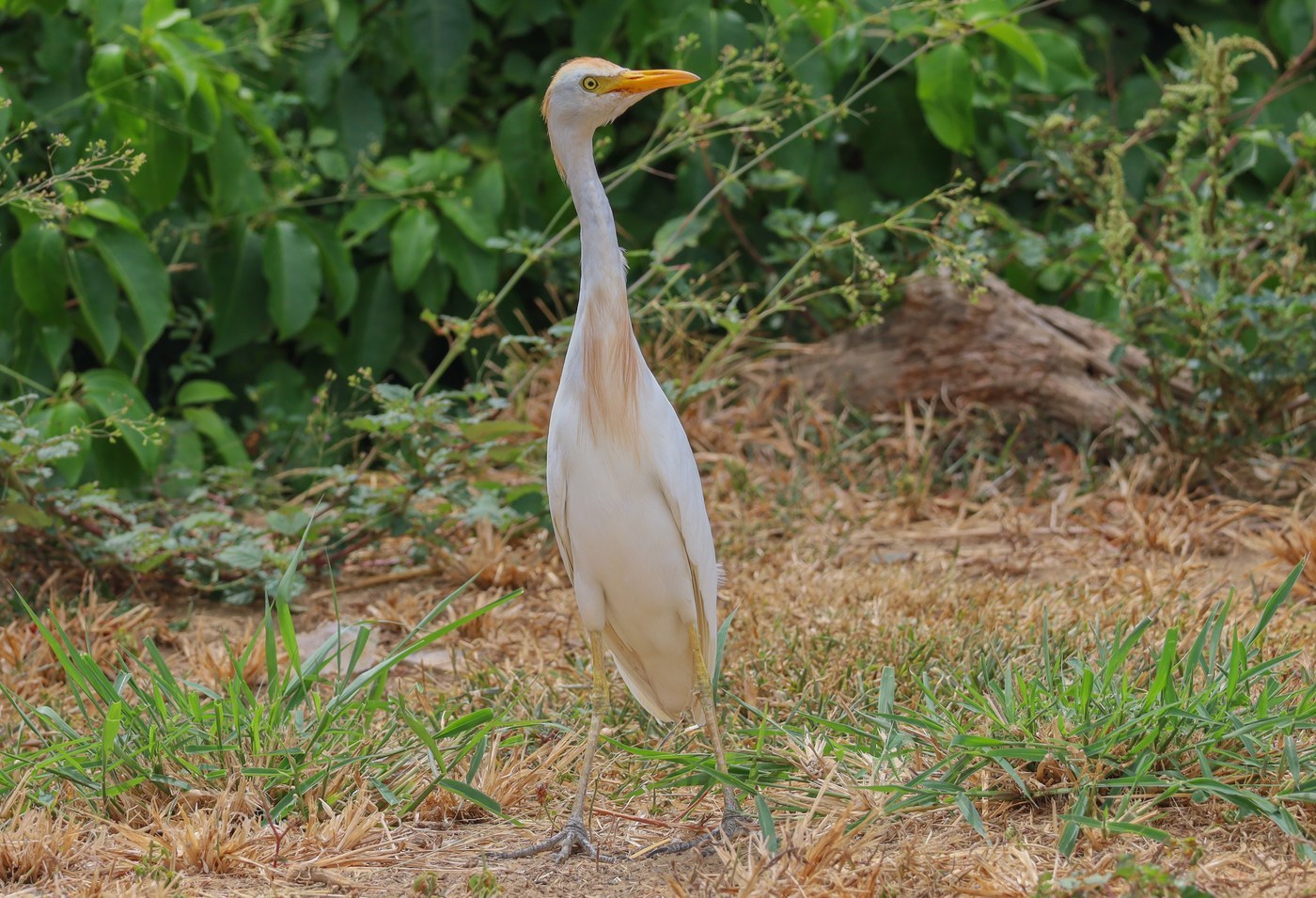
Key Field Marks
- Size & shape: A small, stocky, short-necked egret with a comparatively short, thick bill and shorter legs than other white egrets — appears hunched and compact rather than long and slender.
- Plumage: Bright white overall in non-breeding plumage; in breeding plumage, develops warm orange-buff plumes on the crown, back, and chest, with the bill and legs sometimes flushing orange-red or pinkish.
- Bill & legs: Bill is short and thick, typically yellow to orange (not black like Snowy Egret or yellow-and-black like immature Little Blue Heron); legs are proportionately short and dark to yellowish, lacking the bright yellow "golden slipper" feet of Snowy Egret.
- Behavior: Highly terrestrial for a heron, commonly seen walking in fields and pastures — often directly alongside cattle, horses, or other livestock (and even farm machinery) — catching insects flushed by the animals' movement, rather than wading in water like most herons.
Separating It From Similar Species
- Snowy Egret is slenderer with a thin black bill, black legs, and bright yellow feet, and forages mainly in shallow water rather than dry fields.
- Great Egret is much larger with a long yellow bill and black legs, and has a notably longer neck and more elegant, elongated shape.
- Immature Little Blue Heron is white like Cattle Egret but has a longer, thinner bill that is grayish with a dark tip, and greenish legs, along with a more typical heron-like wading behavior in water rather than fields.
- The combination of short thick bill, compact hunched shape, short legs, and habit of foraging in dry pastures with livestock is diagnostic for Cattle Egret.
Where & When to See It
- Habitat: Pastures, agricultural fields, wet meadows, and areas near livestock; also forages near tractors and mowers, and roosts communally in trees, sometimes with other wading birds.
- Range: Originally native to Africa and southern Asia, it spread naturally to South America in the late 1800s and rapidly colonized North America through the 20th century; now found across much of the Americas, Europe, Africa, Asia, and Australia, making it one of the most widespread heron species in the world.
- Season: Largely resident in warmer regions; northern and inland populations are migratory, arriving in spring and departing for warmer wintering areas in fall.
Voice & Song Cues
- Generally quiet away from breeding colonies; gives a soft, guttural "rick-rack" or croaking note at nesting colonies and when disturbed.
- Not typically identified by voice — its distinctive foraging behavior around livestock and compact shape are far more useful identification cues in the field.
Frequently asked questions
Why is it called the Cattle Egret?
It earned its name from its habit of foraging alongside cattle and other livestock, catching insects that the animals stir up as they graze or move through fields.
How do I tell Cattle Egret from Snowy Egret?
Cattle Egret has a short, thick, yellow-orange bill and shorter dark to yellowish legs, while Snowy Egret has a thin black bill and black legs with bright yellow feet, and typically forages in water rather than dry pastures.
Is the Cattle Egret native to North America?
No, it originated in Africa and Asia and colonized the Americas on its own beginning in the late 1800s, spreading rapidly across the continent through the 20th century.
What does breeding plumage look like on a Cattle Egret?
Breeding adults develop warm orange-buff plumes on the crown, back, and chest, and the bill and legs may briefly flush orange-red or pink during peak courtship.