
Cassin's Sparrow Identification Guide
A plain, secretive grassland sparrow of the southwestern deserts, best known for its distinctive "skylarking" song flight rather than its subdued plumage.
Read the full Cassin's Sparrow encyclopedia entry →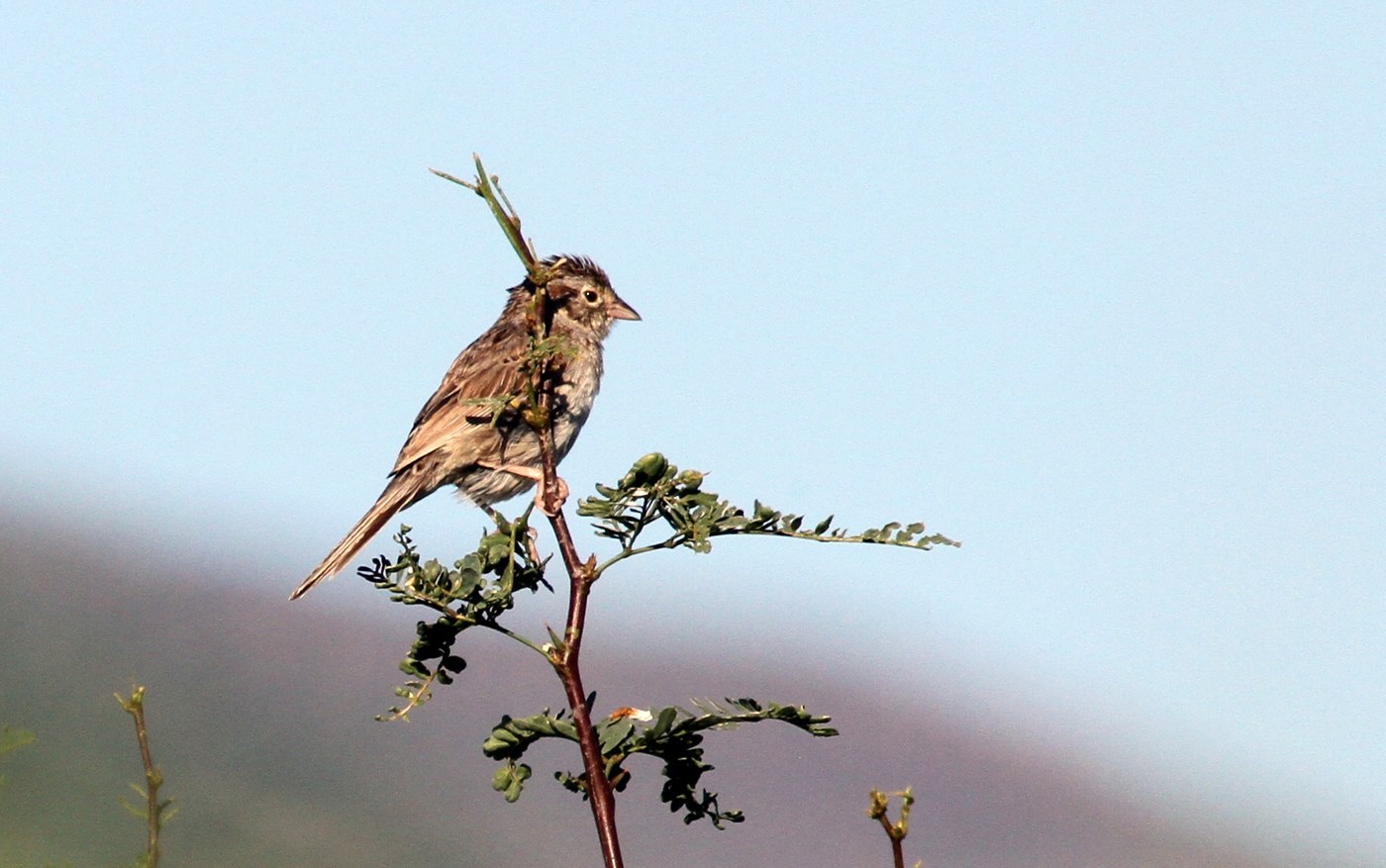
Key Field Marks
- Size & shape: A medium-sized sparrow with a fairly large head, moderately long tail, and rounded wings, typical of grassland sparrows adapted to running and skulking through low vegetation.
- Plumage: Plain grayish-brown to sandy-buff overall with fine, indistinct streaking on the back and faint markings on the breast; noticeably lacks bold facial or breast patterns, giving it a soft, unmarked appearance.
- Tail: Rounded tail with narrow pale tips on the outer feathers, sometimes visible in flight.
- Behavior: Notoriously secretive and hard to see on the ground, where it walks and runs through grass rather than flying; far more often detected by its skylarking song-flight display than by sight.
Separating It From Similar Species
- Botteri's Sparrow, which shares similar grassland habitat in parts of the range, is slightly larger-billed and shows a warmer, more rufous-brown tone with a plainer face; Cassin's Sparrow is grayer overall and has the distinctive skylarking flight display Botteri's lacks.
- Brewer's Sparrow is smaller, has a distinctly streaked crown, and lacks the plain, soft-gray appearance of Cassin's Sparrow.
- Grasshopper Sparrow has a flatter head, shorter tail, and a buffy, unstreaked breast with a more contrasting facial pattern, and does not perform the same skylarking display.
- Voice and display behavior are the most reliable identification tools for this notoriously plain species.
Where & When to See It
- Habitat: Arid and semi-arid grasslands with scattered shrubs, particularly mesquite and yucca-studded desert grassland.
- Range: Breeds across the southwestern United States including west Texas, New Mexico, Arizona, Oklahoma, and Kansas, south into northern Mexico; some populations are resident while others are migratory.
- Season: Most numerous and most easily detected during the breeding season (roughly spring through summer), particularly after good rains stimulate grassland growth and insect abundance, when males perform their song flights regularly.
Voice & Song Cues
- Delivers a distinctive skylarking display: the male flutters upward from a perch or the ground, then glides down on stiffly held wings while singing a thin, sweet, bubbly trilled song, often rendered as a series of whistles followed by a trill.
- The song's structure — introductory notes, a musical trill, and a final note or two — combined with the aerial display is highly diagnostic and the most reliable way to confirm this species.
Frequently asked questions
Why is Cassin's Sparrow so hard to identify by plumage alone?
It is one of the plainest sparrows, with soft grayish-brown coloring and little bold patterning, making the skylarking song flight and voice far more useful for identification than plumage details.
What is the skylarking display of Cassin's Sparrow?
Males flutter up from the ground or a perch and glide back down on stiff wings while singing a thin, bubbly, whistled song, a behavior that is highly distinctive among grassland sparrows.
How do I tell Cassin's Sparrow from Botteri's Sparrow?
Cassin's Sparrow is grayer and performs a distinctive skylarking song flight, while Botteri's Sparrow is warmer brown-toned and lacks that aerial display, staying closer to the ground when singing.
When is the best time to find Cassin's Sparrow?
It is most detectable during the breeding season, especially after rainfall boosts grassland growth, when males sing frequently from perches and in flight.