Carolina Wren Identification Guide
A loud, rust-colored wren of eastern thickets, best recognized by its bold white eyebrow stripe and its ringing "teakettle-teakettle" song.
Read the full Carolina Wren encyclopedia entry →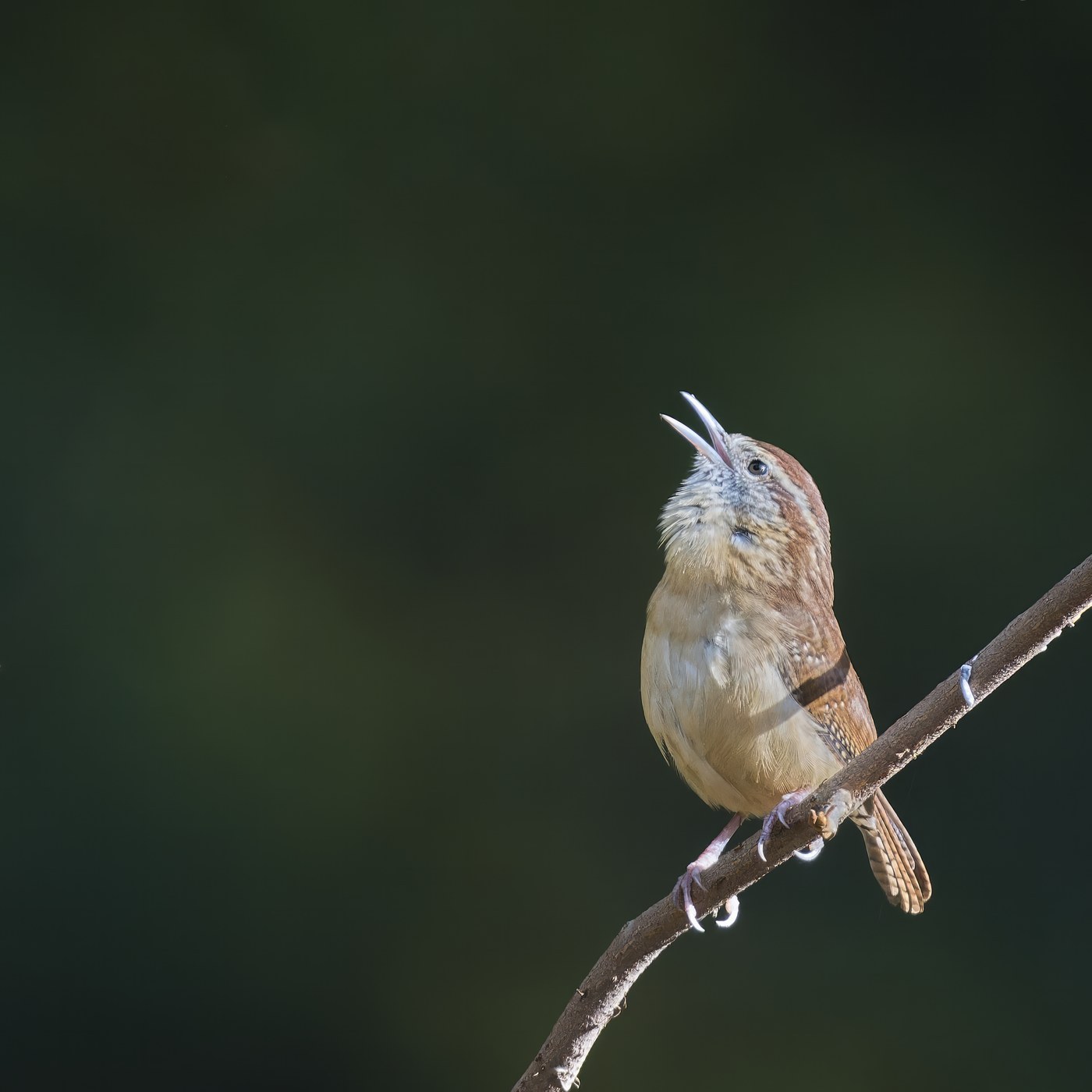
Key Field Marks
- Size & shape: A relatively large, chunky wren (about 14 cm) with a long, slightly downcurved bill and a tail often held cocked upward over the back.
- Plumage: Warm reddish-brown to rufous upperparts, buffy-orange underparts, and a bold, long white eyebrow stripe (supercilium) that is the species' most distinctive field mark.
- Wings & tail: Fine dark barring visible on the wings and tail when seen well.
- Behavior: Skulking but bold and inquisitive, often heard before it is seen as it forages low in dense brush, tangles, brush piles, and around structures like porches and garages; frequently scolds intruders with harsh chattering.
Separating It From Similar Species
- House Wren is smaller, plainer grayish-brown overall, lacks the bold white eyebrow stripe, and has a shorter, straighter bill.
- Bewick's Wren also shows a white eyebrow but is grayer-brown (not rufous) above, has a longer tail often flicked side to side, and white (not buffy) underparts.
- Winter Wren/Pacific Wren are much smaller, darker, and stub-tailed, with heavy barring on the belly that Carolina Wren lacks.
Where & When to See It
- Habitat: Dense understory, tangled thickets, brush piles, woodland edges, and suburban gardens with heavy shrub cover; frequently near water.
- Range: A year-round resident across the southeastern and eastern United States, extending into the lower Midwest and, following mild winters, gradually northward into New England and southern Canada.
- Season: Non-migratory; pairs typically remain on territory together throughout the year and can suffer population crashes after severe winters, followed by slow recovery.
Voice & Song Cues
- Song is a loud, ringing, three-part phrase repeated several times, classically rendered as "teakettle-teakettle-teakettle" or "cheeseburger-cheeseburger," sung by males year-round, including in winter.
- Also gives a harsh, buzzy scolding chatter and a variety of sharp "chirr" notes when agitated; its loud voice for such a small bird is a strong identification clue on its own.
Frequently asked questions
What is the easiest way to identify a Carolina Wren?
Listen for its loud, ringing 'teakettle-teakettle-teakettle' song and look for a bold white eyebrow stripe on a warm reddish-brown, chunky wren with a cocked tail.
How does Carolina Wren differ from House Wren?
Carolina Wren is larger, more rufous, and has a prominent white eyebrow stripe, while House Wren is smaller, plainer gray-brown, and lacks a bold eyebrow.
Does the Carolina Wren migrate south for winter?
No, it is a non-migratory permanent resident that stays on territory year-round, though harsh winters can reduce local populations at the northern edge of its range.
Why do I hear Carolina Wrens singing in winter?
Unlike many songbirds, Carolina Wren males sing throughout the year to maintain pair bonds and defend year-round territories, not just during the breeding season.
Carolina Wren identified by the community
Recent Carolina Wren sightings identified with Bird Identifier.