
Carolina Chickadee Identification Guide
A small, energetic songbird of southeastern U.S. woodlands, near-identical to the Black-capped Chickadee but told apart mainly by voice and range.
Read the full Carolina Chickadee encyclopedia entry →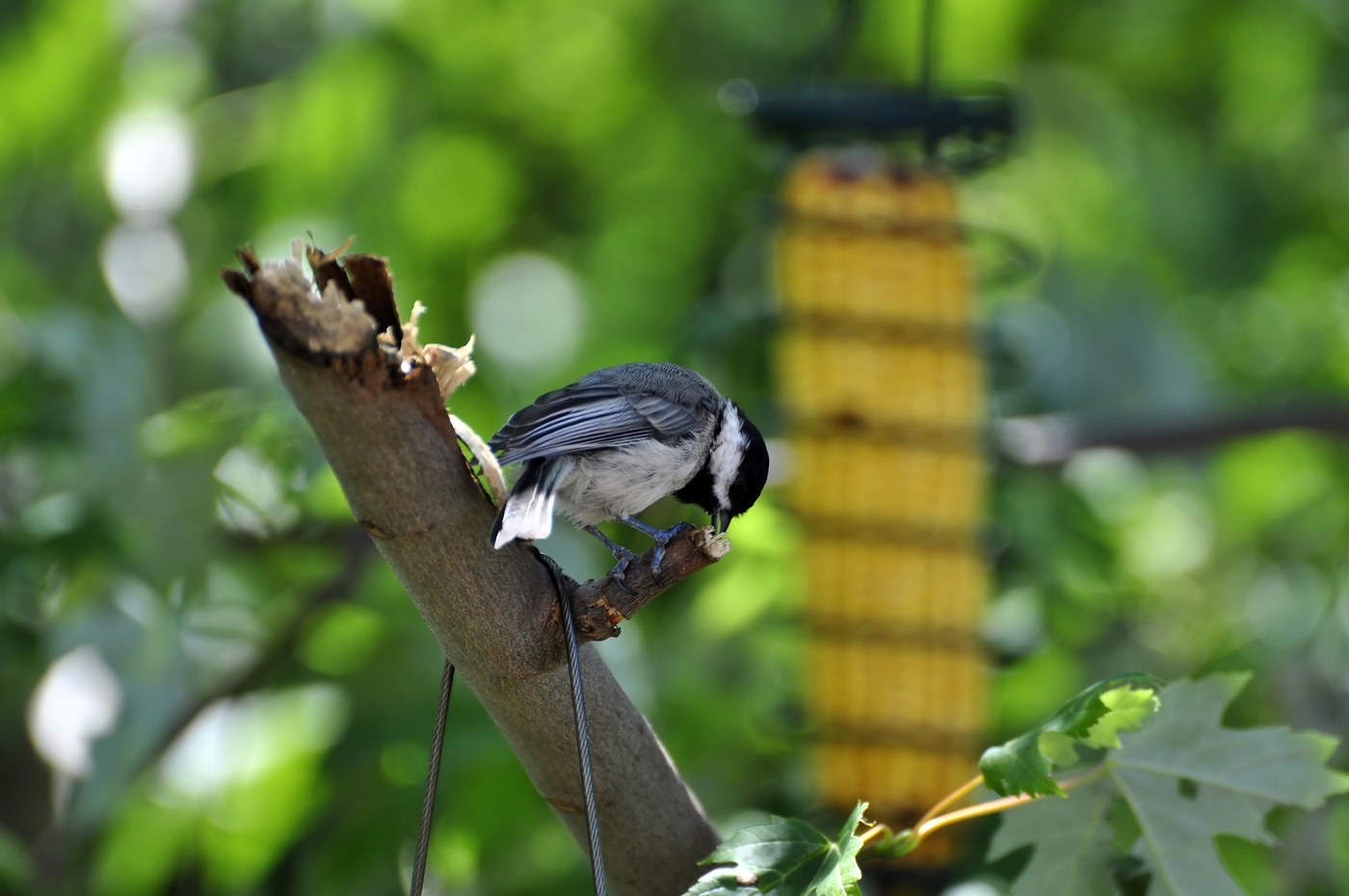
Key Field Marks
- Size & shape: A tiny, round-headed songbird about 11–12 cm long with a short neck, short bill, and compact body — noticeably smaller than the closely related Black-capped Chickadee.
- Plumage: Crisp black cap and bib, bright white cheeks, soft gray back and wings, and pale buffy-white underparts washed with gray on the flanks.
- Wing pattern: Wing feathers show only narrow, indistinct pale edging, lacking the bold white wing-panel highlights sometimes visible on Black-capped Chickadee.
- Behavior: Highly active, constantly moving through foliage, often hanging upside-down while foraging; readily joins mixed-species foraging flocks in fall and winter.
Separating It From Similar Species
- Black-capped Chickadee is very similar but averages slightly larger, has more distinct white edging on the wing feathers, and a sharper border between the black bib and white underparts; the two are best separated by range and voice, since a narrow hybrid zone through the mid-Atlantic and Ohio Valley produces birds with intermediate or unreliable plumage traits.
- Tufted Titmouse, often seen alongside chickadees, has a crest and lacks the black cap/bib entirely.
- Black-crested Titmouse and other titmice are larger with crests, ruling out confusion once size and shape are noted.
Where & When to See It
- Habitat: Deciduous and mixed forests, woodland edges, parks, and residential yards with trees; readily visits bird feeders.
- Range: Resident throughout the southeastern United States, roughly from New Jersey and southern Illinois south to Texas and Florida, filling the ecological role that Black-capped Chickadee fills farther north.
- Season: A year-round, non-migratory resident; does not undertake seasonal movements outside of local dispersal.
Voice & Song Cues
- Song is a clear, whistled four-note (occasionally more) "fee-bee fee-bay," faster and higher-pitched than the two-note "fee-bee" of Black-capped Chickadee.
- Call is a rapid, high, buzzy "chick-a-dee-dee-dee," delivered faster and higher than the call of Black-capped Chickadee — voice is the single most reliable field character where ranges approach one another.
Frequently asked questions
How do I tell Carolina Chickadee from Black-capped Chickadee?
The best way is voice and range: Carolina's song is a faster four-note whistle versus Black-capped's slower two-note song, and Carolina occupies the southeastern U.S. while Black-capped is found farther north, overlapping only in a narrow hybrid zone.
Can plumage alone distinguish the two chickadee species?
Not reliably — plumage overlaps extensively, and hybrids in the contact zone can show intermediate features, so voice and geographic location are more trustworthy.
What habitat does the Carolina Chickadee prefer?
It favors deciduous and mixed woodlands, forest edges, and well-treed suburban yards, and readily comes to feeders offering sunflower seeds and suet.
Does the Carolina Chickadee migrate?
No, it is a non-migratory permanent resident that stays on its territory year-round, though juveniles may disperse locally.