
Cape Weaver Identification Guide
A bright yellow-orange weaver endemic to South Africa, known for its noisy colonies and intricately woven hanging nests.
Read the full Cape Weaver encyclopedia entry →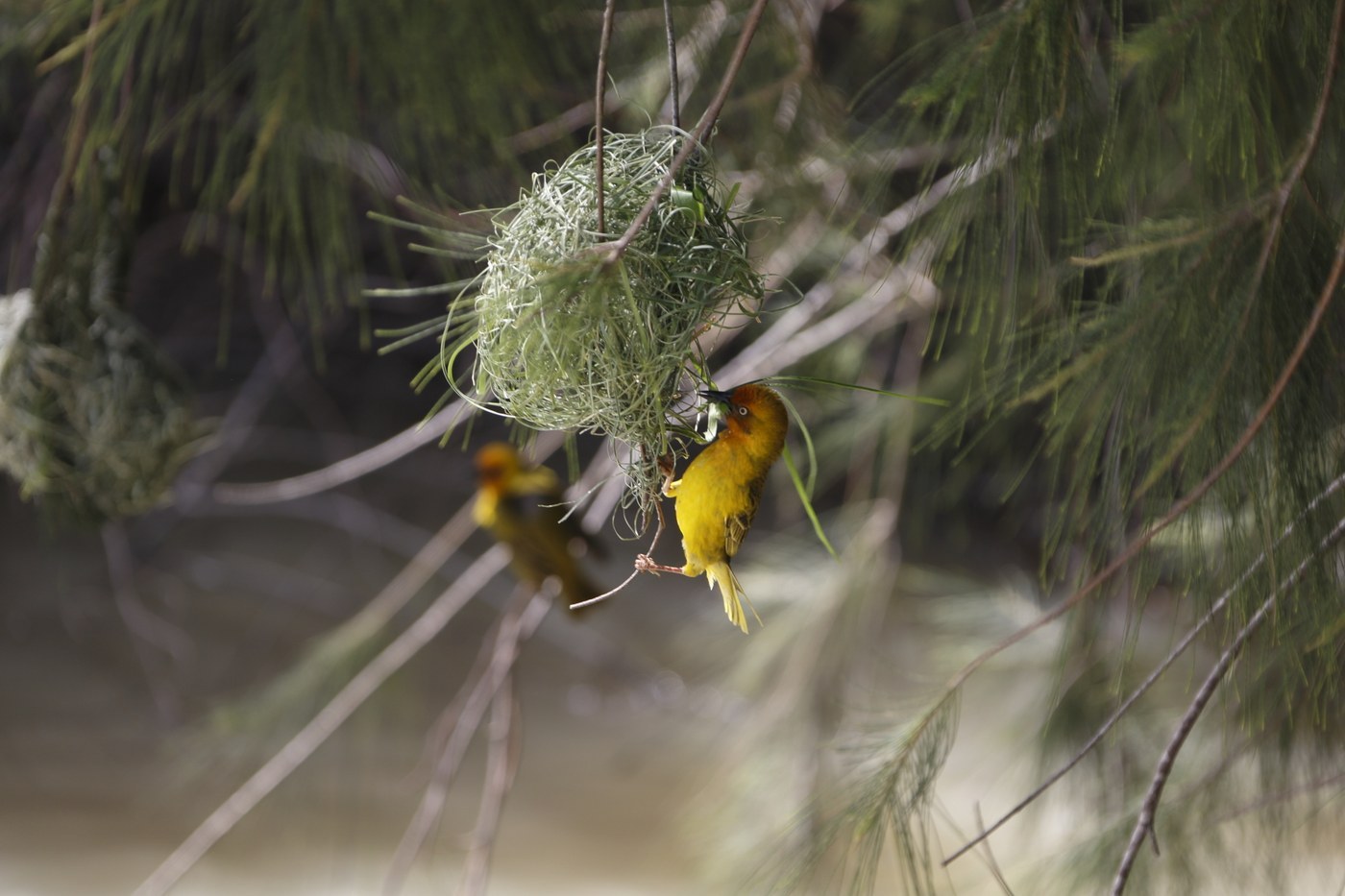
Key Field Marks
- Size & shape: A medium-sized weaver with a stout, conical bill typical of the family, built for husking seeds and manipulating nest material.
- Breeding male: Bright golden-yellow overall with an orange wash on the face and throat, and pale (whitish to pale yellow) eyes that stand out against the bright plumage.
- Female and non-breeding male: Duller, more olive-yellow with some streaking on the back, and paler eyes than most similar weaver females, which can aid identification.
- Behavior: Highly social, breeding in noisy colonies where males weave elaborate, tightly woven kidney-shaped nests suspended from reeds, palm fronds, or tree branches, often over or near water; males perform wing-fluttering displays at the nest entrance to attract females.
Similar Species
- Southern Masked-Weaver: Breeding male has a black face mask contrasting with a yellow body and red (not pale) eyes; female is streakier and less golden overall.
- Village (Spotted-backed) Weaver: Male has a black face/throat and a heavily spotted black-and-yellow back, unlike the more uniformly golden Cape Weaver.
- Cape Weaver's pale eye in combination with an unmasked golden-orange face on breeding males is the most reliable way to separate it from other similarly colored southern African weavers.
Where & When to See
Endemic to South Africa and Lesotho, common in a wide range of open and semi-open habitats including farmland, fynbos edges, wetlands, parks, and gardens, usually near water or reedbeds where colonies nest. Present year-round; breeding activity and colony nest-building are most conspicuous in spring and summer (roughly August–January in the Southern Hemisphere).
Voice
A harsh, chattering, swizzling song typical of weavers, often delivered in noisy chorus from active colonies, combined with wing-whirring display sounds at the nest. Calls include sharp chattering and buzzy notes.
Frequently asked questions
How do you identify a breeding male Cape Weaver?
Look for an overall bright golden-yellow bird with an orange wash on the face/throat and a distinctive pale (whitish) eye, without a black facial mask.
How is Cape Weaver different from Southern Masked-Weaver?
Cape Weaver lacks the black face mask of the Southern Masked-Weaver and has pale eyes rather than the masked-weaver's red eyes.
Where do Cape Weavers build their nests?
They weave elaborate hanging nests from reeds, palm fronds, or branches, typically in noisy colonies near water or wetlands.
Is the Cape Weaver found outside South Africa?
It is essentially endemic to South Africa and Lesotho, making it a signature weaver species of the region.